Suppliers are under pressure to quote at China speed, and most can't stand behind the numbers they're sending. The average supplier now handles around 800 RFQs a year, up from 495 in 2002, with the same spreadsheets, email chains, and handful of veterans who know where the rates live. Speed is what everyone's demanding, and accuracy is where the margin's won or lost.
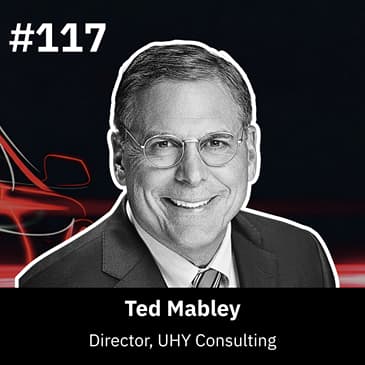
Jan and Tom Roberts welcome back Ted Mabley, Director at UHY Consulting, to discuss his new white paper, Closing the Cost Execution Gap. It builds on his earlier study with the Center for Automotive Research and comes out as OEMs, GM among them, press suppliers to show where every number comes from.
The gap shows up after the PO. A program quoted at a 10% margin launches at 5 or 6, as engineering changes and OEM productivity demands chip away at a quote that captured one engineering level at one moment. Sending the plant manager to sales to win the margin back won't work; the OEMs are too sophisticated for that.
Ted's fix starts upstream, with skilled cost engineers in the room as the bill of materials takes shape, and it runs through the data. Quote history sits in SharePoint, on laptops, and across ERP systems inherited through acquisitions, and connecting it is where he sees AI's biggest opportunity. Jan adds a pointed challenge: total acquisition cost won't drive decisions while purchasing teams are still bonused on PPV.
This conversation challenges supplier leaders to stop treating quoting as paperwork. Ted's first move is deliberately small: pick one high-volume RFQ or VAVE workflow and redesign it end-to-end. The suppliers who fix one workflow now will have a template for the rest, and a cost story they can defend when the OEM asks where the number came from.
Themes Discussed in This Episode
- Why speed without cost accuracy is a liability
- Embedding cost engineering upstream at the BOM
- Connecting fragmented quote, cost, and plant data
- Scaling the RFQ process with automation and AI
- Total landed cost vs piece price
- Why PPV block the total acquisition cost thinking
- OEM-specific playbooks and the case for a common RFQ format
- Starting with one high-volume RFQ or VAVE workflow
This podcast is powered by QAD RedZone.
Featured Guest
Name: Ted Mabley
Title: Director at UHY Consulting
About: Edward "Ted" Mabley has over 15 years of experience optimizing sales and business development operations, providing customer-specific solutions catering to a wide array of industries on a global scale. He works with OEMs, tier-one suppliers, and other manufacturing companies to create transparency in their cost process and develop vendor management programs to address relevant KPIs. His experience includes active cost management in accordance with enterprise product costing procedures, as well as developing strategic business roadmaps, product visions, and sales strategies.
Connect: LinkedIn
About Your Hosts
Jan Griffiths
Jan is the host and producer of the Auto Supply Chain Champions Podcast and The Automotive Leaders Podcast. A former automotive manufacturing and supply chain executive, Jan is recognized as a Champion for Culture Change in the automotive industry. She brings direct, grounded conversations to leaders navigating execution, disruption, and transformation across the global automotive ecosystem.
Tom Roberts (Co-host)
Tom is Co-host of the Auto Supply Chain Champions Podcast and Vice President of Strategic Industry Development at QAD. He works closely with automotive and industrial manufacturers to close the gap between insight and execution, helping leaders move from visibility to systems of action that drive real operational outcomes.
Mentioned in this Episode
- Closing the Cost Execution Gap, UHY white paper
- Automotive Suppliers and the Revenue Acquisition Process – Then and Now (CAR/UHY, 2025)
Episode Highlights
[00:03:11] Twenty Years, More Complexity: Ted's survey of tier one suppliers and OEMs revisits a 2002 study and finds RFQs moving faster, growing more complex, and landing on fewer people with the skills to get them right.
[00:05:29] The Quote Is a Snapshot: A program quoted at 10% margin that launches at 5 or 6 shows how engineering changes and OEM productivity demands erode cost after the PO is issued.
[00:07:05] Cost Engineering Starts at the BOM: China speed means skilled cost engineers have to join while the bill of material and vehicle requirements are still being defined, not after.
[00:08:00] The Skills Gap Behind the Quote: Ted points to JCI's former cost engineering organization as a model for developing talent, a discipline that's largely been replaced by job postings for "four cost engineers."
[00:09:00] AI's Biggest Play Is the Data: With quote history scattered across SharePoint and laptops, the greatest opportunity for AI is reconciling the cost buckets OEMs scrutinize first.
[00:12:40] PPV Blocks Total Acquisition Cost: Jan argues that total acquisition cost won't drive decisions until purchasing teams stop being measured and bonused on purchase price variance.
[00:16:44] One Playbook per OEM: Every OEM has different DNA, and until the industry agrees on a common RFQ format, suppliers need a separate playbook for each customer.
[00:19:08] Start With One Workflow: Ted's recommended first move is redesigning a single high-volume RFQ or VAVE workflow end to end, then using it as a repeatable template.
Top Quotes
[00:07:29] Ted Mabley: "It needs to be a cost engineering team, not a cost analytics team. They need to be people-skilled who know what they're doing."
[00:12:00] Ted Mabley: "It has to be automation because there just aren't enough people in the system to be able to support it."
[00:19:41] Ted Mabley: "You've got to start somewhere. And you have to take a look at it from a holistic point, and you gotta be honest, right? What's working, what's not."
If this episode resonated, share it with a fellow automotive leader and subscribe to the Auto Supply Chain Champions Podcast, where we're closing the gap between insight and action across the global automotive supply chain.
Follow the Auto Supply Chain Champions Podcast for real conversations with leaders who are making hard choices, focusing their bets, and leading with intent.
🎧 Follow the podcast:
🔗 Learn more about QAD Redzone: https://www.qad.com/
[Transcript]
[00:00:00] Jan Griffiths: This is the Auto Supply Chain Champions Podcast. We are on a mission to bring you real conversations with the leaders who are transforming supply chains in the automotive sector. These leaders are true champions of manufacturing, and we're here to share their stories. I'm Jan Griffiths, your host and producer, and I'm joined by my co-host, Tom Roberts, Vice President of Strategic Industry Development at QAD.
[00:00:30] Tom Roberts: Great to be here, Jan. What I see every day is simple: manufacturers don't have a data problem, they've got an execution problem. This show is about how artificial intelligence, systems of action, and empowered teams can help close that gap.
[00:00:45] Jan Griffiths: Let's get into it. This podcast is powered by QAD RedZone.
[00:00:53] Hello, and welcome to another episode of the Auto Supply Chain Champions podcast.
[00:00:58] Let's check in with my co-host, Tom Roberts. Tom, how you doing?
[00:01:02] Tom Roberts: Jan doing well. It's busy season. So this week I was at the American Automotive Summit. Next week is Champions of Manufacturing. Lots, lots of things going on, and you were on with Roop Raj this week. Awesome. Talking about tariffs it was great to see that segment.
[00:01:19] Jan Griffiths: Yeah, there is an awful lot happening. And as we've said many times, this podcast is Auto Supply Chain Champions, and there are so many different facets of the automotive supply chain that we need to cover. And I've been in some conferences just this week, in fact, and lot of discussion around RFQs, cost engineering, costing, with the backdrop of China speed.
[00:01:50] So we get this idea of we've gotta get our arms around cost, we've gotta be able to quote product quickly and accurately.
[00:02:00] Now, you can address the speed issue maybe, but you've gotta have the accuracy that goes with it.
[00:02:06] That's why we are bringing on the show, Ted Mabley. Now, he is no stranger to the mic. It's his second appearance here on the podcast. He is a director at UHY. He is extremely passionate about this subject, and in our first interview with Ted, Ted had just completed a whitepaper with CAR, the Center of Automotive Research, about the RFQ process.
[00:02:36] But now he's taking it another level deeper, and this whitepaper is called Closing the Cost Execution Gap, and that's what we're gonna get into today.
[00:02:48] Ted, welcome to the show. Welcome back.
[00:02:50] Ted Mabley: Great. Thanks, Jan. Thank you, Tom, for having me on. Really delighted to be here. And yes, this is a topic that over the last 30 years I've had a lot of passion and glad to see that it's starting to really gain some traction recently
[00:03:04] Jan Griffiths: So tell us, Ted, what is this white paper all about, and did you feel compelled to write it right now?
[00:03:11] Ted Mabley: Again, to your point, you just did a great job of setting up all the rationale behind it. So last year we surveyed several tier one suppliers and OEMs the RFQ process, and this goes back to documenting the change of a study that I actually was part of back in 2002, and we just said, "Okay, what's changed?"
[00:03:31] And quite frankly, it's gotten much more complex. The speed has increased. The number of people who know what they're doing and have s- the skills in this process are leaving the industry. They're timing out, they're tapping out, it's similar to tooling industry, so many parallels there. And then also the complexity of those RFQs has increased dramatically. From a calculus point, it's a bit of a very disturbing situation for all of those factors and saying, "Okay, how do we go fast?" Right? So measure twice, cut once really under a lot of pressure.
[00:04:08] Tom Roberts: So Ted, from the IT side, going through your three priorities, I see things that I love to see, like data quality, and process discipline. bad is the data out there? I think I know the answer, but when these suppliers have grown through acquisition, they've grown through acquiring new data sets and new ERP systems and new PLM systems how bad is it out there?
[00:04:32] Ted Mabley: Well, we've seen firsthand exactly how difficult it is. So if you have multiple different ERP systems, which one's the truth, right?
[00:04:41] Again, they all are, because if I'm quoting a program, I'm getting data from different plants. So what's the consistency? What's the integrity? is one of the key issues that obviously is part of this, 'cause if I don't have good data, then how do I go fast, right? Because I have no confidence in the fidelity of the information.
[00:05:00] Tom Roberts: Makes absolute sense. And kind of a follow-up question, Ted, something that I remember back from the past, should companies, should suppliers also be tracking sales price variance like they track purchase price variance? Do you think that they should be thinking about this was something tied to the index, or this was something tied to negotiation, or this was tied to a VAVE or something on the sales side? Should they be doing that kind of thing as well?
[00:05:26] Ted Mabley: Again, Tom, really good point because the PO is a spot in time, right? It's based on an engineering level. It's based on a certain point in time. And we all know that that changes dramatically.
[00:05:37] So, if you look at the life of a program with a number of engineering changes, both internally and externally, and then obviously part of that process is the OEM asking for productivity improvements, right, over the life of the program. Therefore, you have to be constantly innovating in terms of how do I look at the cost optimization in all aspects, right? Internally, external procurement, and also to your point, what am I doing today on my margins? I quoted it at say, 10% margin, then once I'm launching at the plant, I'm at 5 or 6. What happened? It can't be the plant manager going to sales, "Hey, you know, go get my margin back." That's not gonna work. The OEMs are way too sophisticated to let that happen.
[00:06:22] And I think, Jan, you had recently run into a gentleman from General Motors, Tony Miller, who's in their program cost op- optimization group, they are actively tracking all of those factors.
[00:06:34] Again, mistakes happen and changes happen, but they just wanna make sure it's fair.
[00:06:39] Jan Griffiths: And Ted, in your white paper, you mention three priorities to close this gap that we've got in this area, and you say, number one, embed upstream; number two, connect the data; and number three, scale intelligently.
[00:06:54] Can you walk us through each one of those and tell us why that's important? So let's talk about embed upstream, 'cause I feel that's where we're headed.
[00:07:02] Ted Mabley: Correct. We're all talking about this concept of China speed. What is China speed, right? Is it a program at two years length? Is it three years in terms of from clay to part? Again, everyone has a different definition about when the go point is. But most importantly is when you're putting together the bill of material, putting together the vehicle requirements, cost engineering has to get involved early on in the process.
[00:07:26] I mean, it's just natural, right? So instead of waiting until a BOM is basically in some level where you can start to quote it, that cost team up early on, and it needs to be a cost engineering team, not a cost analytics team. They need to be people skilled who know what they're doing. They know the BOM, the bill of material, and they know the bill of process.
[00:07:46] Jan Griffiths: Why do you think that doesn't happen today?
[00:07:49] Ted Mabley: Oh, Jan, there are many reasons. How long do we here?
[00:07:51] Jan Griffiths: I know, I know, I know, but
[00:07:53] Ted Mabley: two hours, three hours? Kidding. But serious on it. Part of it is that we have lost so many skill sets in the industry, and again, I go back to the toolmakers and the tool design people. There's a study that's coming out in the next couple weeks that's gonna help kind of put some clarity on that from the Center of Automotive Research.
[00:08:12] But those skills are very similar to what it takes to be in cost engineering. It's a mentorship. It takes time to develop these people. And Tom, back in the day, JCI had a great cost engineering organization for the tier one organization. But they brought people in, they trained them, and then they also had a very good plan to export that talent back out into the operational areas. So again, it was a constant development. There was a plan. We just don't see that anymore. Somebody will put an ad out on LinkedIn saying, "I need four cost engineers." Not knowing if they're good or not, they'll just say, "Okay, well, we got cost engineers." So again, it's building a team, getting the concept defined, putting in a very disciplined RASIC. And then the next bucket, so to speak, is you have to connect the data.
[00:08:57] And Tom, it goes back to your point very, very quickly in terms of it's all over the place, right? It's in sharePoint, it's in my laptop, it's everywhere, right? And how can this beast called AI help? We see that this is the real big play for AI, is connecting all of the disparate data, right?
[00:09:18] So I can compare things. So, for instance, if I quoted to an OEM, you know, last year, most of the people inside the supplier quote team, they're so darn busy with eight hundred quotes, right? So how do you keep things straight? So typically, things get dropped, they get mishandled. There's very little validation. So they submit a quote in, and the numbers and where the OEMs tend to look the closest is the typical buckets, right?
[00:09:46] I've got labor, I got material, I got fixed burden, I got variable burden, right? I've got my overheads, you know, SG&A profit, and then, you know, some of the other overheads around transportation and logistics. If those numbers aren't consistent and don't match up, it's a total red flag, right? And that's where the discussions go off the rail
[00:10:06] Tom Roberts: Absolutely. And I have seen in my past certainly you get into a new program, and I would tell people if, again, this was 15 or 20 years ago, If you're going to go into Brazil, your IT cost for setup is gonna be two or three X." And nobody wanted to hear that because the program already had usually had some sort of momentum already you get to IT. And things like that, I have encountered many. You're gonna layer 1% cost across my organization. I've had to have those discussions here and there, and sometimes you don't think about upfront all of the things you need to do, last mile cost and tariffs and everything.
[00:10:46] I think it's different now, but back then, I don't think everybody always remembered to think about all those things and put them in a checklist or something. So yeah, definitely have encountered that.
[00:10:57] Ted Mabley: Yeah. Yeah. And, we're hearing more and more formalized programs. GM has announced that Ford has been, I think, starting to go down this path as well. It's about having documentation about where your parts and systems are coming from and how resilient are you, and that includes parts and tools, right?
[00:11:16] You have to have both. So as the push is now for localization, it's also causing a lot of pressure in the system to be able to come up say, "Okay, what are our numbers? How much is this tool gonna cost us? If we move this part into North America, how much is this gonna be?"
[00:11:33] Again, focusing on a total landed cost, where in the past it was like, "Well, you know, I got this motor and it's a $2 motor." Well, not really
[00:11:42] Tom Roberts: Right? There's so many other things, yeah...
[00:11:44] Ted Mabley: exactly. Exactly. So many different cost buckets, so getting that data connected, what's the total landed cost, right? Tariffs, program management, logistics, inventory, everything.
[00:11:55] And then also to your point, Jan, about how do you scale this. It has to be automation because there just aren't enough people in the system to be able to support it.
[00:12:05] And so you're gonna have to use automation intelligently. What we're seeing is confusion. And, how do you start to get some of the clutter out of this, this process? Well, that's where AI is really helping. It's helping from an automation point to allow people to be, to make decisions and to be held accountable, right?
[00:12:25] I just can't say, "Well, I got the number from Ted, and, you know, that's it. I'm putting it in the spreadsheet." Well, there's no justification in how I got that number. And that's a transparency that GM is really starting to ask their supply base.
[00:12:37] Jan Griffiths: Yeah, and I could see that passion coming through with Tony, earlier this week. I want to go a little deeper into total acquisition cost, 'cause I happen to be extremely passionate about that, and I'm gonna make a statement. You can tell me if you agree or disagree. We are never, never gonna get to really understanding and driving business decisions with total acquisition cost until we change the procurement measurement system, the purchasing measurement system.
[00:13:09] As long as we drive purchasing people by PPV, purchase price variance, a variance to a standard, until we change that or just have that as just part of it, we are never gonna get to total acquisition cost driving the business. At time and time again, I've worked in organizations where they talk total acquisition cost all day long, but when it comes down to performance and how your purchasing team is measured and how they're bonused, it's all on PPV.
[00:13:42] Agree or disagree, Ted?
[00:13:44] Ted Mabley: I think we have a lot of legacy issues that are still prevalent in the system, and you're absolutely right in terms of how we've looked at things, not maybe holistically, how the environment has changed today from a sourcing and also an engineering speed. if we focus on those things, your purchasing systems have got to catch up.
[00:14:05] And if, again, I hate to use parts and parts, for example, but if we use this. And then, to your point, how am I measured? I'm measured on the total system, right? But it's broken down by individual components, you have to understand those individual components. So how are we going to be able to go faster and be much more transparent?
[00:14:28] And that's the other thing. It's about having fact-based negotiations, to your point, to get to those conversations, saying, "Here's my number. Show me where I'm wrong, and can you help me? Can you help me on getting the cost down for tooling steel? What can you do differently to help me get my total price down?"
[00:14:44] And then the suppliers also got to own up as well saying, "Well, we do have a lot of contingency numbers in here." If we can start to understand design freezes, keep them consistent. The old joke used to be, well, a design freeze from a Japanese OEM meant maybe two changes from the point of engineering freeze to tool freeze, right?
[00:15:05] In North America, it was more like a Slurpee, right? It was kind of sort of frozen, but not really.
[00:15:09] Jan Griffiths: I love that. It was kind of like a Slurpee. That's a great analogy.
[00:15:15] Ted Mabley: Well, I've heard that once or twice and, yes, it's pretty consistent. But again, if we can get those disciplines, that's how you go fast, and that's how you get to this point around cost creep and addressing the issues around what's my number, right? And, why do suppliers mark up to mark down. We've got to look at fixing some of those parts of the calculus.
[00:15:33] Jan Griffiths: Yeah
[00:15:34] Tom Roberts: So some of it I think, Ted, is now you know the OEMs, everybody's got a hard business in automotive. Do you think the OEMs take too much of the benefit when there's a cost down?
[00:15:46] And let me just give you an example. So, we work in manufacturing software. We have lots of customers that we deal with in tier one and tier two. Some of them are quite terrified to talk about if they go through auctions or they go through something and they really have a significant cost down in a particular sourcing area. And it us as a provider because we can't use a name, because the concern is that if it gets out that this amount of millions was saved, then somebody's gonna come get it.
[00:16:18] Ted Mabley: Yeah. And an email's gonna show up some place like, "Hey I've heard you saved 15%. I want 7.5."
[00:16:27] Tom Roberts: So talk about that for a minute, 'cause I know you've talked with OEMs, you've worked with OEMs and tier ones and tier twos. How do you get to some sort of balance with that scenario? And I know I'm asking the " how do you boil the ocean", but how do you get to some kind of balance with that?
[00:16:41] Ted Mabley: Yeah. Again, it, it's the different DNAs of different OEMs, right? You know, some OEMs are much more collaborative and some aren't. And so, the supplier has to have a playbook based on every single OEM, right? One size does not fit all.
[00:16:56] So you've got to know if I'm doing work with Toyota, here's the playbook that we have to use, and it's complete transparency.
[00:17:04] And that's just the way it is. Others you can help obfuscate some of the issues, and again, it's a little bit of the gamesmanship. But eventually, we need to have some common procedures. Common procedures help time and also help from a transparency point. the great nirvana is, like, if we went to a common RFQ format.
[00:17:26] Because everyone's looking for the same data, but everyone has a different system. And what does that do? Time complexity. So if I'm working on a Ford program and I know the Ford RFQ document, and then I got pulled over to a Volkswagen, two different demand requests in terms of data.
[00:17:43] How do I reconcile the two? And you'd think that would be easy, but it's extremely hard. And again, you're looking at different systems, different data. How do I get the data? I'm always calling, "Hey, Ted, did you give me this? I need it in this format now." I'm like, "Well, I already gave it to you. I'm working on the..." You know? So again, we have all of this internal churn going on from a confusion point that until we get into some of these consistent data points saying, "Okay, we all know the buckets are all the same. Everyone's asking a different flavor or a different size of the bucket." Right?
[00:18:12] Do I want a Costco bucket, or do I want an Ace bucket? One of the two, right? So until we get to a common five-gallon bucket, okay, great. Now we can start that discussion.
[00:18:23] Jan Griffiths: This goes right back to the conversation, and I, I can hear Terry Woychowski from Caresoft in my ears talking about this. But the idea of the collaboration at the OEM level. The Chinese are much better at collaborating at an OEM level than we are in legacy automotive and with the Detroit Three.
[00:18:42] And actually, there was a call from the audience in a conference I was at this week for one, can we please have one standard cost breakdown sheet across the OEMs? How wonderful that would be. But until that happens, in your white paper, Ted, there are three leadership questions that I believe our audience needs to ask themselves.
[00:19:05] And what we're going to do is we're gonna put a link to the white paper in the show notes so that our audience can take a look at that. And then what I love is you have one recommended first move, and I am gonna read this out 'cause I like it a lot. 'Cause it's straightforward, it's very pragmatic, and I love that approach.
[00:19:26] "Select one high-volume RFQ or VAVE workflow and redesign it end to end across roles, governance, data, and automation."
[00:19:35] There it is. Just start somewhere. Is that your message, Ted?
[00:19:38] Ted Mabley: You got to start some place. And you have to take a look at it from a holistic point, and you gotta be honest, right? What's working, what's not. And you have to put aside some of the pride, put aside some of the feelings, and say, "Look, this is a critical business issue that we're all dealing with from a competitive scale."
[00:19:57] It is a global issue. Take a look what's going on to the German auto industry right now. One of the questions coming up is, "Okay, are we next? And then when?" So those are some the large decisions that are coming up that we have to face as an industry. And again, you gotta start someplace. Find it, map it, figure out what's broken, fix it, and then from there you've got a template. From there you can start to be repeatable, right? That's the whole process from lean. If I find something, I can fix it. I can start reduce the variances. I can start to reduce the non-value add work, and my quality goes up, my time goes down. It's applying some of those Toyota production methods to a process.
[00:20:38] Jan Griffiths: If our audience wants to get into more of a discussion about this with you, Ted, can they reach out to you directly?
[00:20:44] Ted Mabley: Oh, by all means. I'm happy to.
[00:20:46] Jan Griffiths: Yeah, we'll put all your contact information in the show notes. Ted, please keep doing what you're doing. We love your passion around this subject.
[00:20:53] It is much needed in the auto industry because you tie together the need for speed, the need for accuracy, and the data piece of it. You weave it all in together, and we love that, don't we, Tom?
[00:21:06] Tom Roberts: Absolutely. Data, Data, data. That's got to be be there.
[00:21:10] Jan Griffiths: Thank you for joining us today.
[00:21:12] Ted Mabley: Thank you all. Take care. Really appreciate it.
[00:21:15] Jan Griffiths: We wanna hear from you, our listener. Tell us what are your challenges right now? What conversations do you want to hear across the airwaves on this podcast? Drop us a comment on our podcast website.
[00:21:31] The link is in the show notes.