The automotive industry has spent decades perfecting the physical supply chain. The data underneath it still doesn't line up, and the people walking in the door right now spot it in their first month.
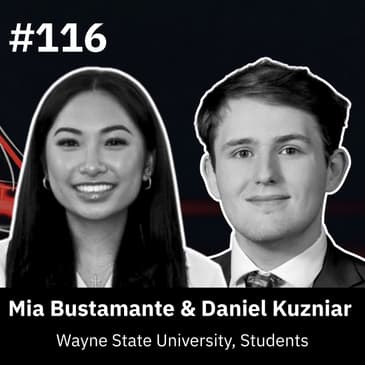
In this episode of the Auto Supply Chain Champions Podcast, Jan and Tom Roberts sit down with Wayne State University supply chain students Mia Bustamante and Daniel Kuzniar to hear what the working world looks like from the entry point. Both landed on live problems immediately. Mia's worked on automotive, consulting, finance, and healthcare projects, focusing on cost optimization, launch readiness, and data analysis. Daniel spent his first year of a tier one co-op on tariffs and supply chain mapping.
Data is the first thing they name. In school, the set is clean, and the answer's already known. At work, the first job is finding where the data lives: one system here, another team's version there, an Excel tracker somebody built ten years ago and never explained.
Daniel saw the same problem from the tariff side. Seven good forms from seven good teams, each right for its own purpose, none able to line up against the others. His ask of the industry is cross-functional data standardization, which is another way of saying you can't ask AI to make sense of silos you haven't broken.
Leadership is where both land next, and they use the same word for it: context. Tell a young employee what decision the work supports and who'll use it, and the work comes back better. Give them something to own, and they stay. When his manager was out for a week, Daniel ran daily meetings for a group of co-ops and built the agenda himself. He'd never done anything like it, and the culture made it safe to try.
This conversation challenges leaders to stop treating early-career talent as a pipeline problem for later. The people asking why a report exists are asking the right question, and the companies that bring them into the room early, with context and real ownership, will move faster than those still saying, "go get it done."
Themes Discussed in This Episode
- Why clean classroom data sets don't prepare students for automotive
- Data standardization as a cross-functional problem, not an IT project
- Context as a leadership requirement
- Giving early-career talent real ownership
- What a year in a co-op teaches about culture and psychological safety
- AI in the classroom and on the job: use it, then verify it
- Bringing younger employees into the room where decisions get made
- Why industry voices belong inside academia
This podcast is powered by QAD RedZone.
Featured Guest
Name: Mia Bustamante
Title: Supply Chain Management and Finance Student, Wayne State University
About: Mia is a student at Wayne State University’s Mike Ilitch School of Business, pursuing a double major in Global Supply Chain Management and Finance. Through internships, consulting projects, and case competitions, she has gained experience across purchasing, supply chain, finance, and automotive operations. She is passionate about technology, leadership, collaboration, and the evolving future of the supply chain industry.
Connect: LinkedIn
Name: Daniel Kuzniar
Title: Honors Global Supply Chain Management Student, Wayne State University
About: Daniel is the president of Wayne State University’s GSCMA (Global Supply Chain Management Association) & a procurement co-op focusing on tariffs for a tier one automotive supplier. Daniel works to coordinate and standardize all types of tariff information to be simple and understandable from the top level, and as accurate as going through each entry & invoice form.
Connect: LinkedIn
About Your Hosts
Jan Griffiths
Jan is the host and producer of the Auto Supply Chain Champions Podcast and The Automotive Leaders Podcast. A former automotive manufacturing and supply chain executive, Jan is recognized as a Champion for Culture Change in the automotive industry. She brings direct, grounded conversations to leaders navigating execution, disruption, and transformation across the global automotive ecosystem.
Tom Roberts (Co-host)
Tom is Co-host of the Auto Supply Chain Champions Podcast and Vice President of Strategic Industry Development at QAD. He works closely with automotive and industrial manufacturers to close the gap between insight and execution, helping leaders move from visibility to systems of action that drive real operational outcomes.
Episode Highlights
[02:13] Straight Into the Deep End: Mia's worked across four industries before finishing her degree, and Daniel's first year at a tier one supplier put him on tariffs and supply chain mapping, two of the least settled areas in the business.
[06:34] There's No Clean Data: Mia's biggest surprise wasn't the analysis. It was discovering that finding the data comes first, and that nobody agrees on where it lives.
[08:23] Standardizing While the Rules Change: Daniel built forms and processes for tariff data while the tariffs themselves kept moving, and suppliers didn't always fill them in the same way.
[11:59] Context Beats Instructions: Mia explains what separates the leaders she learned from: they say what decision the work supports and who's going to use it.
[14:49] Trusted for a Week: With his manager out, Daniel ran daily meetings for a group of co-ops, handed them ownership of the calls, and learned what's possible when a culture makes it safe to try.
[17:55] Verify Before You Trust It: Daniel limits AI while he's still building the skill; Mia uses it daily and checks it against a professor or a textbook. Tom makes the case that a degree without AI fluency is worth less than it should be.
[22:32] Seven Forms That Don't Talk: Daniel's answer on what the industry should fix is cross-functional data standardization, and Tom traces the mess back to growth by acquisition and system convergence nobody ever finished.
[24:32] Bring Them Into the Room: Mia asks leaders for the one thing a training video can't deliver: a seat in the meeting where experienced people think a problem through out loud.
Top Quotes
[07:11] Mia Bustamante: "School teaches you how to analyze that data, but work really teaches you how to find the data first."
[14:25] Tom Roberts: "(Empowerment) gives you tools and context and removes obstacles for you and lets you do the work."
[15:31] Daniel Kuzniar: "The most important thing is to empower co-ops, interns, allow them to have ownership over certain things so that they understand that responsibility going into the workforce."
If this episode resonated, share it with a fellow automotive leader and subscribe to the Auto Supply Chain Champions Podcast, where we're closing the gap between insight and action across the global automotive supply chain.
Follow the Auto Supply Chain Champions Podcast for real conversations with leaders who are making hard choices, focusing their bets, and leading with intent.
🎧 Follow the podcast:
🔗 Learn more about QAD Redzone: https://www.qad.com/
[Transcript]
[00:00:00] Jan Griffiths: This is the Auto Supply Chain Champions Podcast. We are on a mission to bring you real conversations with the leaders who are transforming supply chains in the automotive sector. These leaders are true champions of manufacturing, and we're here to share their stories. I'm Jan Griffiths, your host and producer, and I'm joined by my co-host, Tom Roberts, Vice President of Strategic Industry Development at QAD.
[00:00:30] Tom Roberts: Great to be here, Jan. What I see every day is simple: manufacturers don't have a data problem, they've got an execution problem. This show is about how artificial intelligence, systems of action, and empowered teams can help close that gap.
[00:00:45] Jan Griffiths: Let's get into it. This podcast is powered by QAD RedZone.
Hello, and welcome to another episode of the Auto Supply Chain Champions podcast. Let's check in with my co-host, Tom Roberts.
Tom, how are you?
[00:01:02] Tom Roberts: Jan, doing great.
It's a beautiful day here in the Detroit area. Summer is coming to an end. I'm thrilled to be talking to a couple of college students today. We've dropped off our college student in East Lansing, of course and we've got one other one who's got some classes in spring to take. Summer's coming to an end. It's an exciting time.
[00:01:19] Jan Griffiths: It's back to school for everybody, and I'm seeing it on Facebook. People starting college. And, you know, I have a daughter who is through all of that and in the workplace.
And Tom, you and I are in this because we care passionately about the industry, but we also care very much about the legacy and what we're leaving behind.
And the workforce, the young people coming into supply chain, into automotive today, know, what are they thinking? What are they feeling?
And that's why this episode is so perfectly timed, and I am thrilled to bring onto the show two supply chain students from Wayne State University, and I'm gonna let them introduce themselves.
So we're gonna start with you, Mia. Tell us a little bit about you.
[00:02:13] Mia Bustamante: Hi, everyone. My name is Mia. I'm currently a student studying both supply chain management and finance at Wayne State, and over the past few years, I've had the opportunity to get experience across a few different industries, including automotive, consulting, finance, and some healthcare-related supply chain projects.
So a lot of my recent experience has been focusing on things like cost optimization, launch readiness with a OEM that I worked for, some data analysis, and working across different teams to solve operational problems. I'm still very early in my career, which is really what makes this conversation really exciting for me. So getting to see it in real and where I think the industry can the classroom, and where I think the industry can continue to evolve.
[00:02:56] Jan Griffiths: Wow, that's a lot. That's a lot.
[00:02:59] Tom Roberts: Straight into the deep end. Straight into the deep end.
[00:03:01] Jan Griffiths: Yes, but a what a great experience.
Daniel, tell us about yourself
[00:03:05] Daniel Kuzniar: my name is Daniel Kuzniar. I'm a rising junior at Wayne State University studying Honors Global Supply Chain Management. I am a co-op at a tier one automotive supplier. I've been working there for about a year now, focusing primarily on tariffs, but also working in the supply chain mapping program. And I am also the president of the Wayne State Global Supply Chain Management Association.
[00:03:30] Jan Griffiths: Wow, another one in the deep end, Tom. Imagine your first experience and being thrown into tariffs.
[00:03:37] Tom Roberts: Well, it's great because tariffs are what? Steady state for the last 10 years, no changes, Jan. So, that's gotta be easy work.
No, you've been thrown in the deep end as well. I can't imagine what you're going through right... Well, I can imagine some of it, and we'll talk about that.
But wow, deep end, both of you. Good stuff.
I've always said for automotive, you have to have the love, and you guys are seeing
that already. You've gotta want it. You've gotta have the passion.
[00:04:01] Jan Griffiths: So Mia, why did you pick supply chain?
[00:04:04] Mia Bustamante: I actually didn't grow up knowing I wanted to work in supply chain. I think a lot of students early on hear the word supply chain and they picture trucks, warehouses, or even logistics type of pictures. But once I got into school, I realized how broad it was. You're really touching all areas of the business, so whether that be finance, operations, sourcing, engineering, data analytics, at all at the same time.
And being in Detroit and going to Wayne State definitely made, as Tom was saying, automotive feel very accessible because it's all around you. As you're driving to school, you're seeing everything that's going around. So it really drew me to see how one decision can affect all different types of things.
So whether that's me getting to school or me going to a Case comp, it's stuff like that, that sounds simple, but it can affect all different types of your life and areas as I'm going through it.
[00:04:59] Jan Griffiths: Yeah, that's really interesting.
Daniel, how about you? How did you get into it?
[00:05:02] Daniel Kuzniar: Yeah. So I was recommended to get into supply chain. I was originally looking into various business things, management, marketing. I knew I wanted to do business, but I wasn't specifically sure on what I was doing. And just like, having the opportunity and to meet with people in various different positions, I saw supply chain management as a career path that is focused heavily on problem-solving and dealing with, like, a lot of active issues. You are constantly on your feet, you're constantly doing things, and it's something that I think resonates with my own personal skill set, and it's something that I think would be, at the very least, interesting in my career path.
But yeah, I just really got onto the ground floor my freshman year with a lot of the events and really just kept going from there, and here now.
[00:05:47] Tom Roberts: So I have to ask, expectations versus reality. I've been in the workforce for a long time. I think Jan's the longer than me, and we forget what our expectations were when we started out and what the reality is. So I'm gonna ask you two, expectations on the workplace versus the reality.
What kinds of things did you think were gonna happen in the corporate world or in the work world, and what are you actually seeing and kind of saying without being too critical. But just, what do you see?
What kinds of things are you seeing?
[00:06:16] Jan Griffiths: Tom, let's rip the bandage off.
[00:06:18] Tom Roberts: I guess we're not naming where they're working, so, no, just for real, 'cause there's always gonna be things that are exasperating in the workplace. So I'm just curious.
[00:06:25] Jan Griffiths: You have been here a few weeks and all sudden you're like, Wow this is what working world is like. This is not what expected.
[00:06:31] Tom Roberts: And why are people doing this, you know?
[00:06:32] Jan Griffiths: Yeah. Mia, go first. Tell us.
[00:06:34] Mia Bustamante: One of my biggest surprises was how much of supply chain is problem-solving around imperfect information. In school you're usually just given a clean data set and asked to find the answer, and they already know what your answer's gonna be. So at work, sometimes the first challenge is figuring out where that data even lives.
So you might have one information in one system. Another team's using something completely different, then you have to ask them to explain it to you, and then sometimes it's an Excel tracker that someone created 10 years ago, and then they're trying to reconcile all of it before you can even start analyzing the actual problem.
So I think school teaches you how to analyze that data, yes, but work really teaches you how to find the data first.
[00:07:18] Jan Griffiths: Tom I know you got to have something to say about that.
[00:07:22] Tom Roberts: Oh, it's clean data. You're working with clean data usually in your data sets in university and there is no clean data. There is no clean data in the work, in automotive.
[00:07:33] Jan Griffiths: But that's fascinating feedback for the universities to the take this onboard and go, "You know what? We're giving these students clean data to work with, and that's not reality."
[00:07:41] Tom Roberts: Yeah.
[00:07:42] Mia Bustamante: I also expected processes to be a little bit more standardized too. It surprised me that even at large corporations, sometimes they're still asking, "Oh, like, who owns this data?" Or, "Where does this even come from? And why are these two numbers different?"
So definitely pulling your hair out kind of situations, as I just ended one of my jobs.
[00:08:02] Jan Griffiths: Very interesting
[00:08:03] Mia Bustamante: Yeah
[00:08:04] Tom Roberts: And sometimes I've seen, he or she who goes first makes the rules So they might determine the process because you just move forward, there isn't one, so you say, "Okay, well, this is how the process is gonna work," and sometimes you establish it, or ultimately reestablish something.
So yeah. Awesome.
Daniel?
[00:08:23] Daniel Kuzniar: Yeah. Thank you, Tom.
So one of my earliest expectations was the systems and forms would be a lot more standardized and regulated cross-functionally. But working in tariffs with all sorts of different, like, constant adjustments, constant changes, everything going one way or going the other was a lot of uncertainty.
We didn't really have that much standard things, and we were sort of working on it as it was coming. So we created a lot of forms, we created a lot of information, and we had to constantly adjust that for whatever was going on with new tariff information, whatever was going on with our suppliers submitting back to us their own tariff information, and just trying to regulate and standardize that.
Essentially, we were working a lot towards getting a lot of the information that we were sent to us into one basic uniform way so that we could properly understand what was extremely difficult when you're working with all of the multitude of suppliers underneath you and trying to regulate them to the different systems for the OEMs above you, so.
[00:09:26] Tom Roberts: Yeah, foundational data, Jan. It is the absolute baseline for anything that you're doing in automotive. Certainly in the larger companies it's even more prevalent. But every time I hear it, it's just always data cleansing, data foundations, master data.
So Daniel, just was curious to ask. You mentioned you had to reach out kind of far and wide to get data.
So you've got, I'm guessing Billy Bob has a spreadsheet, and you hear about that from somebody, and you've gotta get that, and then you gotta log into this particular portal that held some information, and then you've gotta go in this ERP system.
Is that the kind of thing you were running into, just they were just, like, different types of systems and spreadsheets...
[00:10:05] Daniel Kuzniar: a decent amount.
There are various systems at this company, and we have a lot of forms that we did try to standardize to send out to them, and a lot of the time we would need to, like, "This information is incorrect," or, "We need you to fill out these fields," those lines where people weren't fully completing them to the exact standards that were necessary, which is understandable.
A lot of it's proprietary information. We need to compromise with that. But it was still just trying to get as much information that we reasonably could to convey the information that we needed in order to get tariff payments or to even just have our own systems to understand what we were paying.
[00:10:44] Jan Griffiths: Yeah. All throughout my career I've seen this, and you're in a C-suite meeting, and a senior level executive or a CEO will go, Oh, okay, so there was an announcement yesterday that we're getting tariffs on three different commodities of whatever percent, right? need to know the impact which- to this business, which is a logical question for a senior level leader to ask.
But then you get the head of supply chain going...
Because when you actually get down to try the level of detail and granularity that you need to pull all that together and where the data comes from, it's much more complicated than anybody ever imagined. So I love that you're actually experiencing that early on in your career.
[00:11:29] Daniel Kuzniar: Definitely. It's a great opportunity. I've pulled my out a couple times reading mountains of 7501 forms, but it's all worth it in the end.
[00:11:40] Tom Roberts: Absolutely
[00:11:41] Jan Griffiths: Okay. Now, I want to ask you about leadership styles and culture.
Mia, as you walk into the workforce, give me some behaviors or traits of a boss that you liked and some that you didn't like. Maybe not a direct boss, maybe you just saw in the workplace. Tell me.
[00:11:59] Mia Bustamante: The leaderships I've learned from the most are the ones who give you context, not someone who's always just like, "Go update this spreadsheet." So stuff like that.
I can do that, yeah, but if they don't explain to me what decision that spreadsheet is supporting or who's gonna use it or why it matters, I'm gonna produce way better work than if I knew what I was doing. I also realize I really value leaders who give younger employees ownership early. You don't have to throw someone into the deep end with no support, but giving someone something they can own makes a huge difference in how someone feels invested at work. So that's thing I've noticed.
Another thing is I feel like approachability matters, too. I naturally find it easier sometimes to collaborate with interns or people closer to my age, because there's less hesitation around asking questions or throwing out ideas or admitting when you really, really don't know something. So, when you're working with people who've been in the industry for 20 to 30 years, it's kind of intimidating factor at first, so you start wondering, "Oh, is this a dumb question?" Or, "Do I even know enough to speak up here?"
So I really appreciate leaders who intentionally make younger employees feel like their perspective is welcome, even if it's as simple as asking, "Oh, what do you think in this problem or situation?"
It makes a huge difference, so.
[00:13:23] Jan Griffiths: There's a lot there. But what I love about what you brought out was idea of empowerment, because in this industry, we're talking about speed, we talk about China's speed, and we are not going to increase the speed of the way that we operate in this industry unless we empower people.
And there's a tendency to think, "Well, you're a student, you don't know anything, so we can't trust you with this data or with this decision."
That is absolutely not case, because the reality is you might actually have a more creative and a better way of doing something than the way that we've been doing it for the last 20 years.
And we've got to get used to empowering people. And are you gonna mess up from time to time? Is there a chance that you will mess up? Of course. Whether you've only been in the workforce five minutes, five years, or 15 years, we're humans, and we mess up.
So that leadership trait of being able to trust and let go and empower is so important, and I am thrilled that you brought that up.
[00:14:25] Tom Roberts: Yeah. Give you tools and context and remove obstacles for you and let you do the work.
[00:14:30] Jan Griffiths: Oh my gosh, Tom, if that isn't the social media quote from this episode, I don't know what is. You nailed it. You nailed it.
[00:14:39] Tom Roberts: I'd like to think I did that as a leader, Jan, but you know, we're always the hero of our own story.
guess. that you're exactly right.
But that was what I tried to do.
[00:14:46] Jan Griffiths: You are exactly right. Daniel, how about you?
[00:14:49] Daniel Kuzniar: A lot of similar points to Mia. I think giving people the context and ability to do things and trusting them in order to do them and succeed to get into a bit of an anecdote, I had an opportunity where my direct boss was busy and his boss was also just busy working. So he was gone for about a week, and we had various co-ops working with us.
And as someone who was fortunate enough to be the most senior, I was given the opportunity to directly instruct them and essentially lead sort of daily meetings just going over what needs to be done and things along those lines, which was a fantastic opportunity that I'm grateful that I had the opportunity to, even at such a low level.
But really just I think the most important thing is to empower co-ops, interns, allow them to have ownership over certain things so that they understand that responsibility going into the workforce.
[00:15:45] Jan Griffiths: That's amazing.
Now tell me, Daniel, you're given this leadership role, this leadership responsibility. Give us a peek inside your mind when that happened. What's happening?
[00:15:57] Daniel Kuzniar: I fell completely out of my depth. I had no idea what was going on. I had been in some leadership positions before, but this is an entirely different level. Never on a corporate front, never having to work with fellow coworkers and help instruct them on how to best act and operate in certain situations. And I really just stepped back. I created an agenda, I had a basic understanding of how things were going to go, and I really tried to do what was doing to me and empowered them to work and do things. They had to reach out to our buyers in order to get certain information for various things. Not getting too specific, but it was something where I was like, "You guys should own and operate these meetings. I'll be there to regulate various information and things along those lines."
But really it was trusting the people that were there and recognizing that if they are given proper instruction similarly to how I was, they will be able to succeed in that front.
[00:16:59] Jan Griffiths: You must have felt safe.
[00:17:01] Daniel Kuzniar: Certainly.
[00:17:03] Jan Griffiths: Yeah, that's huge for the culture of the tier one that you're in because a lot of people without experience in a certain area doing something for the first time would be terrified that if they make a mistake they might get fired. That's a fear that we live with in the auto industry.
So you must have felt safe so that speaks volumes for the culture that you're in
[00:17:21] Daniel Kuzniar: Definitely. Yeah.
[00:17:23] Tom Roberts: Absolutely
[00:17:23] Daniel Kuzniar: I say coming in as a co-op, they are very trusting, they're very understanding, and that's one of the benefits of being a long-term co-op, and been in the role for a year. That role can grow and that role can evolve and change and various different things, and you get a broader perspective as opposed to working on one specific project for a period of time.
Not to say that there's not value in working on one project, but there is, a lot more detail that you get. It's a lot similar to working in the industry as opposed to for a brief period of time.
[00:17:53] Jan Griffiths: Yeah, that's great.
[00:17:55] Tom Roberts: So Jan, I have to ask, I wanna ask the two students what kind of artificial intelligence tools were they exposed to in their internships? Were they chatbots, generative tools, agentic tools? What kinds of things were they exposed to, and where did they see some real help from these tool sets if they did use them?
Daniel, why don't we start with you.
[00:18:13] Daniel Kuzniar: Thank you, Tom.
I think as far as AI tools, we did utilize one specific one that I can't, name in particular for tier end mapping. So just getting an AI platform for that. That was a very interesting form to use and understand. But we were not instructed specifically to use any AI tools.
Generally things like ChatGPT, things along those lines were offered and like suggested. I did make use of some Google Gemini to get a brief understanding of certain tariff codes and things along those lines. But I'm not someone who's super invested in AI.
I think, especially as a student, there are a lot of, far as like gaining knowledge and things, there's a lot more benefit in this role to learn how to do it on my own as opposed to just relying on ChatGPT to develop those skills.
Obviously, there are certain tools that I still would use when necessary for like regulating information and things along those lines, but not in particular. Mostly the one platform that we were given for tier end mapping, and aside from that, just Google Gemini to name one. But yeah.
[00:19:19] Tom Roberts: Mia, how about you? What was your experience with AI tool sets?
[00:19:23] Mia Bustamante: So, at previous internship they've had an AI Chatbot that they've created for the whole organization to use, and it was great. I use AI in all tasks of my day, whether that's to make sure my email's getting across to my manager the right way or even, like, a message sent on Teams, something like that. That's something that I'm always using to make sure my point is being put across the right way.
Even in terms of research, I've used ChatGPT in school, and that's worked very well with internships that I've done 'cause it's all I do is put in the prompt, and I know exactly what I'm gonna look for and a checklist that's already gonna be done for me. So it's something that I'm constantly using every day more and more than ever. Each day I use it
[00:20:06] Tom Roberts: And I've noticed with my kids that are college students and high school as well, that you obviously have to create your work on your own, but they also want you to know how to use the tool set. So it's a very fine line between, hey, if universities aren't teaching AI, then I am safe in saying that your university degree is not worth what it should be if you're not.
But I also understand what you just said. You have to be able to think on your own. You have to have a seat at the table without those tool sets to actually understand and have domain knowledge on what the tool set is returning back to you. Otherwise, you can be getting AI slop or, hallucination or drift or whatever, and not even know that it's giving you something that's wrong.
So great... good to understand that perspective.
[00:20:53] Jan Griffiths: It's a really good point.
[00:20:54] Mia Bustamante: Yeah, and it's great that our university encourages us to use it during most of our classes within research and then validating with that certain professor or a certain textbook to make sure that data's correct. It's definitely an adjustment for me in school because you're not always given that tool.
Let's just say you're writing something down so you don't have a computer or phone on the side for you to, go and research that. So yeah, it's definitely something that I'm learning to do.
[00:21:24] Tom Roberts: And these are all things within the last year or two, right? That universities and students and parents are and workers are struggling with and trying to deal with. So it's all very new as well, so.
[00:21:36] Jan Griffiths: Well, the beauty of Wayne is, and I'm little biased 'cause I'm on the advisory board, but the beauty of Wayne State is that because the advisory board consists of leaders who are in industry. We're able to bring that perspective to the table right away to say, "Okay, listen, we need to get AI. We need to figure out what it is, how to use it, how to bring it to make sure students are prepared."
So I think that that really helps, too. Having that industry voice at the table in the world of academia is critical. We're not two separate worlds anymore. We have to be intertwined.
[00:22:10] Tom Roberts: Absolutely.
[00:22:11] Jan Griffiths: Our closing question for today, I want to know, I'm gonna start with Daniel, what can the leaders in this beloved auto industry of ours, what should we be doing to improve this industry for the future?
Maybe two things. Tell us, what would that be?
[00:22:32] Daniel Kuzniar: Yeah, I think... tough question, but I think one of the main things is data standardization on a cross-functional level. I think a lot the problems that i'm seeing is..
[00:22:44] Tom Roberts: Music to my ears.
[00:22:46] Daniel Kuzniar: A lot of the problems that I see are just based on different teams formulating different solutions to different problems, and a lot of them are very good, right?
There is a value in every single one of these different teams doing it, and they're doing it for their own specific purposes. But the problem then comes in, you have seven different forms that are all fantastic at giving information, but they're all so difficult to pivot across each other. And one of the moves that I've seen so far is a push towards that standardization.
Tools like Power BI, various things along that, that essentially would formulate a lot of that data into databases and make it easier for anyone to understand and see.
[00:23:27] Jan Griffiths: My first response to that is I honed right in on the word cross-functional, because for me that's breaking down silos, and that's improving decision speed, right? That's the thing that got me.
But Tom, how do you respond to that from a data perspective?
[00:23:42] Tom Roberts: Oh, Jan, you know it's music to my ears. I think a lot of the issues, in OEM tier one, tier two is the proliferation of data and process.
And it can be from a number of different things, right? A lot of these companies grew through acquisition, so when you acquire a new company, you probably grow, you're getting a new ERP and a new PLM and shop floor systems or if you're buying even a new plant, you have to do all those things. And sometimes it takes time to do system convergence and process and data convergence. So you don't do it. You do a top-end, GL reconciliation at the consolidation in finance, and then you call it a day.
But I think that there needs to be aggressive action to cleanse data and reestablish those foundations and hierarchies.
[00:24:24] Jan Griffiths: Yeah, absolutely.
Okay, let's go to Mia.
Mia, what should the leaders in this industry be doing to prepare itself for the future?
[00:24:32] Mia Bustamante: Yeah. So I think I'd focus a lot more on the social side of development and making younger professionals feel more empowered to contribute.
So similar to Daniel, I think he would also have much to say, but a big part of high school was online, so I think that experience made me value in-person and connection a lot more.
There's only so much you can learn from a screen or a training video or Excel sheet, so a lot of the real learning happens when you're sitting in a room with people who have years of experience, listening to how they think through a problem, asking questions, and seeing how those decisions actually get made.
So I think companies have a huge opportunity to bring younger employees into those conversations earlier, letting us sit in on meetings, working cross-functionally like you guys just mentioned, from experienced professionals, and collaborating with people at our stage of our careers. I think that environment really helps build confidence, especially this young, super intimidating to speak in front of people. So people who have experience in those years, having leaders who actually listen to your opinion make you feel like your perspective matters.
[00:25:39] Jan Griffiths: Well, that's my gem, isn't it, Tom? That's authentic leadership right there.
[00:25:43] Tom Roberts: That is. Absolutely. Absolutely.
Context is for kings and queens, and honestly, Jan, I think their generation has done a better job of demanding of more context in the work that they're doing than maybe we did. We were kind of like, "Go get it done," or we would try and go get it done, and I think that the context needs to be there.
Otherwise you just can't round out the edges of the work you're doing and really understand and get passionate behind it.
[00:26:08] Jan Griffiths: In our generation, Tom, we were given a task, we would never question it. We would just take it.
We would never seek to probe, you know, why do you need this report? Why is it this date? What decision is it supporting? And I see with the younger generation now. They will absolutely do that and it is 100% the right thing to do.
We're getting closer to co-creating agreements, which is the core foundation to positive accountability, and I see that starting to happen. But what I'm hearing is we need to do more of it, and we need to do it much faster.
[00:26:42] Tom Roberts: Absolutely. Jan, I think we'll be in good hands.
[00:26:45] Jan Griffiths: I think so too. I think so too.
Well, this has been an absolute pleasure.
Daniel, thank you for joining us.
[00:26:52] Daniel Kuzniar: Thank you, Jan. Thank you, Tom.
[00:26:54] Jan Griffiths: Mia, thank you for joining us today.
[00:26:56] Mia Bustamante: Yeah. Thank you guys. It's been great.
[00:26:58] Jan Griffiths: All right, onward and upward.
[00:26:59] Tom Roberts: Good luck with the school year and best wishes and good luck on your careers. Fantastic.
[00:27:05] Jan Griffiths: Maybe we'll ask you to comeback a year from now and see how things have improved. How does that sound?
[00:27:09] Daniel Kuzniar: I love it.
[00:27:10] Mia Bustamante: Sounds great.
[00:27:11] Jan Griffiths: Okay, you're on.
We wanna hear from you, our listener. Tell us what are your challenges right now? What conversations do you want to hear across the airwaves on this podcast? Drop us a comment on our podcast website. The link is in the show notes.