Logistics doesn’t always get the attention it deserves in the automotive world. Yet a wealth of knowledge is sitting inside 3PLs; companies that don’t just move parts but keep the entire system running.
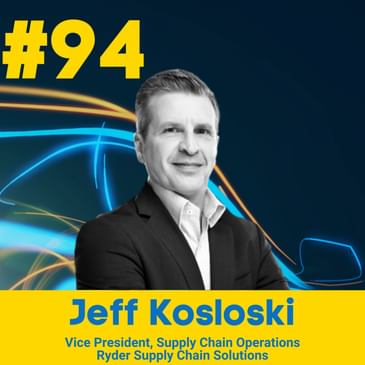
That’s why she brings in Jeff Kosloski, Vice President of Supply Chain Operations for Automotive, Aerospace, and Industrial at Ryder, to talk about what a modern 3PL really does.
Jeff explains that Ryder handles everything from transportation and warehousing to sequencing, line-side delivery, and industrial engineering support. It’s not just outsourcing; it’s about helping manufacturers design better, leaner supply chains.
He describes how Ryder has invested more than $1.7 billion in automation and AI over the past several years, exploring robotics, data tools, and new tech through its venture fund, Ryder Ventures, to keep up with the rising cost and complexity of manufacturing.
But behind those investments is a simple truth: change is constant. Short-term uncertainty keeps logistics teams on their toes, while automation and AI are the biggest long-term disruptors, Jeff says.
The challenge in automotive is standardization: every part, container, and process looks different, so implementing automation requires more creativity. Ryder’s engineering teams constantly test new robotics and warehouse systems to meet that challenge.
Jim asks how Ryder manages efficiency when the environment keeps shifting. Jeff says flexibility is key. They move with customers as priorities change while focusing on improvement across the supply chain.
That leads to the heart of the episode: collaboration. Jeff says the best partnerships are built on trust and open communication. His ideal scenario? A meeting where you can’t tell who the customer is and who the 3PL is, and everyone is rowing in the same direction.
On the subject of AI, Jeff is clear: it’s no longer hype. Ryder uses it to forecast problems, improve routing, and make faster decisions. But people remain central to the work. That’s why Ryder focuses on growing new talent through leadership programs that expose young professionals to every side of logistics while building their technical and people skills.
When asked what skills matter most for the future, Jeff doesn’t hesitate: digital fluency and critical thinking. Leaders need to understand AI tools firsthand and learn how to apply them in real operations. He admits he’s learning it himself because ignoring it isn’t an option anymore.
When asked what advice he’d give to supply chain leaders facing constant disruption, Jeff says the speed of change has never been faster, so don’t chase every new idea or wait for perfection.
Surround yourself with smart people, embrace the unknown, and give your team the freedom to innovate. Mistakes will happen, but staying still is worse.
Themes discussed in this episode:
- The evolving role of 3PLs as strategic partners driving efficiency in automotive supply chains
- How Ryder integrates automation and AI to enhance logistics performance and reduce operational costs
- The challenges of applying automation in automotive logistics where parts and packaging lack standardization
- The power of collaboration and trust between OEMs and 3PLs in achieving long-term supply chain success
- How shared goals and transparent communication strengthen partnerships between manufacturers and logistics providers
- The growing impact of AI and predictive analytics on real-time logistics planning and decision-making
- How Ryder’s leadership development programs prepare the next generation of logistics professionals through hands-on experience
- Why embracing change, learning new technology, and empowering teams are key to staying competitive in a fast-moving supply chain industry
Featured on this episode
Name: Jeff Kosloski
Title: Vice President, Supply Chain Operations - Automotive & Industrial at Ryder Supply Chain Solutions
About: Jeff is the Vice President of Supply Chain Operations at Ryder Supply Chain Solutions, where he oversees North American logistics operations across the automotive, aerospace, and industrial sectors. With more than 30 years of experience at Ryder, Jeff has built deep expertise in global logistics planning, industrial engineering, procurement, and transportation management. His career includes leading complex customer implementations, standardizing business processes across regions, and developing tailored solutions for automotive supply chains.
Connect: LinkedIn
Mentioned in this episode:
Episode Highlights:
[04:07] Beyond Trucks and Warehouses: Jeff breaks down what a 3PL really does, revealing how Ryder’s work goes far beyond moving freight — from managing transportation networks to supporting manufacturing and improving supply chain efficiency.
[05:21] Automation in Motion: Jeff shares how automation and AI are transforming logistics, explaining how Ryder is investing over $1.7 billion in robotics and technology to meet customer demands and stay ahead of rising industry complexity.
[08:17] Flexibility Is the Strategy: In a world of constant change, Ryder keeps supply chains moving by staying agile, adjusting plans as customer needs shift, and finding new ways to drive improvement even when the market is unpredictable.
[09:30] Riding the Tariff Waves: When tariffs trigger sudden demand spikes, Ryder tackles them with creative solutions using shared warehouse space, cross-border facilities, and strong partnerships to keep customers ahead of disruption.
[10:43] Collaboration Over Transactions: True partnerships, Jeff says, aren’t built on price tags or contracts but on trust, open communication, and shared goals where both sides challenge each other, solve problems together, and move as one unified team.
[16:47] AI Takes the Wheel: AI isn’t hype anymore; Jeff explains how Ryder uses both generative and predictive AI to forecast problems, streamline work, and give logistics teams the tools to make faster, smarter decisions.
[19:18] Building Tomorrow’s Leaders: Ryder invests in the next generation through hands-on leadership programs and a culture that helps young professionals grow, stay inspired, and build lasting careers in supply chain.
[23:03] Digital Fluency First: Today’s must-have is digital fluency with strong critical thinking, built by learning generative AI hands-on—from prompt basics to applying it in real operations.
[25:41] Embrace the Unknown: Change in the supply chain is accelerating, and Jeff’s advice is clear: stop chasing shiny tools, stay curious, surround yourself with smart people, and give your team the freedom to learn and innovate.
Top Quotes:
[07:04] Jeff: “ It's more challenging to develop solutions, but the reality is we'd better figure out how to do it, because like I said, our customers are asking.I think there's an increasing application of automation needed if companies wanna provide more efficient and competitive solutions for our customers. With electrification and increased technologies in vehicles, their costs are increasing. So, manufacturers really need, you know, 3PLs to come in with a lower cost solution to offset those.”
[12:48] Jeff: “I think all strong partnerships, whether it be a business relationship or a personal relationship. Every now and then, you need a little spirited debate to get to the best solution. So, you know, I think that has to happen. And one of the barometers for me is when I participate in quarterly business reviews or strategic business reviews, the customer is me walking into the room and not being able to tell who's wearing what Jersey. Is it the customer that's talking? Is it someone on my team talking? And that's, I think, that's true collaboration.”
[18:29] Jeff: “AIs in logistics are no longer just the hype. I think it's more of a strategic imperative or strategic initiative, maybe in any company that's serious in supply chain, about driving efficiency, building resilience, and providing customer satisfaction. You gotta get on the AI train, 'cause it's leaving the station for sure.”
[26:57] Jeff: “Don’t be afraid to fail because of what you don't know. Surround yourself with people who are smarter than you. Get uncomfortable, embrace change, and leverage your team to drive the innovation. Kind of give your team that freedom to dream. Provide a framework to help control risks because I mean, there are some risks with new technologies, whether it be data risks or operational risks, that type of thing. But really engage and embrace that change.”
[Transcript]
[00:00:00] Jan Griffiths: This is the Auto Supply Chain Prophets podcast, and we are on a mission to bring you the latest insights and thought leaders leading the charge on supply chain transformation in our beloved automotive industry. This podcast is powered by QAD and AIAG. I'm Jan Griffiths, your host and producer. Let's meet your co-hosts.
[00:00:27] Jim Liegghio: I'm Jim Liegghio from AIAG.
[00:00:29] Terry Onica: I'm Terry Onica from QAD. Let's dive in.
[00:00:36] Jan Griffiths: Hello, and welcome to another episode of the Auto Supply Chain Prophets Podcast.
[00:00:40] Terry Onica: Let's check in with my co-hosts, Terry Onica. What have you been up to? Well, I'm getting excited, our Champions of Manufacturing in Europe and North America are coming up within just weeks now, which is super exciting. We've got customers, industry analysts, AI experts, and a lot of customers that are gonna be attending. So, I'm excited about that.
And on a personal note, we haven't really talked about personal notes lately, I'm gonna be running the Army 10-miler in Washington DC next weekend. And so, I am super excited about that. Never have done that before.
[00:01:10] Jan Griffiths: Wow, the Army 10-miler in Washington DC
[00:01:13] Terry Onica: Yeah. 35,000 people will be attending. 35,000 runners.
[00:01:17] Jan Griffiths: That's awesome. You're an inspiration.
[00:01:20] Terry Onica: Thank you.
[00:01:20] Jan Griffiths: Jim, what have you been up to?
[00:01:22] Jim Liegghio: Well, I'm glad Terry brought up running, Jan. I was gonna bring up running, too. It's actually trail racing season. It's fall, it's marathon season. So, I've got a couple trail half marathons under my belt already. I'm astounded at watching these long distance runners come in. These a hundred milers and 50 milers coming in. The determination, the grit, the perseverance, right? And it got me thinking a lot about supply chain, ironically, and how runners have to be supply chain experts. They have to plan their gear, their attire, they have to plan their training schedules, then they have to execute on race day.
You never know what you're gonna get. So it's kinda like supply chain. You never know what the weather's gonna be like, what could happen in the meantime. So, it's definitely running season to Terry's point, but it also got me thinking about supply chain and logistics in a weird way. A little bit of nerding out for you there, but that's what I've been up to.
On an AIAG front, Jan, it's events season. It's not running season, it's events season. We just had our Quality Summit, which is our biggest annual event. Very successful, and next year it's gonna be even bigger and better. So, first of many fall events here at AIAG. We're all excited about that, of course, and already planning for 2026 in terms of training schedules, and budget, and all that kind of stuff. So looking forward to that.
[00:02:23] Jan Griffiths: Yeah, that sounds really exciting. Well, I'm not gonna talk about running. But talking about events, I am gonna be MCing an event in New York, November 18th with Auto Procurement, and it is a gathering of all procurement leaders, CPO levels across multiple different industries, which I absolutely love. And it's at Carnegie Hall, so I am really looking forward to that. And that makes me think about collaboration.
So often, in the auto industry, we don't like to collaborate too much with people outside of our industry, and we really need to do more of that. We can learn so much from other industries and other people, and we can learn so much from partners and suppliers who are already in our network.
And I was thinking about logistics. We talk a lot about logistics and supply chain, but there's an area that is untapped, really untapped resource. There's so much knowledge in supply chain in logistics companies. They are the glue that really pulls it all together, and I really firmly believe that we need to lean in more to our logistics and 3PL providers. And that's why I am thrilled today to have on the show, Jeff Kosloski. He is the VP for Supply Chain Operations, Automotive Aerospace, and Industrial. See, that's what I like. There's that collaboration coming in across industries. He gets that perspective and at Ryder. So, Jeff, welcome to the show.
[00:04:00] Jeff Kosloski: Thank you very much. Glad to be here and looking forward to talking about supply chain and logistics.
[00:04:06] Jan Griffiths: Yes. Jeff, we throw around this term 3PL, third-party logistics, and I know that everybody on this call listening to this episode has got an idea of what they believe a 3PL is. So, just get us grounded, what's a 3PL? What do they do?
[00:04:24] Jeff Kosloski: Alright, well, I'm gonna give it to you from my perspective and the Ryder perspective. So, for us, it's primarily, we're more domestic focused, so North American based. But as far as the services that we provide, when customers look to outsource to companies, they look to the third-party logistics providers. And from our perspective, we break that down into transportation. So it could be dedicated transportation with our trucks and drivers, or it can be transportation management where we're managing an inbound supply chain or outbound supply chain for a customer and actually outsource to other carriers, common carriers. And then, we obviously do some warehousing, specifically in the automotive industry, we do a lot of manufacturing support, so sequencing, mine side replenishment, that type of stuff. And we provide industrial engineering, continuous improvement services to our customers as well. You know, help them from a consultative approach and how they can make their supply chain more efficient.
[00:05:15] Terry Onica: Wow, Jeff, that's amazing. And you are so critical to the automotive industry, for sure. And we've got all these disruptions that we're facing right now. From your perspective, in your world of a 3PL, what are some of those big disruptions that you see right now?
[00:05:30] Jeff Kosloski: I've talked specifically to automotive because that's been where most of my career has been spent, and it's always changing, fast pace industry. That's what makes it so fun and attractive. Ironically, it makes it a love-hate relationship. I tell my kids all the time that what I love about my job, I also hate about my job at times. I always say like, once automotive logistics is in your blood, it's really tough to leave the industry. From the industry itself, I think the elephant in the room, the short term disruptor right now, is the continuing uncertainty, whether it be in the industry, geopolitical things or the economy itself. That's kinda that short term disruptor that obviously we'll see fade away.
But I think from a longer term perspective, the primary disruptor is automation and probably the future use of AI to drive innovation. We hear quite a bit about automation to streamline our operations from our customers. They're consistently asking, in some cases, to address labor shortages in certain regions of country, sometimes to just assist our team members in doing their jobs more effectively. An example would be like a automotive automated storage and retrieval system makes their job easier. It makes them more productive.
Unfortunately, I think from an adoption and application perspective, other industries are probably further along on the automation road, probably 'cause they have more standardization like in parcels, that type of thing. But automation is here to stay, and I think it's much easier to deploy automation when packaging and boxes are similar sizes.
And in auto, we have standards. I think we've done a great job, with Jim's organization helping define the standards, you know. But based on the part characteristics and sizes, the containers that we have to handle varied widely. And it's more challenging to develop solutions, but the reality is we better figure out how to do it, because like I said, our customers are asking.
I think there's a more increasing application of automation needed if companies wanna provide more efficient and competitive solutions for our customers. With electrification and increased technologies in vehicles, their costs are increasing. So manufacturers really need, you know, 3PLs to come in with a lower cost solution to offset those.
We're putting a lot of money into that area. You know, I think we've always been on kind of the leading edge of transportation, logistics, and pushing the boundaries of really what's possible. On the supply chain side, we created Ryder Ventures, you know, venture capital fund to bet on some companies that really are creating technology and applications that'll help drive the industry.
Example, we've invested in humanoid robotics company, Apptronik. We really wanna stay close to lead players in the tech space and pilot that technology when it's ready for our customers. And we've got a dedicated engineering team that evaluates automation, robotics technology. So, I think you can see between having a dedicated team, and I think we've invested like $1.7 billion over the last, you know, six, seven years just on automation. So, you know, I think we see that as the place to go in the future.
[00:08:17] Jim Liegghio: You got a lot of investment obviously, and you guys are giants at what you do. And you take your economies at scale, let's say, and you apply that to find efficiencies for customers and that kind of thing. The current environment, you mentioned uncertainty, of course, we're no stranger to that. How do you, how do you juxtapose the two? How do you find efficiencies in this current environment? How do you bring value to your customers in a very kind of chaotic, uncertain environment, right? You guys are pros of what you do in a stable environment. How do you adapt and roll with the punches going on today? What are some of the tricks you can share with the group here?
[00:08:45] Jeff Kosloski: You know, Jim, I don't know that it changes our perspective. I mean, we know what we know at a given time, so as our customer make decisions, we need to be flexible and move with them.
I'll tell you from an automation perspective, it makes it a little bit tougher because there's some big investments, right? You don't wanna invest in something that might go away and not have the payback period. But, you know, as far as driving improvements to the overall supply chain, I don't know that our job changes much. We just need to be a little bit more nimble.
And as the business ebbs and flows and our customers change direction, we need to be able to move with them. And, unfortunately, sometimes that means maybe holding off on some automation, but as far as driving, you know, innovation and improvement across the supply chain, I don't know that it really changes our perspective.
[00:09:29] Jan Griffiths: Jeff, we hear a lot about surge of activity in the logistics field with tariffs. People trying to get ahead of the curve, trying to ship products in ahead of tariffs, maybe changing that when tariffs are announced. How on earth do you deal with those kinds of surges, those peaks and drops?
[00:09:49] Jeff Kosloski: It's been challenging for sure, Jan. You know, we have got a lot of customers that are looking for kind of temporary space, so maybe interim solutions, if you will, to do exactly what you said, pull ahead, you know, of tariffs, that type of thing.
We have multi-client warehouses that we do have some, you know, space available in. So we do try to leverage our other industry verticals, if you will, to help with some of those surges in some of that temporary space that's needed.
But it's certainly challenging when it comes to space. We've seen a lot of that activity down along the border and we do have some warehouses in Laredo and such that we've leveraged as well. It's challenging and where we can help, we do. And where we can help connect via partnerships that we have, we'll also do that too. So that spirit of collaboration and still providing a solution to our customer.
[00:10:37] Jim Liegghio: And that's one thing I wanted to get to with you, Jeff, is understanding that collaboration. In fact, you led me right to the point I was gonna ask you. You know, a lot of people think 3PL and they think transactional. I'm gonna offload some work. I'm gonna outsource it for X, Y, Z reason. It's a cost savings, whatever. I want you to outline for the audience more of how it's a collaborative approach, especially in this industry. Like you said, you may have to have a multi-client solution or something, and things that have been flow.
Can you kind of explain more of your philosophy of collaboration at Ryder? I mean, AIAG we're all about collaboration. That's our, that's the fundamental tenet of what we do. So, I'd really like our audience to hear from you to kind of dispel the myth of 3PL as a purely transactional thing and a more of a collaborative relationship.
[00:11:18] Jeff Kosloski: That's a great question and something actually I'm fairly passionate about. Most of our successful partnerships are collaborative. It's what we strive for as a 3PL. If you look at Ryder's vision, overall vision, we focus on perfecting the supply chain, and our goal is to be the most trusted logistics and transportation partner in North America. So the number one criteria for that collaboration is that trust.
When we get into transactional relationships, my history is that we will rarely get to a second term. I think there's too much focus and cost discussions and not enough focus on value where both parties can benefit.
And look, I'm not going to say that companies aren't facing cost pressures right now. There's a lot going on in the industry as we talked about earlier, but we really try to get into relationships with customers that are looking for a true collaborator that's seeking to, you know, drive costs outta their supply chain, uncover the hidden waste, and really get to their lowest enterprise cost.
And I understand that our cost for our services is also, I don't want that to get lost on the audience. You know, we need to be competitive. But I think having the trust to share critical planning data, having mutual goals, and truly driving collective success is a multiplier in a true collaborative environment.
And I talked a little bit about trust and it being the number one thing. I mean, trust works in a couple different ways. Quite frankly, successful partnerships really happen when the customer and the 3PL are fully committed to one another. but it really has to be a give and take relationship.
We need to be able to, you know, push back on one another. I think all strong partnerships, whether it be a business relationship or a personal relationship. Every now and then you need a little spirited debate to get to the best solution. So, you know, I think that has to happen. And one of the barometers for me is when I participate in quarterly business reviews or strategic business reviews, the customer is me walking into the room and not being able to tell who's wearing what Jersey. Is it the customer that's talking? Is it someone on my team talking? And that's, I think, that's true collaboration.
[00:13:19] Jim Liegghio: That's interesting. Yeah.
[00:13:20] Jeff Kosloski: You get everyone ro rowing in the same direction, talking the same talk, and complimenting one another. That's the sweet spot for a partnership and where we've seen success.
[00:13:29] Jan Griffiths: I love listening to that, but I gotta tell you, you're bringing back some awful memories, as somebody who has implemented a 3PL twice in their career and has the scars to prove it, not Ryder, by the way. One of the things, listening to you talk about the understanding the strategic relationship, right? When you articulate the way you just did, most normal people would be like, "Okay, that makes sense. Yeah. It needs to be more strategic, more collaborative, not transactional." Uh-huh. Until a plant manager finds out that his transportation route, on one little route, that's nothing, that doesn't really, isn't a rounding error in the total logistics cost, that he can get a hundred dollars cheaper.
Therefore, he thinks this 3PL thing is a complete waste of time. And then he decides to amplify that voice and that thinking throughout the entire organization until you are dragged into the CEO's office to say, "What the heck are you doing? Why are we doing this when this guy can get it cheaper?"
And you're like, "Really?" Are we transactional or are we strategic? Is that going to happen? Will there be one or two routes that somebody can find cheaper or somebody else? Yes, but you have got to be in this for the long term. You have got to be in it in terms of scale. It's gotta be either you are all in or you are not. You can't be partially in to this kind of relationship. So now that you've given me a chance to get that off my chest, what you say?
[00:15:01] Jim Liegghio: Some trauma there. I sense some trauma there, jan.
[00:15:03] Terry Onica: Really? Geez.
[00:15:06] Jan Griffiths: You've been, you've seen that, haven't you, Jeff?
[00:15:08] Jeff Kosloski: No, I've never seen that. Yes, I have experienced that quite a bit, and it doesn't mean that we can't do both, right? When those type of issues come up, I think we need to address 'em, right? And kind of quiet the masses. But we do need to focus on that total value, right? And there's a payback period, we measure that, right? A return on investment for our customers because, yes, there might be some pennies slipping out and we'll work to fix those as they come up. But our general job is to lower total enterprise costs, so that's what we're focused on, and it's gonna benefit both parties.
[00:15:42] Jan Griffiths: Yeah.
[00:15:43] Jeff Kosloski: And I've heard that noise, I've been through this, I have scars as well, right? Can't run away from that. But it's one of the things that I have a lot of pride in. I mean, our length of partnerships with some large OEMs. I know all of you have worked in the industry, so you know you don't just casually keep 20, 30, 40 year relationships without the trust and the customer seeing value. We have to constantly deliver the value. We can never allow each other, you know, customer and 3PL to become complacent. And I think that's where, you know, we strive as a company.
[00:16:13] Jan Griffiths: And I think with any initiative, it's about communication upfront. Whether it's a new technology that you're putting in play, whatever you're doing, it's about that communication upfront and explaining, making sure everybody understands this is a strategic relationship, this situation will happen, and we know that. So, really, just cutting it off before it happens. That's my lesson learned.
[00:16:34] Terry Onica: Well, there's so much excitement in this conversation, it's great. But I wanna get in here and ask a question. I've been waiting patiently.
[00:16:42] Jim Liegghio: I can see it. I can see it on your face. Go for it, Terry.
[00:16:44] Jan Griffiths: Oops.
[00:16:44] Terry Onica: Please let me ask a question. So, early on you talked about AI, and so that always perks my ears. We're hearing so much about AI. So, Jeff, what do you think AI in logistics, hype or game changer?
[00:16:59] Jeff Kosloski: We're past the hype stage and it's definitely a game changer at this point. You know, the key right now, I think, finding a balance between being kind of cutting edge and a fast follower. We've seen some initial opportunities and probably two main buckets from an AI perspective.
The first is chat. I think there's many tools that are kind of ready now to help streamline roles that exist within the logistics function, if you will. Simple example is just using copilot kind of to brainstorm on how to present an idea or how to write a first draft of like a really long document and even a proposal. It can help frame, you know, build that framework. It's an area where an organization can really work to be cutting edge since, you know, it involves a lot of R & D work and you can with some fast prototyping tools. But I think we, you know, from a chat perspective, it really helps develop and drive the AI maturity within a team and get some of that easy exposure.
And then, the other area I think is kind of agentic or automated AI. Maybe around leveraging the machine learning to build optimization capabilities, you know, within certain specific processes, whether it be, could be labor planning, could be routing and order optimization. You using generative AI to prescribe solutions to problems, you know, through using like predictive analytics. We're doing a lot of that where we're taking information, trying to be better about forecasting when we might have a problem and use that to help our frontline employees make decisions quicker.
The bottom line is AIs in logistics is no longer just the hype. I think it's more a strategic imperative or strategic initiative maybe in any company that's serious in supply chain about driving efficiency, building resilience, providing customer satisfaction. You gotta get on the AI train, 'cause it's leaving the station for sure.
[00:18:49] Terry Onica: I completely agree. I am really excited about seeing some really good use cases and the benefits that are starting to be derived in the industry. I was at the AIAG Quality Summit, and there was a electronics supplier there talking about how they were using it to really dig deeper into quality data and how it was really helping them. So, I am really excited to hear that, you know, you're seeing the same things and the same benefits as well too.
[00:19:18] Jim Liegghio: I got a kind of a curve ball question, Jeff. You know, kind of changing gears a little bit. My impression of Ryder is that you guys do a great job bringing people up through the industry, introducing people to supply chain and transportation right outta school. And I guess it's because I've seen on LinkedIn some pretty big anniversaries of, you know, people I went to college with, still working at Ryder and enjoying the ride and becoming supervisors and managers and directors and such. Your focus on developing future talent in supply chain, I think is kind of unique and it's a passion that Terry, Jan, and I all share. Maybe talk a little bit about that and how you guys are developing the future talent of supply chain from a human standpoint.
[00:19:53] Jeff Kosloski: So, an another passionate area for me, I'll talk through kind of a lifecycle we went through around retention and bringing people into the organization. So, probably about, I dunno, six, eight years ago, we started a university focus program and our main office here in Detroit is in Novi so we kind of built a triangle between that location with Central Michigan, Michigan state, and Wayne State. We built kind of an ambassador program where we have people recruiting at those universities.
And then, coming out of that, we actually developed what's called the leadership development program. So, we hire candidates right out of, right outta college there. It's a 18 month rotational program where we put them through a transportation management type for six months, put 'em in a warehouse for six months, and put 'em working with drivers and trucks in a, you know, dedicated transportation environment for six months to really build them and show them what the company does and what their options are as far as career pathing.
And then, specifically within my organization, we started this and have now expanded it out across the entire industry vertical. But we have a person who is focused on development for our employees. So, whether it be LinkedIn learning, we have lunch and learns. We have, we do disc training. We talk about emotional intelligence, and we really try to expose, we give the tools, I'll say, and expose the employees and give them opportunities, but as you guys probably know, your personal development really is upon yourself and each individual employee can choose, you know, self-select into those, but we'll give you the tools to get there and help coach you along. But we also need the employees to jump on board.
We've invested a lot of resources in bringing good talent into the organization, developing them, and then obviously the focus is on retention because you mentioned, it's one of the tools I use for recruiting all the time. I'm like, you wanna talk to somebody that's been here 5 years, 10 years, 20 years? Like you tell me and I'll go get you somebody to talk to. Because I subscribe to the theory that people do not stay at a company that has bad culture. So, I sell culture all the time, but it's becoming more difficult, right?
The younger generations do move around more extensively. But you know, as I talked about that leadership development program we have, I ask and make the candidates come in and promise me that, "Hey, if you want another job, come talk to me before you go outside and look," because know that people, you know, move companies a lot quicker now. I really wanna be able to talk to 'em and offer them what meets their needs relative to where they want to go in the industry. Because, you know, we talked about the scope of Ryder and what we offer. Like I can pretty much get you in any supply chain role you want. Maybe not procurement, but other than that, I think we can fit you into a role that would satisfy you, so..
[00:22:41] Jim Liegghio: Yeah. Hats off to you guys. I wanted to recognize the people part of this, right? We could talk artificial intelligence and optimization all day long, but I wanted to recognize the people development piece of what you guys do, 'cause I certainly see it from afar. And hats off to you guys. It's people. It's always a people business and supply chain. I always say that.
[00:22:56] Terry Onica: But Jeff, I am super impressed with all that you're doing. I hope more and more organizations are doing that. So Jeff, what do you think is the number one skillset needed for those that are in supply chain today and in the future?
[00:23:09] Jeff Kosloski: So, from an AI perspective, I think the top skill is really learning firsthand capabilities of the generative AI, specifically chat within your specific role. I will tell you this from my own perspective, don't be too proud to ask for help in understanding it. I did internally, I had someone reach out to me, said, "Hey, if you don't need the help that's fine." I'm like, "No, no," I'm like, "I need to get that base knowledge of AI."
So, I guess I'd call it more digital fluency and critical thinking. That foundational requirement to really understand what opportunities exist within AI and then really push your team and help drive and accelerate operational value. As I mentioned, I, you know, I don't think it's an either or. I think it's human and machine have to work together in a collaborative environment.
But I would say start with learning the concept of prompt engineering, which you know how to talk to an AI chat bot and then kinda mature those capabilities to the point that you're able to collaborate and ideas and analyze data and you know, using an AI chat box and then transfer that AI knowledge into like operational processes and problems to really enable or unleash, I guess, would be the word. More wide scale improvements and face knowledge for sure.
[00:24:23] Terry Onica: And you know Jeff, what I really like is you're at the executive level and you're learning about it, right? And I think that's how it gets in the culture, 'cause it has to start at the top. I think a lot of companies are still lagging behind because the executives aren't getting on board to understand what it can do. And so, you're very much an inspiration for being at that level and really taking the time to not only understand it, but promote it within your organization. I'm very impressed.
[00:24:47] Jeff Kosloski: Yeah, it's, look, it can be scary when you don't know. I think that's why I raised my hand and said, "Okay, I can pretend like I know or I can actually know." So, I decided it's probably better to know.
[00:24:58] Jan Griffiths: Yeah. And AI can do a heck of a lot more than just summarize your meeting notes.
[00:25:02] Jeff Kosloski: That it can.
[00:25:03] Jim Liegghio: It can make Jan do back flips on stage, I hear.
[00:25:06] Jan Griffiths: Yes.
[00:25:07] Terry Onica: We saw it.
[00:25:08] Jan Griffiths: I made myself do a back flip. I had used AI on a picture to make myself do a back flip on stage. It was amazing. Jeff, lots of supply chain leaders listening to this episode. What advice would you give them as they look toward the future, given that we're in this period of massive disruption, and chaos? It's gonna be the name of the game. I mean, that's the world that we're in. So that as a given, AI, all the things we talked about today.
What's the one thing that you would say to a supply chain leader that they should focus on, maybe an action that they should start to take right now? What would that be?
[00:25:51] Jeff Kosloski: Well, I'm gonna answer this from someone that's been in the industry for 30 years, and I'll tell you that the speed of change in the automotive supply chain has incredibly accelerated. Whether it be business change, technology change, and advancement. It's so, it just happens so fast now.
I guess my advice would be don't be paralyzed by always chasing the shiny object. You know, I had someone, a colleague, probably 25 years ago, use this analogy. It was more around the shift from mass manufacturing to lean manufacturing, but I think it really applies to some of the people like myself who have been in the industry for a very long time.
We've really advanced supply chain management industry to the point where we'd probably be in the baseball hall of fame if there was one for supply chain, but with the business changing so much, the game has changed. So, we've become these experts, right, in baseball. And now, the game with automation and AI is really football. So it brings everyone back down to this foundational level maybe of understanding, which is scary as I alluded to earlier.
But don't be afraid to fail because of what you don't know. Surround yourself with people that are smarter than you. Get uncomfortable, embrace change, and leverage your team to drive the innovation. Kind of give your team that freedom the dream. Provide a framework to help control risks, because I mean, there are some risks with new technologies, whether it be data risks or operational risks, that type of thing. But really engage and embrace that change, I think would be my advice.
[00:27:25] Jan Griffiths: I love that. Embrace the change. Jeff Kosloski, it has been a pleasure having you on the show today. Thank you.
[00:27:31] Jeff Kosloski: Thank you for having me. It's been a lot of fun.
[00:27:33] Jan Griffiths: We love to hear from our listeners, reach out to any one of us, our contact information is in the show notes. And if you want to dive deeper into our content, check out our website at autosupplychainprophets.com.