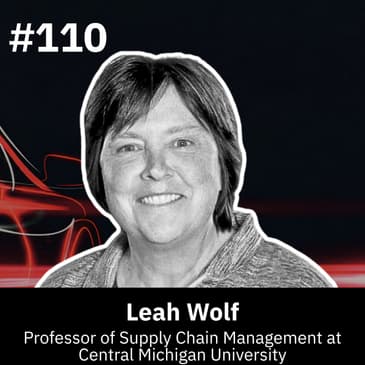
The automotive industry spends a lot of time talking about supply chains, but not nearly enough time talking about the people who make them work.
In this episode of the Auto Supply Chain Champions Podcast, Jan Griffiths and Tom Roberts are joined by Leah Wolf, retired General Motors supply chain executive and professor at Central Michigan University, for a conversation about one of the industry's most important and often overlooked challenges: developing the next generation of supply chain talent.
After spending 33 years leading supply chain operations at General Motors, Leah now brings real-world experience into the classroom, helping students bridge the gap between theory and execution. From case competitions and plant tours to supplier strategy and inventory management, she shares how universities can prepare students for the realities of today's manufacturing environment.
The conversation explores how the skills required for supply chain success are evolving. Technical knowledge remains important, but leadership, teamwork, adaptability, and problem-solving skills continue to set great supply chain professionals apart from the rest. As AI and automation reshape the industry, Leah and Tom discuss why technology will amplify human capability rather than replace it.
This conversation challenges supply chain leaders to rethink their talent pipeline. The organizations that build strong partnerships with universities, invest in experiential learning, and engage future talent early will be better positioned to navigate disruption and lead the next era of automotive supply chain excellence.
Themes Discussed in This Episode
- Building the automotive supply chain talent pipeline
- Bridging academia and industry experience
- Why real-world learning matters in supply chain education
- The evolving role of AI in supply chain careers
- Leadership, teamwork, and problem-solving under pressure
- Developing future-ready supply chain professionals
- University partnerships and talent development strategies
This podcast is powered by QAD RedZone.
Featured Guest
Name: Leah Wolf
Title: Professor of Supply Chain Management, Central Michigan University; Retired General Motors Supply Chain Executive
About: Professor Leah Wolf spent 33 years with General Motors, primarily serving in global supply chain leadership roles across North America and Europe. Since retiring from GM in 2016, she has focused on developing the next generation of supply chain professionals, teaching graduate and undergraduate supply chain management courses at Central Michigan University and Wayne State University while bringing decades of real-world industry experience into the classroom.
Connect: LinkedIn
About Your Hosts
Jan Griffiths
Jan is the host and producer of the Auto Supply Chain Champions Podcast and The Automotive Leaders Podcast. A former automotive manufacturing and supply chain executive, Jan is recognized as a Champion for Culture Change in the automotive industry. She brings direct, grounded conversations to leaders navigating execution, disruption, and transformation across the global automotive ecosystem.
Tom Roberts (Co-host)
Tom is Co-host of the Auto Supply Chain Champions Podcast and Vice President of Strategic Industry Development at QAD. He works closely with automotive and industrial manufacturers to close the gap between insight and execution, helping leaders move from visibility to systems of action that drive real operational outcomes.
Episode Highlights
[02:43] From the Plant Floor to Global Supply Chain: Leah reflects on her 33-year career at General Motors, beginning as a production supervisor and eventually leading supply chain operations across multiple countries and cultures.
[04:28] Learning Beyond the Classroom: Students gain hands-on experience through case competitions, trade shows, plant tours, and real-world consulting projects before entering the workforce.
[08:53] The Total Enterprise Cost Lesson: Jan and Leah discuss why great supply chain decisions require balancing piece price, inventory, logistics, quality, and supplier relationships rather than focusing on a single metric.
[12:19] Teaching Real-World Problem Solving: Leah explains how she challenges students with current supply chain issues and forces them to think through implementation, execution, and business outcomes.
[14:22] Making Supply Chain Exciting: Plant tours, warehouse visits, and real manufacturing environments help students understand the fast-paced and dynamic nature of supply chain careers.
[18:28] The Skills That Never Go Out of Style: A sense of urgency, leadership, transparency, teamwork, and strong interpersonal relationships remain foundational skills for supply chain success.
[19:46] The Blackout That Tested a Team: Leah shares a memorable story from the Northeast Blackout and how a highly engaged team found creative ways to keep production running.
[22:31] Why AI Changes the Game: Tom and Leah explore how AI, automation, predictive analytics, and risk mapping are transforming supply chain operations and decision-making.
[25:01] Preparing Students for an AI-Powered Future: Students are increasingly exposed to AI applications that automate routine processes and help supply chain professionals make faster, more informed decisions.
[26:55] Building a Stronger Talent Pipeline: Leah encourages supply chain leaders to engage with universities early, support internships and experiential learning, and build relationships with future talent before graduation.
Top Quotes
[10:23] Leah Wolf: “Total enterprise cost is key, and I teach that all day long. You've got to run the numbers, and you've got to do the business case.”
[15:18] Leah Wolf: "I would go into work every day thinking I've seen it all. And then, I'd go to work the next day, and something else that I'd never even dreamed would've happened would've happened. "
[24:47] Leah Wolf: "Everything you just mentioned, I've done manually, and it's very difficult, and sometimes you can't get all the answers, and maybe until it's too late. But with AI, it's going to change all that. It's just gonna be amazing."
Follow the Auto Supply Chain Champions Podcast for real conversations with leaders who are making hard choices, focusing their bets, and leading with intent.
🎧 Follow the podcast:
🔗 Learn more about QAD Redzone: https://www.qad.com/
[Transcript]
[00:00:00] Jan Griffiths: This is the Auto Supply Chain Champions Podcast. We are on a mission to bring you real conversations with the leaders who are transforming supply chains in the automotive sector. These leaders are true champions of manufacturing, and we're here to share their stories. I'm Jan Griffiths, your host and producer, and I'm joined by my co-host, Tom Roberts, Vice President of Strategic Industry Development at QAD.
[00:00:30] Tom Roberts: Great to be here, Jan. What I see every day is simple: manufacturers don't have a data problem, they've got an execution problem. This show is about how artificial intelligence, systems of action, and empowered teams can help close that gap.
[00:00:45] Jan Griffiths: Let's get into it. This podcast is powered by QAD RedZone.
Hello, and welcome to another episode of the Auto Supply Chain Champions podcast. Let's check in with my co-host, Tom Roberts. Hey, Tom, how are you?
[00:01:08] Tom Roberts: Doing well, Jan. Looking forward to today's episode. I have a vested interest in this as I have a child that is in supply chain, and went through the program. So I'm very happy to be part of the podcast today guest.
[00:01:23] Jan Griffiths: Yeah, me too. My daughter has just taken her first full-time role, and she is in the automotive industry, but she's not in supply chain proper. But she's certainly getting to understand supply chain, that's for sure. But it's tough out there, Tom. You know, graduates have a very difficult time landing jobs now.
[00:01:42] Tom Roberts: Absolutely, but I will talk about something I think that one of the universities in question today did that was a positive for today's graduates. But yeah, it's tough. I mean, you have AI coming on. Is there automation? Or are there gonna be jobs available? Those are all things that we'll talk about.
[00:01:59] Jan Griffiths: Well, we often talk about the materials supply chain, and today we're gonna talk about the talent supply chain or the talent pipeline. And that's why it gives me great pleasure to bring onto the show Leah Wolf. Leah is a retired GM supply chain executive, but she has been spending quite a bit of time as an educator at CMU, so she has crossed the world of being a practitioner into the world of academia, and I have learned that they are two very different worlds. Leah, welcome to the show.
[00:02:38] Leah Wolf: Thank you very much. I enjoyed being here.
[00:02:41] Jan Griffiths: Great. Tell us a little bit about your background, Leah.
[00:02:43] Leah Wolf: So, I was with General Motors for 33 years. I started at 19 years old in 1983 as a production supervisor, so I think everyone can imagine what that might have been like, but progressed through spending most of my time in global supply chain, and I lived in Canada for three years, Mexico for two years, Germany and Poland for a couple years, and spent my time in various places in the United States. So, I've been in a lot of different places and seen a lot of different things, as you can imagine.
[00:03:19] Jan Griffiths: So then, what happened after your career at GM? How did you end up in the world of academia?
[00:03:24] Leah Wolf: Yeah, so teaching was always something I was interested in in the back of my mind. And so, a year before I retired, I started teaching some classes at Wayne State. And General Motors had a very tight relationship with Wayne State because we championed the global supply chain competitions there. So, we provided real world situations for the competition cases. And so, that's when I started teaching at Wayne State and then ultimately got to CMU full time, and taught online at Wayne State. It got a little crazy for a while, but I was used to the time spent. Supply chain is a 24/7 gig anyway, so.
[00:04:07] Tom Roberts: It is. Leah, you're teaching the next generation of supply chain professionals at CMU. And as I said, I have a vested interest as one of my sons actually went through the program and you were one of his professors.
[00:04:15] Leah Wolf: Yes, I was
[00:04:15] Tom Roberts: What does a typical student in your program look like? And what originally drew them to supply chain?
[00:04:28] Leah Wolf: The students I get have, they're in their last year, so I teach mostly the graduate level classes, and they're in their last year of getting their supply chain major. And by that point, they have had the opportunity to be part of the Supply Chain Management Association at CMU. They've had the opportunity to participate in case competitions like the one I mentioned at Wayne State University. We go to that one every year.
We offer the MODEX and the ProMat trade shows for visit. We have plant tour visits that we take our students on. And the Logistics Management Council, we work, like, with Gordon Food Services for an example, and we help them with projects. So, last year we helped them with an analysis of where is the best place in the US for their next distribution center. And the year prior, we worked on a freight conversion project where they're go to collect the prepay and what was the best way to go.
And so, by the time I get them, they've had their toes in the water, and they are either really super excited because of some of these experiences that they've had, or they're just kind of waiting to graduate to see what happens. So, the ones that are super excited, they have a feel for it, and so now I have the opportunity to teach them the material in a way where I can provide examples.
So, everything I teach within-- I mean, it's all in my mind because I did it for 33 years. I can come up with an example of why this is so important.
[00:06:12] Tom Roberts: Absolutely.
[00:06:13] Leah Wolf: For example, the purchasing strategies class, why is supplier relationships so important? And so, I can give examples of why that is. And the same thing with inventory materials management, why is lowering your inventory so important? It's because it's so expensive to have inventory.
And then, I'll even offer personal examples, like if you have $100 a month and paper's on sale, are you gonna buy $100 worth of paper? Well, if you do, then you can't go out and have a beer or two 'cause all your money is tied up. And so, with companies it's the same thing. If you tie up all your money in inventory, then you can't go do R&D. You can't go buy the latest tech equipment. You can't hire experts 'cause you have your money. So, those are some of the examples that I can give them
[00:07:06] Tom Roberts: It's funny that you bring that up because I have talked to a number of suppliers where somebody gets a volume discount on something and they buy too much, and they have to hold the inventory for a while. They have to hold excess inventory and trade working capital is affected but they got a great deal. They got a great deal on some commodity I've heard of from a couple of folks.
[00:07:24] Leah Wolf: We actually do, in one of my classes, the inventory materials management class, we actually go through an example of which way should this supplier go. They get a 2% discount, and so what should they do? And we go through the actual example. And so then they have to make a decision. Okay, what? Do you think it's worth it? So, do you have to buy square footage to be able to house this extra material? Do you need the money for something else? We actually go through those examples. And the real problem is though, that's paired with you can't run production out of inventory. So, you don't want too much, but you gotta have enough.
[00:08:05] Tom Roberts: Right, you can't have a stockout, but you don't wanna have excess inventory and high-lows driving all over and then your insurance costs are going through the roof, and footprint and the whole thing.
[00:08:15] Leah Wolf: So, from an operations standpoint, that's the biggest conundrum that you have as a supply chain director. You have to keep your inventory low, but you can't run the plant out, and it gets ugly both ways. But I also tell them, it gets a whole lot uglier if it's a stock-out and you're not on the other side of too much inventory.
[00:08:35] Tom Roberts: Yes, and that number goes up every year, is it $50,000 a minute? Is it $100,000 a minute for, you know, if you shut down an OEM?
[00:08:43] Leah Wolf: It's expensive. It's very expensive, yes.
[00:08:47] Jan Griffiths: Okay, well, since we're going down this rabbit hole, let's go down the rabbit hole.
[00:08:52] Leah Wolf: Let's do it.
[00:08:53] Jan Griffiths: I was at the Wayne State case competition earlier this year, and one of the questions I asked the finalists, and they went through the analysis, and they made the right business decision, and they're looking at inventory, and they're looking at the piece price, and they're balancing it all out, and they're doing all the right things. And then I said to them at the end, and this was cruel, but I did it. I said, okay, so now here comes a new director that you're reporting to, and you are going to be measured on PPV, on Purchase Price Variance. You're not measured on inventory. You're measured on PPV."
[00:09:32] Tom Roberts: Right, and paid a bonus maybe.
[00:09:35] Jan Griffiths: You're gonna get a bonus on PPV. Now, are you still gonna make the same decision? And they hesitated, 'cause that's a heck of a thing to throw at somebody who's never been in the workforce before, right?
[00:09:49] Leah Wolf: Yes.
[00:09:51] Jan Griffiths: You know what warmed my heart? You're gonna love this, Leah. They all said that they would make the right business decision, the decision that they'd made before they knew that. Now, when they walk into the working world and they hit the reality of that, it might be a different story.
[00:10:05] Tom Roberts: And they got kids across the table that they're feeding.
[00:10:08] Jan Griffiths: But the initial gut reaction and the intention was to do the right thing for the business, which is a total acquisition cost decision. But all of my career, Leah, everybody talks total acquisition cost, nobody does it, really.
[00:10:23] Leah Wolf: Total enterprise cost is key, and I teach that all day long. You gotta run the numbers, and you gotta do the business case. So, in the '90s at General Motors, we had a purchasing VP, his name was Ignacio Lopez. And so, I was there at the time, so I saw it, I lived it. But as we all know, his focus was on piece price, and he didn't care about anything else. He didn't care about quality. He didn't care about logistics cost. He didn't care about supplier relationships. And sure, they saved a ton of money on piece price, but guess what happened to logistics cost? They went completely out of control. The quality was degraded significantly. And I think he lasted a couple of years. And that's just to pass this on, this detailed story on, that I got to live and see and tell them how important total enterprise cost is.
Packaging, if it's in China and it has to go to the US, you're spending a lot more on packaging because you have to maintain the quality of that piece versus if it was five minutes away. You're gonna package it a whole lot different. Logistics, clearly one of the biggest expenses, but it's everything. And then, supplier relations, I can't emphasize enough how important that is.
[00:11:47] Jan Griffiths: Now, Leah, I'm gonna pull us back out of that rabbit hole now, 'cause now that I put us in it, I'm gonna bring us back out of it. But Leah, we've been talking to you a lot about real world, right? Real world experiences. But how do you prepare students for that? I mean, it's one thing to teach them total enterprise cost, but then when they get into the real world and they're faced with the PPV and all these other things, and the pressures from other departments, how do you prepare them to survive in the automotive industry, in the culture that we have right now?
[00:12:19] Leah Wolf: Probably the biggest thing I do in my purchasing strategies class, I do not use a textbook. And that's the class that Tom helps me out in every single year. And so every week, I put them into groups, four or five per team, and every week I give them a problem that they have to go research on their own.
So, cybersecurity might be one week. The latest trends in supply chain processes. The latest trends in inventory management. And I have it all laid out for the entire semester and they have to spend time. And I have very specific questions, it's like, "Okay, here's the issue. Now, if you were in this situation, what would you do about it based on these trends? But not only that, how would you execute it? How would you implement it? And then what would be your intended results?"
And then, when we have class, we go through each team, and I can help them talk through, okay, that implementation schedule, that's not gonna work, and here's why. So, let's talk about something that will, and let's do it together. So, I'm gonna tell you why that won't work. Now, you help tell me what you would do differently based on why I told you it wouldn't work. And so, I make them think through the answers to all these different situations that hit supply chain now, not 20 years ago, but now.
[00:13:48] Tom Roberts: Awesome. So, Leah, a question for you. So, I know that tech and finance, or so supply chain doesn't always have the 'wow' factor, the cool factor that maybe tech and finance does, and people don't always know exactly what they're talking, you know, they don't know exactly what it is, if you're talking to somebody who isn't in manufacturing and supply chain. These are really good paying jobs, and there's a lot of them out there. How do you get the next generation knowledgeable and interested in that? You see this new generation, are we getting them prepared? Are they ready? And how do we get more people interested?
[00:14:22] Leah Wolf: I think it's getting them into the environment. So, these plant tours, getting them to see Ryder, a Ryder facility. Last semester, we got them into Lansing Delta Township Assembly, which is I was a supply chain director that built that plant. And then when they come back from those tours, they are full of so many questions. And I think that's one of the biggest ways to make it happen.
And so, then the next layer of question is how do you get them interested in going on those tours? And I think the way in is you talk to them about the environment. It's a fast-paced environment. You're on 24/7. There's lots going on. I tell students, and this is true, I would go into work every day thinking I've seen it all. And then, I go to work the next day and something else that I've never even dreamed would've happened would've happened. And there's a lot of students today that they're thinking about, Do I wanna be bored at work? Is the job I'm gonna get when I leave this university gonna be repetitive? And am I gonna be doing the same Excel spreadsheets sitting at a desk all day long? And is that what I want in my life, or do I wanna, do I wanna thrive in this connection and motion environment? And you'll hit the passion meters of those students that don't wanna sit at a desk all day.
[00:15:52] Tom Roberts: Yeah. It's funny, years ago when I was kind of analyst level, I remember asking somebody who was a friend of my brother, and this person's career was skyrocketing. He was an executive, and It was a mystery. I was like, "What do you do all day?" And he looked at me and he said, "Tom, I look at spreadsheets, and I go to meetings and say reasonably obvious things." I think, I think the next generation.
[00:16:18] Jan Griffiths: That's brilliant. I love that
[00:16:20] Tom Roberts: Yeah, it stuck with me. And I know, and I hear it from my own kids, they want a job where they're doing the cerebral work, and they're walking around something like a plant, something like a facility, and there's a mix of tactile things and cerebral things. And that's a great point, Leah, is earlier in my career, now in my career, there's no better day than when I'm in a plant.
[00:16:45] Leah Wolf: Oh my God, I love it.
[00:16:47] Tom Roberts: When we visit a customer and I see whether it's injection molding or assembly or whatever it is, there's nothing like getting into a plant and actually seeing, okay, this, it grounds you, right? It reminds you.
[00:16:56] Leah Wolf: It does.
[00:16:57] Tom Roberts: It's not just ones and zeros and transactions. It's this is where it all happens. You see the high/low move by and the whole thing is, it's grounding. It's a grounding experience.
[00:17:08] Leah Wolf: Yeah, so the other thing I do to that point, I bring in videos of plants. And so, I have a video of Lansing Delta Township, which, you know, was easier for me to do, but I'll spend hours going online, and I'll look for warehouses. Like, there's high bay racking warehouses. Coca-Cola has an amazing one in Spain, and it's like a 10-minute video, and you can show them all the automation, and then I can stop the video, and I can say, "Okay, now see on the dock how the fork truck has to go over the dock plate? And if you, if you cube it 100%, you're gonna tear out the ceilings. So, you can never cube a 100%, but if you can get to 95% or even 90%, you're doing pretty good, but that's just an example. But all the conveyors and the warehouses, like, I can stop, and I can talk about storage, and I can talk about material movement inside a facility. And so, I do a lot of videos like that. And then, bringing in guest speakers I think are so good because they don't have to just believe me when they hear it from somebody else. Yeah, clearly, I'm a good source and I'm credible, but hearing it from more and more people the exact same thing, it just makes them like, wow, wow, this is really the way she says it is, so.
[00:18:28] Jan Griffiths: No, I love that. Now, tell us about the skill set that we needed in supply chain five years ago even is different to the skill set that we need today. How do you see that skill set evolving?
[00:18:41] Leah Wolf: Yeah, so I'll start with one of the first things I was told at General Motors in 1983, and that was having a sense of urgency, and I don't think that's gone away. Always having that sense of urgency of doing everything you can now because you don't know what's gonna pop up in the future. So you can minimize your risk by getting rid of all the known risk, and then now you have time to deal with unknown risk, right? So, that would be one thing I would say.
Another is the interpersonal relationships to build a strong team. There's no one person that can do it all, and if you don't have a strong team and if you don't have the leadership skills that with the transparency and integrity to build that team, it's gonna be tough. I mean, it's tough with a good team, and I'll give you an example. So, when I was at Lake Orion, and I built pretty good teams, but when I was at Lake Orion, we had the Northeast Blackout, if you remember that.
[00:19:46] Tom Roberts: I do.
[00:19:46] Leah Wolf: I had the whole plant covered except for one part, and it was stuck in a truck at the Canadian border. And of course, we told everybody not to go through Canada, but you know that one person that doesn't listen. We told them to go around Ohio. And so, we're stuck at the Canadian border, and so I say to my team, I say, I got them all together and I said, "Okay, here's the deal. First of all, we're not shutting this plant down. We're gonna figure this out. That's number one. Number two, I'm gonna go to Dunham's and I'm gonna buy every single wetsuit they have, and we're gonna go to Port Huron, and we're gonna get the truck down to the river, and we're gonna swim across, and we're gonna get the parts and have a truck on the other side. And that's how we're gonna get the parts. And so, while I'm gone, you guys are more than welcome to come up with a better idea." And they all just looked at me like, "She's crazy enough to do that." So, but the team, they did come up with a ferry. They were able to procure a ferry. They were able to get the truck on the Canadian side down to the river, and we had a truck on the other side, and we did not shut that plant down. Now, that's a strong team that doesn't just walk out and say, "Oh, well." You know.
[00:21:04] Tom Roberts: No parts. Let's go home. Yeah.
[00:21:06] Leah Wolf: They figured it out and they worked together, but you can't do those things without a strong team.
[00:21:11] Tom Roberts: Right. And I don't think people who are not, I think people who are not in automotive don't always realize there are stories of chartering triple sevens from Shanghai to Detroit to get parts, or people flying helicopters from one plant to another to give parts, or a guy throwing four seats in a truck to drive it to the plant to make sure that they're right in sequence. These things hang on the razor wire sometimes in automotive and or you can shut the whole thing down.
[00:21:45] Leah Wolf: I've done it all. We've done the seat.
[00:21:48] Tom Roberts: You got some helicopters at Delta?
[00:21:49] Leah Wolf: Got, I got a helicopter at Lake Orion. We cleared the dock and got a helicopter there for some brackets from the body shop. We got some C9s out of China. In Orion, or in Oshawa, I had a supplier that was only a mile away that we needed door pads, and for 45 minutes they said they were on the way, and it was a half mile away, and I'm like, "Screw this." I got my truck and I ran over there and threw them on the back of my truck, and we got the plant running, so yeah.
[00:22:19] Tom Roberts: Exactly.
[00:22:20] Leah Wolf: Yes.
[00:22:22] Jan Griffiths: Now, those are all, all great skill sets and yes, needed, much needed. Tom, what's your thought about the skill set more on the tech side? 'Cause I think we need a mix of both, right?
[00:22:31] Tom Roberts: Absolutely. So, this is where Leah and I met. So again, I mentioned my son went through the program at Central. He was a dual major in logistics management and I think purchasing and supply chain, if I'm not mistaken. And I think James had talked to Leah, and Leah had asked me as in my role, could I come in and talk to the class about technology in purchasing and so forth. And there is a massive sea change in what's available in technology from what there was just a few years ago.
[00:23:01] Leah Wolf: Exactly.
[00:23:01] Tom Roberts: Things that we would have dreamt about ten years ago, now you can automate steps in the sourcing process. Now you can automate steps in the procurement after you've executed the PO and you need to do changes in quantities or dates and so forth, you can automate from the communication coming in even an email and to extract from the email and then execute in the ERP system.
So, lots of different things that have happened. There's geopolitical risk mapping, where you look at your supply chain, you know where your POs, where the supplier sending locations are, you know the routes they're taking. So, is there a flood? Is there a earthquake? Is there a Strait of Hormuz issue? You can find everything that's going through the Strait of Hormuz, for example, and also try to get exactly the amount which suppliers, the valuation of the cargo, all of those things.
And those technologies are readily available now. Certainly in the products that we have available at QAD. Those are the kinds of things I was able to talk to Leah's students about is, hey, here's all the new things that weren't even really there a few years ago: the automation, the data, the analysis, the capabilities around that.
[00:24:14] Jan Griffiths: Yeah, I could see how the two of you would make a great team. Leah, with all the school of hard knocks, as we used to say, experience. And you, Tom, with all the technical fluency and what's required, how the two of you would make an incredible team for a supply chain student.
[00:24:30] Tom Roberts: It was a great experience for me. It was a great experience for me to talk to the class.
[00:24:34] Leah Wolf: And it was invaluable for the students. I mean, when we talked the next class period, they're like, "Oh my gosh, I had no idea that AI could take commands from a text." And so, just for them to see how it applies, which I wouldn't have that knowledge. So, being able to reach out to Tom to come into the classroom has just really enhanced the education of the students at CMU, 100%.
[00:25:01] Tom Roberts: So, once in a while, GM or an OEM might change their demand, if you can imagine.
[00:25:07] Leah Wolf: Yes.
[00:25:07] Tom Roberts: Last minute.
[00:25:07] Leah Wolf: Really? That happens?
[00:25:10] Tom Roberts: It's a little difficult for the suppliers to deal with sometimes. So, you know, looking at AI around those demand signals and how can you look at the historical demand, can you make predictions on it? Can you match it against all your POs and all the inventory levels and see if you have the right things on hand, or do you need to execute some kind of premium freight or something to move on something? So, you have AI applied to that.
There's things that are being looked at around if a supplier has say a commodity contract where they can get recovery from an OEM. Say that there's a copper contract or wiring harnesses or steel or foam chemicals. So now, it's much easier to get to the data to actually find out, hey, did I have an amount of commodity that was subject to favorability where I can go and ask ACME, OEM, "Can you give me back money for the quarter 'cause the index went up for MEPS or London Metals Exchange or ISIS or whatever it might be?" So yeah, there's just a lot more tech. A lot more tech out there, a lot more tools, so people aren't running reports and putting together spreadsheets as much.
[00:26:15] Leah Wolf: Everything you just mentioned, I've done manually, and it's very difficult and sometimes you can't get all the answers and maybe until it's too late. But with AI, it's gonna change all that. It's just gonna be amazing.
[00:26:29] Tom Roberts: If invite me back, I will show some of those simulations to your class in the fall.
[00:26:34] Leah Wolf: You are considered invited back for the rest of my career.
[00:26:40] Jan Griffiths: Now, before we close today, Leah, tell me, what advice would you have for supply chain leaders out there who are concerned about building their talent pipeline in supply chain, things that they need to think about?
[00:26:55] Leah Wolf: I think they need to really focus on staying in touch with universities that have strong supply chain programs. So clearly, I'm gonna advocate for CMU, but I also know Wayne State has a very good program and so does Michigan State. And so, by staying in touch with those schools and getting more integrated into their programs prior to graduation, then they're gonna have the opportunity to get the best talent. So, that would be my recommendation, and that's what I would be doing if I was still a Supply Chain Director at General Motors.
[00:27:33] Jan Griffiths: I agree with that, and having gone through the case competition at Wayne State earlier this year, if that isn't a great place to pick the talent, I don't know what is, 'cause I could tell you straight away from that case competition who I would hire and who I wouldn't.
[00:27:48] Leah Wolf: 100%. There's a perfect example of another place to go, but getting more fully integrated, not just to graduation when you have the career fairs, but get down into their programs, get into their juniors and seniors and do these tours and advocate, internships, and I think that's the best way they're gonna find the best talent.
[00:28:09] Tom Roberts: Yeah, and I think these universities specifically, and I can definitely talk about Central, and I'm gonna call out Mark Spieles.
[00:28:17] Leah Wolf: He's great.
[00:28:18] Tom Roberts: In the Supply Chain Management Association. My son showed me the spreadsheet after spreadsheet after spreadsheet of jobs that Central alumni had arranged with Mark to send to the students who were looking for entry-level jobs.
[00:28:35] Jan Griffiths: Wow, that's impressive.
[00:28:38] Tom Roberts: Yes, and if you were in the supply chain management program, you would be the recipient of those things, and that's exactly how my son got hired at where he is. So, I saw that action of advocating and doing a lot of work to get those kids jobs.
[00:28:52] Leah Wolf: CMU does an amazing job getting students full-time employment upon graduation, and they do start earlier. They start certainly at the junior year, and if you're a sophomore and want to get involved in some of these plant tours and the CSMA, which is Supply Chain Management Association. There's guest speakers, there's activities, there's trade shows they can go to and start doing all that networking activity. Yeah, CMU does a really good job, I have to admit.
[00:29:24] Jan Griffiths: Okay. Well, that's great. And Leah, thank you so much for joining us today. It's great to have you on, and please keep doing what you're doing to help get young people excited and trained in supply chain.
[00:29:36] Leah Wolf: I'm on it. Thank you so much for having me.
[00:29:40] Tom Roberts: Thank you.
[00:29:41] Jan Griffiths: We wanna hear from you, our listener. Tell us what are your challenges right now? What conversations do you want to hear across the airwaves on this podcast? Drop us a comment on our podcast website. The link is in the show notes.