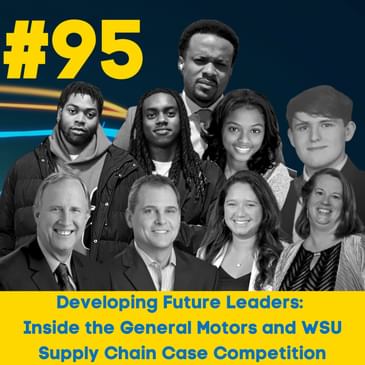
Every strong supply chain starts with strong talent, and at Wayne State University, that’s exactly what’s being built. This episode takes listeners inside the General Motors and Wayne State Supply Chain Case Competition, where students from across the country step into real-world challenges and learn what it takes to lead the industry’s future.
The conversation opens with Lori Sisk from Wayne State University, who introduces the FAST Program (Future Advantage Supply Chain Training), a groundbreaking initiative designed to expose Detroit high school students to the world of supply chain management long before college.
Lori explains how the program combines classroom learning with hands-on experience, allowing students to graduate with a certificate in supply chain and a clearer path toward college or immediate industry work. She’s joined by two standout students from the program, Malik and Jeffrey, whose stories bring the program’s impact to life.
Jeffrey recalls how little he knew about supply chain before joining, but after a summer internship with WF Whelan, he found himself fascinated by the behind-the-scenes logistics that keep goods moving.
Malik adds that what surprised him most was how many steps it takes to make something as simple as a roll of tissue. He says that getting hands-on at each stage gave him a new appreciation for the complexity and teamwork involved in manufacturing. Both now see supply chain not just as a career option, but as a field full of opportunity and purpose.
Then comes Chris, a graduate of the Automotive Supply Chain Immersion Program (ASCIP), a 20-week course co-led by AIAG and Wayne State. For him, the program went far beyond the classroom. It provided him with direct access to industry leaders, real-world learning experiences, and a network of mentors who helped him view the supply chain from an entirely new perspective.
The focus shifts to the General Motors and Wayne State Supply Chain Case Competition itself, with GM’s Bill Hurles and Dave Leich. They recount how the program began in 2011, shortly after GM’s bankruptcy, as a way to strengthen the industry’s talent pipeline. What started as a small idea has now evolved into a global event, drawing universities from across North America, Mexico, and beyond.
Student competitors Danielle Griffin and Daniel Kuzniar then share their perspective on tackling this year’s case, focused on EV adapter sourcing for GM’s Factory Zero. They explain how teamwork, diverse expertise, and late-night preparation sessions helped them stay composed under pressure.
Finally, Lori Sisk and GM’s Christina Meredith take listeners behind the scenes of organizing the event. From coordinating sponsors to creating an unforgettable Detroit experience, their shared goal is clear: showcase the city, connect students to industry, and grow the future of manufacturing talent.
Themes discussed in this episode:
- The FAST Program’s role in introducing Detroit high school students to real-world supply chain experience
- The role of Wayne State University in developing the next generation of supply chain professionals
- How partnerships between universities and industry leaders like GM strengthen the talent pipeline
- The value of the AIAG–Wayne State Automotive Supply Chain Immersion Program in advancing professional growth
- How case competitions prepare students to solve real industry challenges with creativity and collaboration
- How industry-university partnerships help Detroit remain a global hub for supply chain education and manufacturing growth
- The case competition’s lasting impact on students, sponsors, and educators as they collaborate to strengthen the supply chain community
Featured guests:
Name: Lori Sisk
Title: Assistant Professor, Wayne State University
Discussed: [01:14] Talks about launching the FAST Program (Future Advantage Supply Chain Training) to introduce Detroit high school students to supply chain careers through real-world learning and industry exposure.
Name: Malik and Jeffrey
Title: FAST Program Students, Southeastern High School
Discussed: [02:25] Describe how the program helped them understand how products move, how teamwork drives operations, and how their internship experience at WF Whelan inspired them to pursue careers in supply chain.
Name: Chris Rochon
Title: Student, AIAG–Wayne State Automotive Supply Chain Immersion Program (ASCIP)
Discussed: [07:53] Shares how the 20-week immersion program deepened his understanding of real supply chain challenges and gave him access to industry leaders who shaped his professional growth.
Name: Bill Hurles and Dave Leich
Title: Former Executive Director of Supply Chain and Executive Director, Supply Chain, General Motors
Discussed: [11:39] Explain how the GM & Wayne State Case Competition began in 2011 and how it continues to challenge students to solve real GM supply chain problems through creativity, collaboration, and practical thinking.
Name: Danielle Griffin and Daniel Kuzniar
Title: Students, Wayne State University
Discussed: [21:16] Talk about competing in this year’s case focused on sourcing EV adapters for GM’s Factory Zero. They share how teamwork, time management, and confidence helped them deliver under pressure.
Name: Lori Sisk and Christina Meredith
Title: Event Organizers, Wayne State University and General Motors
Discussed: [00:00] Detail how the competition comes together each year, from securing sponsors and writing cases to creating a world-class student experience that highlights Detroit’s role in developing future industry leaders.
[Transcript]
[00:00:00] Jan Griffiths: This is the Auto Supply Chain Prophets podcast, and we are on a mission to bring you the latest insights and thought leaders leading the charge on supply chain transformation in our beloved automotive industry. This podcast is powered by QAD and AIAG. I'm Jan Griffiths, your host and producer. Let's meet your co-hosts.
[00:00:27] Jim Liegghio: I'm Jim Liegghio from AIAG.
[00:00:29] Terry Onica: I'm Terry Onica from QAD. Let's dive in.
[00:00:36] Jan Griffiths: Hello, and welcome to another episode of the Auto Supply Chain Prophets podcast. Today, we are live recording from Wayne State University, and you know that we often talk about supply chain topics, but what about talent supply chain? And what about getting students, even before they hit Wayne State, excited about supply chain. Today, we are gonna be talking to two students from the Detroit Public School Community District. And here to tell us all about the program is Lori Sisk from Wayne State.
[00:01:14] Lori Sisk: Hi, so we decided to start a FAST program in Detroit and we gathered some friends to help us start this program. FAST is Future Advantage Supply Chain Training Program, and the intent here is to get the high school students to learn about supply chain, and to actually have an experience in supply chain and graduate with a certificate in supply chain. So this will enable them to go further on into their studies in college or start straight out of the high school and go and work in a supply chain arena. Whether it's at a company or within a logistics organization, whatever that may be. Today, I have with me two of our three students who started this pilot program, Malik and Jeffrey, and unfortunately, one of our students could not be here, and her name is Lakora. So, I'm very excited for you to meet them today. And I am just so impressed with these young students and look forward to their future, and I hope someday you get to meet them as well.
[00:02:24] Jan Griffiths: So, let's meet the students. Jeffrey, tell us about yourself.
[00:02:29] Jeffrey: Hey, I'm Jeffrey from Southeastern 12th Grade, graduating very soon, and to the right of me is my classmate, Malik.
[00:02:38] Malik: Hi, my name is Malik. I also go to Southeastern and this is my senior year and I'm excited to graduate this year or next year, I should say.
[00:02:45] Terry Onica: So, both these students are in the middle of the program. It started last year and they did an internship over the summer and they just recently started back up. So, Jeffrey, can you tell me what you've enjoyed the most about the FAST Program?
[00:02:59] Jeffrey: What I enjoyed the most about the FAST Program is getting to learn about the FAST program. At first, I really didn't know what I was getting into, but as it keep going, I actually like the program. I enjoyed everything and, as you said, the WF Whelan job, I enjoyed that too. I enjoyed the whole experience in itself.
[00:03:16] Terry Onica: Great. Malik?
[00:03:17] Malik: What I enjoyed the most about the FAST program is that they actually took the time out to come to our school and actually teach us each step that's in supply chain. Like it's so many steps that's in it, I couldn't believe it was that many steps that actually go into making like a roll of tissue. I actually enjoyed learning all the steps and everything that went into making little things.
[00:03:40] Terry Onica: That's awesome. So, you had mentioned, Jeffrey, that you did an internship, both of you and Malik, were part of an internship, and Lakora as well. So, Jeffrey, what did you enjoy the most about the experience of working at WF Whelan as an internship over the summer?
[00:03:56] Jeffrey: What I enjoyed the most was probably the quality room. It's probably getting to markdown the products and seeing if anything is wrong with them. And also, just getting to meet everybody that was on the floor, Lindsey, Nico, getting to meet them. And Lindsey, she's teaching us about the paperwork, how you gotta do that, and just everything.
[00:04:14] Terry Onica: Great. Malik, how about you?
[00:04:17] Malik: I enjoyed the hands-on work, like we was actually able to get hands-on in each step, 'cause it's each compartment's at the logistics company. So we was actually able to get hands on, like going to sales, the quality room, shipping, processing. I enjoy the hands-on work, 'cause I feel if you get hands-on, you'll be able to learn what you're doing better and you'll actually have a better understanding of what's going on.
[00:04:42] Terry Onica: And we were so grateful, Lori, aren't we? For WF Whelan to offer these students an internship and it, at the very end, they had to go present to everybody and it was really amazing. And I have to commend all three of you just awesome job. I'm not a mother, but I'm telling you in the back as they were presenting you, I was like, almost like tearing. When they presented what they had learned. It was just amazing. So, how has this program so far inspired you to consider a role in manufacturing or supply chain?
[00:05:13] Jeffrey: It inspired me a lot, like I said, I didn't know much about the program. And as I got in the program and started learning everything, and like Malik said, every step that it takes to getting tissue to point A to point B and everything, it just inspired me a lot. From the program, the internship, being here for my second year, it's just a lot. And then, I just know there's more to continue on. So, I definitely was trying to take this opportunity as far as it can go besides, after my 12th grade year.
[00:05:43] Terry Onica: That's awesome. Malik?
[00:05:46] Malik: So the program has helped me like wanna actually take this further because when I first heard of supply chain, I didn't think it was as big as it really is, 'cause it's global. And everything is supply chain, like the clothes on your back, everything. And since I've already started supply chain in the 11th grade, and I've already experienced so many things with it; the internship, the classes, the meetings. Actually being able to connect with bigger names. I kind of have like a jumpstart. So, if I was to take this to the higher level, I would know more than the average person, so I'd be able to put my skills really to use and be able to help the company.
[00:06:30] Terry Onica: And I can say, watching you all, you have all grown so much. I am very amazed at what you've accomplished just in the first year and at your internship. And I look forward to seeing what you're gonna do at the end of this year and being able to add this experience to your resume before you even graduate from high school. That's gonna be really awesome.
[00:06:50] Jan Griffiths: Yeah, and I remember Terry, after she had been to, I think, your presentations, she called me up and said, "Jan, I can't wait for you to meet these students." She was so excited. But really, here we are looking at the talent supply chain. The talent part of supply chain. And it's not just for products and services, we have to look at the people coming into supply chain. So congrats, Lori, to you, and not only to the students, but to everybody involved in the FAST program. And my question to you, to the audience is this: what are you doing to build your talent supply chain?
[00:07:29] Terry Onica: And our next future champions of manufacturing.
[00:07:32] Jan Griffiths: Our next future champions of manufacturing. Are you the next future champions of manufacturing, Jeffrey?
[00:07:38] Jeffrey: Of course.
[00:07:39] Jan Griffiths: Yes?
[00:07:39] Jeffrey: Of course.
[00:07:40] Jan Griffiths: Malik?
[00:07:40] Malik: Yes.
[00:07:41] Jan Griffiths: Yes.
[00:07:41] Malik: Proud to say it
[00:07:42] Jan Griffiths: Thank you for joining us today.
[00:07:44] Malik: Thank you for having me.
[00:07:44] Jeffrey: Thank you for having us.
[00:07:45] Lori Sisk: Thank you.
[00:07:47] Jim Liegghio: Auto Supply Chain Prophets on site, on location today at the Wayne State University, Mike Illit School of Business. And we have with us today a handful of students that are participating in the GM Case Competition, and we caught up with Chris Roshan, who's currently about to graduate from the AIAG Wayne State Program, known as ASCIP (Automotive Supply Chain Immersion Program.)
Chris, you're about to graduate from ASCIP, which is a 20-week intensive evening program at AIAG in conjunction with Wayne State University. What are your thoughts getting ready to graduate from that program?
[00:08:16] Chris: I'm excited. I love the program. The first day I got there, I met some amazing people. The kind of people that come through the door, I wouldn't imagine I would've met. And when I met 'em and I was able to pick they brains and ask certain questions, it actually filled certain gaps in the business that I have and actually gave me a better niche towards the direction I'm trying to go towards, and also being able to connect with 'em. And having that kind of access to actually say, "Hey, this is where we met," and having that pinpoint to jump off into further conversations, which I've done already too, to further, actually, to kinda further and nurture certain relationships and the direction that I'm going.
So, when I look at, the program and the value that is added within the last year in my life, in my business, you know, just like I told you like 90 days ago, I said, "Man, this is an amazing program and I don't think a lot of people know exactly or understand the real value of what you guys offer."
[00:09:19] Jim Liegghio: Yeah. We carefully chose that word immersion in the new titling of the program, 'cause it really gets you into supply chain. You're meeting executives and practitioners, folks that have kind of been in the trenches and you're gaining that experience by being immersed in their life stories and their experiences.
[00:09:33] Terry Onica: And Jim, how long has the program been on for now?
[00:09:35] Jim Liegghio: Yeah. So, Terry, we're going into the 13th year next year already for ASCIP. So, a couple little changes along the way, but for the most part, it's intact from its original inception and visualization. So yeah, 13th year. Lucky number 13th next year.
[00:09:47] Terry Onica: And did you know I was in the second, in your program?
[00:09:49] Jim Liegghio: Yes, I did hear that. Yeah.
[00:09:50] Terry Onica: Yes. And I agree, it's an amazing program. And one of the things I really like is that you just don't realize how broad supply chain is. I mean, how many different fields you can go into. And as I'm thinking to the students that were just on here today, I mean, you can go anywhere. Once you're in, you're in. And there's just so vast, I can't think of any other career that you could go into that you'd have so much opportunity.
[00:10:14] Jim Liegghio: Yeah, a hundred percent agree. Having had different roles within supply chain, you can go anywhere from here. So, Chris, what's one key takeaway you would say that you've learned throughout the program or one key value driver of this particular program that you wanna share with others?
[00:10:26] Chris: To actually take advantage of the people, take advantage of the opportunity that you guys bring into the program, because I think it's strategic and the people that you guys do bring. And if you actually pay attention to what these people, the speakers have to say, it may be able to help you along the lines of something you may have not asked yet. They may be someone that you can ask a certain question that could answer your question, and that's where I learned the tremendous value in. It is being able to ask questions that may be different from the people that I would deal with. But ask the people that's coming into this program to speak, and a lot of times they're like, "You know what? I never thought about that." "You know what? That's a different way of thinking about it." And they actually helped me along with that and just may add a seed to two and two and say, "Well, I put it just like this, and then look at it like that." And I'd be like, "Okay."
[00:11:21] Jim Liegghio: Well, thanks very much. There you have it folks. Join us in Lucky Number Year 13 for the ASCIP Program, March 12th, 2026. But we're taking applications now.
[00:11:29] Terry Onica: And Jim, go to the AIAG website to find out more about it.
[00:11:32] Jim Liegghio: Yep, just go to AIAG.org under Learning Pathways and you'll find the program there. Thanks, Chris.
[00:11:37] Chris: No problem.
[00:11:38] Jan Griffiths: And there's a lot of excitement going on here today we are at Wayne State because it is the GM-Wayne State Supply Chain Case Competition. And joining us today is the Godfather of the program, the one and only Bill Hurles, and also Dave Leich from General Motors. Gentlemen, welcome to the show.
[00:11:58] Dave Leich: Thank you. Excited to be here.
[00:12:00] Jan Griffiths: Bill, tell us a little bit about the history, the legacy behind this program.
[00:12:04] Bill Hurles: Sure. We started the competition in 2011. And to tell you a little bit of a story there, 'cause if you put it in context, at that period of time, General Motors had recently come out of bankruptcy. Auto industry had gone through the recession of 2009, 2010, and it was rapidly recovering. At the same time, we compounded some of our challenges by having the Japan earthquake and the tsunami. So right while we were in the crisis mode, I received a letter from Wayne State, from Dr. John Taylor, asking "Would GM like to be involved in a case competition?"
We didn't know what it was. At that time, I remember going, we need some time. We're in a crisis mode right now. Give us a couple months to reflect on this. Decide what is it gonna take? Why would we wanna do it? What's expected of the GM team? And so, we consensed with our group. In meeting with the Dr. John Taylor and some of his faculty at that time, we outlined what was needed.
And we felt, looking to the future, we could see where we were gonna be moving into a hiring mode. The volume was going up. We saw this as a great opportunity to learn what were the university's teaching in supply chain, 'cause you go back to 2011, the different curriculums, the maturity of the education was very limited.
So this really gave us a great opportunity to understand what is being taught at various universities around the country. So, we assembled a team, 'cause part of the role that we needed to play was to write the business case, and a team was assembled to write the first business case that was then given to the students. We had set the format. Wayne State had helped us define here's the process we want to use.
We agreed to host it here at the Marriott, the GM Grandstand. And so the first year went on. And since that point in time, the GM employees and the Wayne State employees really have enjoyed being part of it. From being judges, to writing the cases, to helping support the activity. And so, today, it's the 14th annual event and we're really proud, there's been over, I think, somewhere around 1100 students have now gone through the program and are, we'll say graduates of the supply chain competition. So, it's been an exciting journey.
[00:14:18] Jim Liegghio: It's a pretty incredible program, Bill And Dave. I've kind of seen it from afar over the last handful of years, and like you said, seeing the GM employees that were once students participating, coming back as writers and judges and that kind of thing. So that's very, very cool and very exciting to see that.
So it started out with real world problems, right? You guys were writing cases around real world issues. Is that still the case today? How are the cases developed today in today's climate? There's a lot going on, so how do you pick one, I guess is a another question there.
[00:14:42] Dave Leich: Yeah. I would say that the cases are very, very relevant in terms of what is happening within our company at the time. So typically, we're looking at real life problems, things that we have dealt with. It's not necessarily an open issue that we're looking for the students to solve. But it's based on real life things that have happened within the year. And certainly, there's lots of events that are happening around the world that gives us plenty of things to make real life examples for.
[00:15:12] Jim Liegghio: And what a unique opportunity for the students to kind of get a glimmer or a glimpse of that, what's going on or what has taken place in maybe in the past year or something. So, how many university students can really say, "Wow, this is practical, hands-on, real world stuff that I'm expected to come up with a solution to. And I'm being judged on that."
[00:15:28] Terry Onica: How many universities are involved in this program and how many teams do you have? Just approximately.
[00:15:33] Bill Hurles: Well, this year there's 20 universities here. We've gone up to 24. And the participation has been North America and global. In the past we've had teams from Brazil, from China, Poland, have participated in Mexico. And so, it's been diversified. We found that about 20 universities seem to be the right size. 24 was a little bit more demanding of the resources in the facilities and stuff like that. So right now, there's 20 universities right outside the room here getting ready for the finals here this afternoon.
[00:16:01] Jim Liegghio: Yeah, it's a huge deal. Walking in this morning, it just reminded me this is a big deal for everybody. For you guys, for the students, for the professors and faculty here at Wayne State, so we're just excited to be part of that today. That said, 20 teams, Bill and Dave, what are your expectations of the top five, top three teams. What does the exemplary team look like in the end for you guys?
[00:16:19] Dave Leich: Yeah, we can tag team this. Before we both get to, judge the finals here later today. So I think as with any supply chain issue or problem, it's not black and white. It's very, very complex. So we're looking at how the students approach the case, how they approach the problem. We're looking at why they're making decisions that they did. We're trying to understand the trade-offs that they considered, trading off between cost or resilience. How they're looking at the customer point of view. Of course, how they present, how they organize their information, the command they have with the information.
And then, what's also interesting is we always, we add a twist to the case kinda last minute. So they get lots of time to prepare for the case, but then we add a twist last minute because the problems that we deal with, always have, they're super, super dynamic. So, we throw a little twist at 'em.
[00:17:13] Jan Griffiths: I love that.
[00:17:13] Terry Onica: Last minute one too.
[00:17:14] Dave Leich: That's right. Last minute. And it freaks them out a bit, but it's awesome to see how they react to the twist.
[00:17:20] Bill Hurles: Yeah. And what I would add is one of the goals when we first set up the program is we wanted to put them into a real life situation as far as problem solving, but we also wanted to have them have work together as a team to solve it. So as we judge, we're looking for how balanced is our solution? How well does it appear that each member has contributed to the solution, 'cause that's how we operate the business. That's how we need cross-functional training. We need the input of individuals to solve problems effectively. So this gives us the opportunity, so as we judge that, you know, a kid of Dave earlier today, I said in some cases, I think today's competition, there's gonna be style points are gonna be really important, how well the team presents, how they handle our questions.
So as part of the process, they'll present their solution, and then we'll have about 10 or 15 minutes a Dave and I and Nikki will be asking some questions and we look for their confidence in how they respond to that. Again, real life situation. We take a solution into our leadership, they're gonna ask a few questions.
Our ability to answer that distinctly, positively, forcefully in some cases is the decision making that they use to decide, yeah, we're gonna go with that solution or we're not. So we bring that variable into play too that I think is really interesting to watch.
[00:18:36] Jim Liegghio: So I'm hearing creativity.
I'm hearing teamwork trade-offs, which Dave mentioned so trading off safety versus maybe taking a risk where it's appropriate, that kind of thing. Yes, but I love the twist thing. I guess I hadn't seen that yet, and I really think that's cool that. There's a twist at the end. How do you react to that?
Absolutely. How do you stay calm under pressure with something you didn't expect?
[00:18:55] Dave Leich: Yeah, I think what's also great is since these schools are from all over the country, a lot of 'em just have very little exposure to the automotive industry. So to hear very fresh perspectives with no biases, 'cause we grew up here and so this is all we know. To hear those, the fresh, innovative ideas and the thoughts that come from those that just have had little exposure to the automotive industry is, it's just really cool to hear that.
[00:19:23] Terry Onica: Yeah. So what sticks out in memory over the years of you doing this from a case competition?
[00:19:30] Bill Hurles: Yeah. One, I guess I would say it was one of the early on cases, and I think it was Colorado State, was the, university that actually was selected to be the winner. I don't remember the exact case, but I remembered in their presentation is how they formatted their solution. The slides they use, how they presented that information to communicate to us what they would do.
I remember taking that slide deck back to our group. We used some of the formats and some of the tools they had used because one thing that I think is really exciting about the whole competition is the students are learning the new technology. Dave and I were in the industry for many, many years and to be honest, some of our knowledge is antiquate.
You look at today, the incorporation incorporating ai and I mean, that's not something I learned in school. I doubt if Dave did either, and so seeing them bring forward different. Techniques and solutions as a leader, it helped us look at this is what the capabilities are and the students are outlining applications of that, that in some cases maybe even our own team is now to be aware of.
So it's been a learning exercise for the GM team and the Wayne State team, along with the students themselves.
[00:20:42] Jan Griffiths: Well, thank you gentlemen, both of you, Bill and Dave, not only for the case competition and why you're here today, but for your dedication and work to the industry, to the broader automotive industry, to General Motors, and to being so committed to building the talent pipeline that we so desperately need.
The next champions of manufacturing are could be right here. In this room in Wayne State today. So thank you for joining us and sharing your thoughts today.
[00:21:14] Dave Leich: Thank you.
[00:21:15] Jan Griffiths: And we're excited to be here right in the middle of the Wayne State General Motor Supply Chain case competition. It's time to get a student perspective. Let's talk to two students that are participating representing Wayne State. We have Danielle and Daniel. Daniel, tell us about yourself.
[00:21:34] Daniel: Hi, I'm Daniel Kozar.
I'm a sophomore here at Wayne State University studying global supply chain management. I'm also a procurement co-op at American Axle Manufacturing, and I'm the Vice President of our Global Supply Chain Management Association.
[00:21:47] Danielle: Yes. Hi, I am Danielle Griffin. I'm a junior here at Wayne State University studying accounting and global supply chain. I was a GM case, member, and currently I'm a purchasing intern at Adian.
[00:21:59] Jim Liegghio: Well, fantastic. Welcome to both of you and good luck this weekend, in the competition, so I'm sure it's nerve wracking. I'm sure it's exciting and I'm sure it's fun. What is your favorite part about the case competition?
[00:22:09] Danielle: My favorite part would definitely be networking, talking to other students that I would never meet otherwise, and also getting a chance to meet with the GM coworkers and GM leadership. I had a great talks with Bill, who was the ex vice, executive of the supply chain, so I would have never gotten the opportunity to meet him , not for this case competition.
[00:22:29] Terry Onica: So tell me, what is this year's case competition about and how do you prep for it as a team?
[00:22:34] Daniel: So this case competition is, focused on purchasing EV adapters for the GM factory Zero. So generally you're given three suppliers. You're only allowed to single source, and you need to determine, based off of the various information that they give us.
Which would be the best option for GM's Factory Zero. We had the 49 ERs, which was in San Francisco. It had the highest quality, the highest labor cost, and it was the furthest away from Factory zero. We had the Cardinals, which was located in Mexico. The lowest labor cost, the lowest quality. And about middle range on distance.
And then the Cowboys manufacturing, which was located in, Dallas, Texas. It had, the, middle of the pack. For labor cost, the shortest amount of distance and, middle of the pack for cost as well. So you had to determine which of those was the, best option.
[00:23:27] Jim Liegghio: Okay. So you're only allowed to single source.
Okay. So we've heard about creativity throughout the case competition, but it sounds like there are, definitely are some rules around what you're allowed to come up with in this case.
[00:23:36] Daniel: There were a decent amount of restrictions, but the Wayne State team, from what I've ascertained, had a very interesting perspective on it.
We took what they were doing with the sourcing for these parts, and we decided to go beyond the scope of the case. It was just a problem about sourcing for these adapters, but we looked at the Optic QIV, which was another GM vehicle, which had a, the NACS port. Built into it. So we looked at that and we determined that the best thing for the customers and consumers, in alignment with all of GM's values that they were telling us, they care much about quality customers, all of that.
We decided it would be optimal for GM to add Factory Zero in all of their vehicles, put the N-A-N-A-C-S adapter in all of the vehicles so that. You could go at any Tesla supercharger or any other thing just to, like if you're on a road trip, you can plug it in anywhere. It's more optimal for charging, like an adapter causes a slight, like decrease in the charging speed.
[00:24:32] Danielle: And then for NACS, it's North America charging standard. And then that disconnect is if you had the standard charger, it would be a direct port from the charging station to your car instead of the car adapter and then charging station, which give you less juice for your car.
[00:24:48] Terry Onica: So how do you prepare for it as a team?
[00:24:50] Daniel: There are two types of case competitions. There's this one where you're given the case like a month in advance, and then there are some where you only have 24 hours. So you need to source the problem as soon as possible in those, generally, before you even get the case, I think the most important thing is to understand your team, understand their strengths and assets.
Our teammates, Spencer, English, Olivia Dossey, Danielle and myself, we all have very different areas of expertise. Spencer, interned at Tesla. So he had a great perspective on EVs. I'm currently working at American Axle Manufacturing in, tariff mitigation and tier and resiliency. So I had a general idea of like the geopolitical landscape.
Danielle and Livia were both very, very well versed in, the analytical, like financial elements of the case. Danielle being, CPA as well are going to be soon to be cpa. Oh,
[00:25:36] Danielle: wow. So that's the goal. That's fantastic. That is the goal.
[00:25:39] Daniel: She'll do a great job, but we had a lot of different perspectives and then going into evaluating the case once you get it, whether you get it 24 hours before or a month before in our case, you just need to read it as much as possible, understand the company, and, understand the case as best you can. Once you understand the case, you need to do the analysis on like what would be the best solution to the problem.
And then understanding the company, what their values are. I think using their perspective potentially, looking into what the company has done in similar cases or other ones like I said, with the optic QIV, putting the NACS adapter inherent to the vehicle and just assessing what do you think would be best? Creating a great presentation and delivering with confidence.
[00:26:21] Jan Griffiths: Okay. Good. Danielle? Tell me about the actual presentation itself. Because it sounds like you guys have a really good handle on the content. Yeah. But tell me about how do you prepare as a team to deliver the presentation?
[00:26:36] Danielle: One of the kind of struggles we had as a team is definitely lining up schedules.
Everyone has different class schedules. Some of us are working weekends, some of us aren't working weekends, so. The best step to prep was aligning our schedules together. If we have to meet at 10:00 PM on a Wednesday, then that's what we had to do. But it all worked out in the end. Same with just using strategies.
If we had one word document, we can all edit the Word document on our own time. So it's a way to work together and still see our edits and just collaborate as a team. And just when we got to the competition itself just preparing ourselves to present in front of the judges. Really understanding that we put in the work for this case competition. We know our content better than anyone else. If we mess up, they don't know it, but we just have to be confident and just believe in ourselves, and I think we did a great job yesterday.
[00:27:26] Jan Griffiths: I will tell you mm-hmm. That the way you just spoke about preparing mm-hmm. For the, presentation, so many people miss that point that of understanding that you know the material better than anybody.
Yeah. And even if you do miss a couple of points. Nobody's gonna know. Mm-hmm. So, kudos to you on figuring out how to prep the presentation. Mm-hmm. Because it's not only about what you say, it's how you say it. Definitely that, that can really carry a team into success or failure.
[00:27:56] Danielle: Mm-hmm. I definitely agree. And I know our teammates, we worked really hard on this and I'm so proud of us and the result we had. Yeah.
[00:28:02] Terry Onica: How has the Wayne State program inspired you to want to be or have a future in the supply chain, whether it's in the automotive industry or any place else? How does this really help that and we have a lot of listeners out there that are from companies, and how do they attract the talent like yourselves.
[00:28:21] Danielle: For Wayne State, I was really attracted to the program because the faculty members, Lori Sisk herself, they're real advocates of the students. They make us get in front of the employers. We learn what employers want in their future employees, what they wanna see in interns. So it's definitely the level of commitment the faculty has to really prepare students for this industry that attracted me. Originally I was accounting and finance, but global supply chain seemed like a great start for me, and I'm so happy I changed.
[00:28:52] Terry Onica: Yep. Well that's awesome. How about you, Daniel?
[00:28:54] Daniel: For me, I think it was just the plethora of opportunities. We have so many connections, our supply chain org, which I'm the vice president of, we have so many connections with ISM, with AIAG, with C-S-C-M-P, with the Transportation Club in Detroit.
We go to various conferences, mema, all that stuff. I leveraged a lot of those opportunities very early on in my freshman year, and I got to meet the faculty who kept pushing me to go to these events who kept, giving me so many opportunities and taking advantage of all of them. It's a great program that really just wants all of their students to win. We have such a fantastic culture of just helping people out. There's a lot of, like earlier today, like some of the volunteers and some of our teammates, we were all talking about resumes and just how best to like, look for jobs, what employers we'd like, want to work at all that stuff. Just understanding them and, how best to operate and navigate in the process.
[00:29:44] Jan Griffiths: Well, we wish you all the very best in the competition and thank you for joining us at the mic today.
[00:29:50] Daniel: Thank you so much.
[00:29:51] Jan Griffiths: All right.
[00:29:51] Danielle: Thank you so much for having us.
[00:29:53] Jan Griffiths: Let's go behind the scenes for the Wayne State GM Supply Chain Competition and understand a little bit more about that. Lori Sisk tell us.
[00:30:02] Lori Sisk: Thank you Jan. So I'm here with my partner Christina Meredith, and she's from gm. And we start planning a week after the case competition. So we get together almost every week and we talk about, okay, where are we gonna have the case competition?
'cause things may be changing in downtown Detroit. And then we're also talking about the dates and just getting started. And then we also. So talk about the, sponsorships too for the following year. So not only do we have GM who sponsors, we also have a few other ones, right? Christina?
[00:30:35] Christina Meredith: Yeah, we have Ryder Lear from the GM side that we work with closely for many years.
I think over the last 10 years they've been with us. And then a couple new thanks to Lori this year, Cummins. We have American Axle and also Elm Analytics, AIAG Jim as well. So, we have a great group of people together.
[00:30:52] Lori Sisk: So how is it like being a sponsor? Jim,
[00:30:55] Jim Liegghio: You know what kinda watch it from the background and watch you guys execute this event and it's a fantastic event, first of all.
But I almost feel like not worthy as a sponsor. Right. I'm in the mix, but I'm kind of standing back. But really our interest is to support the future growth and supply chain leadership and getting students in the pipeline and what better way to accelerate that than through our case competition. And of course, our partnership with Wayne State University. So.
[00:31:15] Lori Sisk: So it takes a lot of efforts to actually get this done. Like I said, we meet on a weekly basis, but it's really, a joint team between Wayne State and Journal Motors, and I think you've heard from Bill Hurles as well. So he's on our committee and we really strive every week to just make sure that we have all the check marks done.
And then we also have event logistics, which one of our key members of our. Staff, Pam Williams is instrumental in the planning of everything she does, right, Christina?
[00:31:43] Christina Meredith: Making sure the food shows up, making sure we are in the right rooms. And I would say from the GM side, we also have to take into account writing the case for the following year.
We do that typically in January timeframe. It depends on what's going on in the industry. Obviously right now we wrote it about. A service and production type situation that is coming to fruition as we sit here this weekend. So sometimes a little bit of chaos takes a great big team. I would say there's probably 10 people that help along the writing process and from January until we send it in September, October timeframe, they are hard at work and it's in addition to everything planning as well.
[00:32:21] Jim Liegghio: Well, you guys got a pretty well-oiled machine here. The case competition's been around for a good number of years now. I know things change the landscape of Detroit changes and buildings change and of course, faculty and things. What would you say some of the biggest challenges you would say, year over year of organizing such a large scale event in such a high caliber event?
[00:32:37] Christina Meredith: I think one big change is how we went from what we did pre COVID I to our virtual year during COVI and then afterward how do we tailor the different events, you know? Is a factory tour available that year? We're lucky we got to go to Factory Zero this year. That took us only an hour and a half, but it did push us out into the afternoon a little bit. So we had to pivot when we did our panel versus when we did our guest speakers. But we are also trying to really focus on developing content for students that is ever evolving. And maybe one year we do something it doesn't take, we'll change it and try and grow and learn the next year as well.
[00:33:14] Lori Sisk: And we're really good about trying to get really good judges too. I think we've had some repeat judges and I just wanna put a plug in for Wayne State, 'cause a lot of the planning team is Wayne State alum, and several of the judges are Wayne State alum, so we're very, very proud of that. But there's also a lot of students who have come here in the past, out of those 20 teams, and now they're being judges.
So they actually competed in the past and now they're judging. So it's really cool to see that transition and see that excitement around the whole case competition. The weekend is we put Detroit in the best. We really do. We stay, downtown, we take them on the Princess cruise boat, we go to the Port Authority for dinner.
We treat these kids like royalty. And so I just have been talking to some of the students. They're like, I never knew Detroit was so nice. And it just puts that out there. And I know that, Bill and Dave talked about automotive, but it's also just Detroit too, just. Putting Detroit in the best light.
And I think we've been so fortunate to be able to do that for these kids around the country and Mexico. We have a team here from Mexico as well, and in the past we've had other international teams from China, Poland, Brazil, Netherlands. So I think it's the best case competition in the world. I know I'm very biased, but I'll tell you, we put the best foot forward and in every way, and our sponsors are huge, huge reason for that. So we appreciate. All of our sponsors so much, especially General Motors and the time and effort that they put into it that my alum put into it every week and every year. We really appreciate you.
[00:34:41] Terry Onica: So, Lori, how do you pick a team? How did you pick the Wayne State team? Can you tell us about that?
[00:34:47] Lori Sisk: Yeah, that's a really complicated process in my brain. It's hard to describe it, so I really look for students who have some experience, but maybe some that don't too, because I want them to come in with a fresh perspective.
And so we as a host team never allow anybody who's interned at General Motors. To compete in the General Motors case competition. But you know, I do try to select students that may have some automotive internship experience, but I also want some fresh eyes.
So I have one of our case competitors. Daniel is a sophomore. He's just now working at AAM and so. That perspective and, being able to bring in those fresh perspectives as well as having some experience in the automotive industry and other industries too.
[00:35:33] Terry Onica: I was really impressed. We just interviewed a couple members of the team and they already have background in the automotive industry at tier one suppliers already.
So that's hat off to Wayne State that you've got students already interning at Tier one Automotive and they're not even in their senior year yet.
[00:35:49] Lori Sisk: I work extremely hard to connect them with industry. I'm also a career coach here, so this all wraps around what we do with General Motors and, I still call these guys my kids , no matter how old they get, they're still my kids.
So yeah, it's building that relationship with the alumni, with our advisory board, which. You all are on, the 40 member, advisory board and just continue growing that future talent by all the connections we've been able to make and all the wonderful people that we're connected to, including everybody sitting here.
[00:36:19] Terry Onica: And how do you select the other 19 teams? Do the universities come to you? Do you solicit other universities?
[00:36:25] Lori Sisk: So they're repeats. But then if someone back out or we have to ask someone to leave because they didn't show up for something or what have you, then we really keep the same group coming. Unless someone can't attend and we'd like to expand it, but then it gets more complicated. Right. With over a hundred people. Do you wanna talk about that Christina?
[00:36:43] Christina Meredith: Yeah, I would say, Wayne State does a great job at really diversifying the 20 schools. We've had 25 schools. We took out the international.
Aspect of it at some point in time just because the sponsors didn't have the same ability to maybe offer them jobs or it just was a little bit of a price tag for a lot of those schools. But they have grown over time too, that some schools may determine, we don't have the funding this year, but don't forget about us because they're scared to fall off the list, then they won't be able to be coming back.
Now the next year, we've had a couple of different Texas teams, I think over the years too. We have Howard that comes, which is really awesome as one of our HBCUs, but. Over the years, different schools have heard about it, attending different events. I know that Wayne State goes to the Colorado case competition.
We hear from the students in college. I did not have that experience, so this is awesome for them to be able to come here. One of the biggest things too, in selecting the schools, I think is the diversity of how each team gets chosen. Some students say they signed up for it, some students say they were chosen for it, but they all come here really ready to go and excited to hand out their resume. Hopeful to meet people just at a breakfast or a networking dinner, things like that. So they take full advantage of what is offered for them.
[00:37:59] Jim Liegghio: One of the things I appreciate about the Wayne State University programs in particular, the supply chain program, is how it ties to business, not just locally, but globally, but absolutely locally, because Lori has a passion for getting students into career, paths, working opportunities, and internships.
And it's really, I think from where I sit in industry at a IG. Important to see people putting time and effort into that, and especially Lori and her team. But the case competition really brings that home in terms of an alliance between business manufacturing and academics. So kudos to you guys for the work you put into this.
[00:38:30] Christina Meredith: Thank you. We also just did networking bingo at lunch right before this to get them to intermingle at each other on LinkedIn, find out different things, so trying to get the schools to interact too. Everybody's learning differently. Maybe some people are not from the motor city, but that's something we've added over time. From feedback from the different schools.
[00:38:47] Lori Sisk: Yeah, I think networking is a big part of the case competition. So, yes, they get a case. Yes, they learn from that. Yes, they learn about winning and losing. But the networking is also as, if anybody knows me, I'm crazy on networking. And so, it's a huge, huge opportunity for them to network. And a lot of these kids go to other case competitions or go to conferences and they see people again and they're like, "Wow, I met you," and blah, blah, blah. And it's so like, oh, I'm glad you're in my world now, you know, 'cause that's what I do every day. And they're like, Lori you know everybody. And I'm like, "No, I don't," but, you know.
[00:39:18] Jan Griffiths: Well, your excitement and passion for this is palpable. Thank you both for everything that you do in making sure that talent supply chain is coming in to the industry and into the function. Thank you for joining us today.
[00:39:34] Christina Meredith: Thank you.
[00:39:35] Lori Sisk: Thank you.
[00:39:36] Jan Griffiths: And that's a wrap from the Wayne State University and General Motors Supply Chain Case Competition 2025. My question to you is this, what are you doing to develop your talent pipeline for supply chain? We'll see you next time.
We love to hear from our listeners, reach out to any one of us, our contact information is in the show notes. And if you want to dive deeper into our content, check out our website at autosupplychainprophets.com.