For most of the last 30 years, automotive sourcing ran on a short checklist: best-cost location, acceptable quality, reliable delivery. That checklist now includes compliance, ESG requirements, and tariffs, all of which can change from one week to the next. Buyers are being asked to make long-term sourcing decisions on forecasts that rarely hold, and nobody’s adding headcount to help them do it.
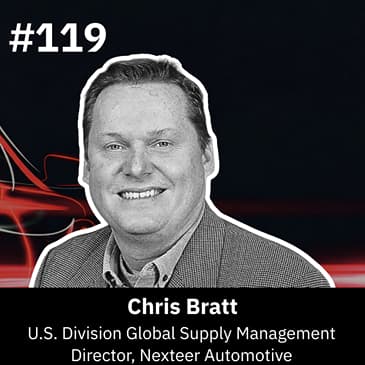
Jan and Tom Roberts sit down with Chris Bratt, U.S. Division Global Supply Management Director at Nexteer Automotive. He’s spent more than 20 years in automotive purchasing across Europe, Asia, and the United States, on both the OEM and Tier 1 sides. Nexteer runs as four regional companies, each with its own P&L, so Chris lives with the consequences of every sourcing call in his region.
Dual sourcing is at the center of his approach, and it goes against everything the industry taught buyers about bundling volume and chasing scale. Chris says plainly that his own teams see it as double work: two parts to release, test, and validate, two suppliers to manage, and no extra resources. He wins them over by pointing to companies that were brought to their knees when a sole source failed. He’s also selective: it’s reserved for high-volume programs and safety-critical components that can’t be retooled in a few days. The second source sits in a different region, so one tariff doesn’t hit both.
Resilience also means rebuilding the capability that’s left in the country. The U.S. stopped making several commodities Nexteer now needs, and when there’s no supplier, the question becomes whether to make it in-house. Chris has moved people off traditional buying desks and onto what-if scenarios. They’re looking for the time bombs in a supply base that was sourced years ago, when risk barely factored into the decision.
AI cuts both ways for Chris. It can take on the workflow and number-crunching that eat up buyers’ time, though it’s been harder to make work reliably than the industry expected. Meanwhile, hyperscalers with far deeper pockets are buying up the same electrical components, rare earths, and magnets that the automotive industry needs. Chris doesn’t expect things to calm down, and he sees more of procurement’s work shifting to exceptions. This conversation challenges leaders to fund resilience the way they’d fund any core capability, with the people, regional footprint, and flexible specifications to absorb the hundred-year event that now shows up every year.
Themes Discussed in This Episode
- Regional P&L ownership inside a global supplier
- Why Buyer 101 no longer covers the job
- Dual sourcing as a deliberate risk decision
- Selling resilience to the people doing the work
- Rebuilding commodities that the U.S. walked away from
- AI as both a tool and a competitor for supply
- Flexible specifications under material constraints
- Exception management as the core of procurement
This podcast is powered by QAD RedZone.
Featured Guest
Name: Chris Bratt
Title: U.S. Division Global Supply Management Director, Nexteer Automotive
About: Chris is the U.S. Division Global Supply Management Director at Nexteer Automotive, where he leads the organization’s supplier strategy, performance, and operational execution. He brings more than 20 years of automotive purchasing and supply chain experience, with international assignments across Europe, Asia, and the United States. His global perspective and commercial expertise provide valuable insight into the evolving opportunities and challenges shaping today’s automotive supply chain.
Connect: LinkedIn
About Your Hosts
Jan Griffiths
Jan is the host and producer of the Auto Supply Chain Champions Podcast and The Automotive Leaders Podcast. A former automotive manufacturing and supply chain executive, Jan is recognized as a Champion for Culture Change in the automotive industry. She brings direct, grounded conversations to leaders navigating execution, disruption, and transformation across the global automotive ecosystem.
Tom Roberts (Co-host)
Tom is Co-host of the Auto Supply Chain Champions Podcast and Vice President of Strategic Industry Development at QAD. He works closely with automotive and industrial manufacturers to close the gap between insight and execution, helping leaders move from visibility to systems of action that drive real operational outcomes.
Episode Highlights
[03:39] Buyer 101 Is Gone: Price, quality, and delivery used to define a sourcing decision; now compliance, ESG, and tariffs sit on the same scale, and all of them keep moving.
[07:13] Selling the Second Source: Chris explains why teams first see dual sourcing as double work, and how real cases of sole-source failure change their minds.
[08:00] Where Dual Sourcing Earns Its Cost: High-volume programs and safety-critical, hard-to-replicate components get the backup plan; small parts that can be tooled in days don’t.
[09:44] Bringing Lost Commodities Home: Some commodities the U.S. stopped producing are needed again, which forces a choice between developing new suppliers and building the capability in-house.
[11:27] Hunting the Time Bombs: Nexteer has moved people off traditional buying desks to stress-test a supply base sourced before risk was part of the decision.
[13:48] AI’s Other Front: Tech companies with far deeper pockets are driving up the price of electrical components and limiting their availability, which repeats a pattern automotive saw in the semiconductor crisis.
[16:10] Tariffs and Regional Hedging: Dual sourcing across different regions protects against tariff increases and keeps the option to return to a lower-cost source if tariffs fall.
[17:13] Exceptions Are the Work: AI can handle the middle of the bell curve, but Chris sees one-time events outnumbering routine work in procurement.
Top Quotes
[07:16] Chris Bratt: ” You have to sell the concept to manage the change.”
[15:06] Chris Bratt: “And there’s always a solution. I’m a big believer that the human race will find a solution to most of the problems it faces over time, but ‘over time’ is the one thing that we don’t always have.”
[16:55] Chris Bratt: “I think AI can help with repeatable tasks, but actually, supply chain repeatable tasks seem to be coming less and less. Everything seems to be unique these days.”
If this episode resonated, share it with a fellow automotive leader and subscribe to the Auto Supply Chain Champions Podcast, where we're closing the gap between insight and action across the global automotive supply chain.
Follow the Auto Supply Chain Champions Podcast for real conversations with leaders who are making hard choices, focusing their bets, and leading with intent.
🎧 Follow the podcast:
🔗 Learn more about QAD Redzone: https://www.qad.com/
[Transcript]
[00:00:00] Jan Griffiths: This is the Auto Supply Chain Champions Podcast. We are on a mission to bring you real conversations with the leaders who are transforming supply chains in the automotive sector. These leaders are true champions of manufacturing, and we're here to share their stories. I'm Jan Griffiths, your host and producer, and I'm joined by my co-host, Tom Roberts, Vice President of Strategic Industry Development at QAD.
[00:00:30] Tom Roberts: Great to be here, Jan. What I see every day is simple: manufacturers don't have a data problem, they've got an execution problem. This show is about how artificial intelligence, systems of action, and empowered teams can help close that gap.
[00:00:45] Jan Griffiths: Let's get into it. This podcast is powered by QAD RedZone.
[00:00:53] Hello and welcome to another episode of the Auto Supply Chain Champions podcast. Let's check in with my co-host, Tom Roberts.
[00:01:00] Tom, what have you been up to?
[00:01:01] Tom Roberts: Hi, Jan. Busy season. So we had the American Automotive Summit in Detroit. I was there. Was at Champions Manufacturing in Chicago, then next week I'll be presenting at Fabtech out in Las Vegas.
[00:01:12] So definitely a busy time, but great time to be associated with automotive certainly.
[00:01:17] Jan Griffiths: Yeah, I know. I've been on stage a lot too. I was on stage for 12 hours at the Art of Procurement Catalyst Conference, and I opened it. I think we talked about this before. I was thinking about a theme, and I opened it with Eminem, Take Your Shot, and charged the entire audience, all full of procurement professionals, to take their shot because we don't, we don't have any more time. We're out of time.
[00:01:41] This is a time for massive transformation, and the ground keeps moving beneath us every single minute of the day. It's a very different world that we live in. And that's why, Tom, we're bringing on the show a leader in the tier one space who's also worked for an OEM. He gets it. He knows exactly what we need to do to transform this industry for the future.
[00:02:05] That's why I'm thrilled to bring on the show today Chris Bratt.
[00:02:09] Chris is the director responsible for global supply chain management for Nexteer, the Americas.
[00:02:17] So Chris, welcome to the show.
[00:02:21] Chris Bratt: Thank you, Jan. Nice to be here.
[00:02:23] Jan Griffiths: Great to have you.
[00:02:24] So Chris, here you are in charge of a region, in charge of procurement for a region for a major tier one. And my first question for you is a simple one, but I see a lot of companies moving towards a regional structure.
[00:02:40] Tell us about that.
[00:02:43] Chris Bratt: Yeah, so I think, at Nexteer, we kind of have that. So, whilst we're a global company and we certainly have corporate staffs that kind of keep us joined up and, working together on anything that has global synergies, still fundamentally, Nexteer is four regional companies that have their own profit and loss responsibility and they manage their own destiny.
[00:03:05] So, we have the US division, Mexico division, a division that covers Europe and Morocco and Brazil, and then an Asia Pacific region.
[00:03:13] Tom Roberts: So Chris, when we were talking previously, you had mentioned that geopolitical risk is something that you face all the time. Talk to us about some of the challenges that you're facing in geopolitical risk in your supply chain and what you have to do to try and mitigate some of that risk.
[00:03:29] Chris Bratt: Yeah, and I think that's one of the hot topics of the time, right? I think ever since COVID really, it just feels like supply chains have just been challenged in so many ways with, you know, semiconductors and inflation. And now I think what we're seeing more than ever is this macro geopolitical environment with much more tension in it. If we looked at how we ran procurement pre-COVID or, when the world felt much more global.
[00:03:54] It was kind of, okay, what's the best price or the best cost location? Make sure the quality is there and make sure the delivery is there, right? That was kind of Buyer 101 back then, but now we seem to have so many more variables that we have to manage when we're sourcing, and the thing is, they're really dynamic.
[00:04:13] So, decisions now have to take into account compliance, ESG topics, and as well as tariffs, which just mean that your traditional sourcing footprint is kind of really up in the air, and that kind of takes you down the whole path of risk that you mentioned there, Tom.
[00:04:30] So, what can we do? What's the right decisions? We're trying to make long-term sourcing decisions and, in an environment which doesn't really give a lot of long-term forecast accuracy. So that's the real challenge, and there's no one answer out there that's going to fix that.
[00:04:46] But certainly, we would look to dual source or multi-source across regions to try and just mitigate that risk, right? You've got cost risks. If your low-cost location is subject to tariffs and all those kind of things and you don't know how dynamic they're going to be over time, you're going to wanna make sure that you've got, a low-cost option as well as a, a local option.
[00:05:06] And even just the climate changes, and you see much more kind of real black swan events that used to, in theory, be every hundred years and now every year. Risk is just something that we have to manage every day in the decisions we're making, and that's what, keeps us on our toes, and often we're making decisions, and you don't know if it's going to be the right one.
[00:05:23] So you're going to have to always have that ability to pivot down the line if something fundamentally changes from the assumptions you had at the time.
[00:05:30] Tom Roberts: Right, and it's amazing, the web of the supply chain in automotive because you can have a one hundred-year flood in Thailand or something that affects the supply chain, and then a one hundred-year earthquake that happens somewhere that affects some other part of the supply chain, and then a solar flare that takes out something for a day. And they're all one hundred-year events, but there seem to be an endless amount of one hundred-year events that touch your supply chain somewhere that can shut the whole thing down.
[00:05:56] So, the fact that there's people actively, purposely dual sourcing simply for the opportunity to ramp somebody up if you need to and if somebody comes offline, that, I mean, it's just part and parcel to automotive with the supply chain so tightly knit. So very interesting mitigation.
[00:06:15] Jan Griffiths: Yeah, I think that dual sourcing is a great strategy, but it's not one that we've loved in automotive in the past because of the cost. 'Cause you might be looking at duplicate tooling, and if you have...
[00:06:28] Tom Roberts: You're trading life scale.
[00:06:29] Jan Griffiths: Yes, and if you are looking at an option to a low-cost country, then chances are that the piece price is greater.
[00:06:38] But you have to look at it because now we're talking about resilience, we're talking about managing risk. But how do you do that, Chris? I mean, that's going to be a very, very difficult discussion. You have to understand risk and prioritize risk, 'cause you can't say dual strategy for everything, dual sourcing strategy for everything, 'cause that would make no sense at all.
[00:06:58] How do you go at this?
[00:06:59] Chris Bratt: Yeah, it's a great question, and certainly is a challenge. And you're right that historically in the auto business, this wasn't what we were taught to do. We were taught to bundle volumes, right? And leverage scale and all those kind of things, and dual sourcing goes completely against that.
[00:07:13] And from a mindset point of view with the organizations, it's an ongoing exercise to get people on board with it because, at the grassroots level, they're just seeing it as double work. Oh, now I've got to release two parts, and I've got to test two parts, and I've got to validate two parts, and I've got to work with two suppliers, and nobody's getting extra resources to do this, right?
[00:07:33] So it is a challenge, and you have to sell the concept to manage the change because it certainly doesn't come naturally yet. And, if we look at historical issues in the industries where companies are caught out when they are sole sourced, right?
[00:07:47] And, anything happens there and it can bring them to their knees and that's what highlighting those examples and kind of training the organization that says, " What we're doing is trying to avoid this kind of a situation and this kind of a disaster."
[00:07:59] So, yeah, dual sourcing is certainly a challenge. In terms of, you're absolutely right, you can't do it on everything, right? Nobody has the resources. And many programs are niche or lower volumes where it's certainly going to be difficult to justify the investment in dual sourcing. So typically we would look at, commodities or programs that are higher volume, commodities that are more difficult to replicate in the short term, right?
[00:08:23] They're the ones where you wanna be able to have a backup plan that you could turn to quickly, right? So, if it's a small part that you can tool up within a matter of days, that's maybe not so critical. But some of the major components that require testing, and customer validation, especially from Nexteer point of view, our products are absolutely safety critical.
[00:08:43] So, you have to make sure that you're validating both of those sources as we kinda go down the dual sourcing path.
[00:08:50] Tom Roberts: So Chris, as you're looking at this alternative sourcing, do you do when you find a supplier in a region that might not have the infrastructure that you typically are dealing with, and you have to maybe try and figure out how they're going to get the parts to you?
[00:09:03] How do you work with somebody in kind of an area that maybe you're not as familiar with or just doesn't have the infrastructure that you're typically used to?
[00:09:10] Chris Bratt: Yeah, great question. You have to have a robust supplier development program because you are introducing suppliers that are new, that we haven't dealt with before, and that brings risk in itself. The other challenge to that is everybody we're working on timescales now that are so much more compressed than they used to be.
[00:09:27] So, to get a supplier on board quickly and robustly is a challenge, and that's something that we have to spend lots of time and build a robust process to do it, but process that doesn't slow the organization down, doesn't become too bureaucratic, and certainly doesn't introduce excessive risk.
[00:09:44] So it's managing all these competing priorities, which is certainly making supply chains an exciting place to be right now. And then, as the other thing you rightly say, sometimes now we've gotta look for suppliers of certain components in certain regions that just, historically haven't had that.
[00:10:01] They've walked away from those industries or those commodities or those technologies, right? And now we kinda need them back and trying to create a supply base of a new commodity is real challenging in some of the regions. And the US is a good region.
[00:10:14] There's many commodities that the US just stopped investing in, doesn't make anymore, and potentially we need to look to bring that back on board. And if you can't find that, then we have to look at, okay, do we, do we wanna do this in-house, right? Have we got the expertise to do it in-house? So these are a lot of the, these are a lot of the challenges that we're working through.
[00:10:33] Jan Griffiths: We had a guest on the show, Chris, a few weeks ago talking about an office of resilience, and really, it was more of a thought process around a dedicated group of people who are working on resilience as a topic, and we haven't found any companies out there that have a dedicated office of resilience, of which supply chain would be a part of.
[00:10:57] But how do you manage that internally? How do you communicate with the key stakeholders to drive the resilience agenda for procurement?
[00:11:07] Chris Bratt: It kind of comes back a little bit about just managing the expectations and the mindset about now that risk is so much more prevalent than it used to be, or it certainly feels like it is, and we've seen those examples. Like we've all seen them in the press and it's like this is what can happen and this is why we have to build resiliency into what we do.
[00:11:27] And certainly, if I look at our human capital, we have reallocated some of the time and the people away from maybe more traditional buying desks that they had, right? And then seeing how we can replace those whether it's with smarter systems that frees up the time for people to actually invest and think about, what-if scenarios with the decisions that we're making or even the situation we have.
[00:11:53] So, our supply chains today were sourced many years ago, because of the lead times and maybe risk wasn't really an element that we took into account when we did that. But, there could be time bombs ticking out there that we kind of just wanna try and get visibility into before these events actually happen.
[00:12:12] So yeah, certainly, from a human capital allocation point of view, we are putting more time and resourcing into resiliency.
[00:12:18] Jan Griffiths: Well, and this is a perfect segue into AI because you have to look at predictive data to help you figure out, what's going on in the world and what's the next catastrophe. Is that an area that you're using AI?
[00:12:31] Talk to us about AI, not just in that instance, but in a broader implementation for you within procurement at Nexteer.
[00:12:39] Chris Bratt: Yeah, you probably hit the second biggest topic that we, that we talk about. So AI and what's its impact to what we do. And there's many tales to AI, I think, in managing automotive supply chain.
[00:12:49] So let's start when I said we were kinda allocating human capital more to risk management. It's like, well, to do that, like I said earlier, nobody's taking on more people.
[00:12:58] The resources aren't there. So how do you free up that time? And so, we look at how can we use AI to help with, managing the workflows that the buyers have to do.
[00:13:09] So things that were necessary bureaucracy that people were doing that take time, and need to be done robustly, how can we have AI assist that. Providing the right information at the right time so that data at hand as opposed to them having to crunch numbers. So that kinda helps us from, or we're trying to use AI to do that, and we're making some progress. But it's tough. I think the industry's talked about how do we use AI in procurement for a while. And there's many people out there selling AI. There's many people developing it themselves. But to actually get it to work robustly is I think a challenge that maybe was underestimated. So that's kind of one aspect, where we're using AI.
[00:13:48] The other thing that Tom and I talked about, I think when we were last together, was as this planet becomes AI-enabled and there's this race to AI, the other challenge we have as automotive, and this is what we saw a little bit in the semiconductor crisis a few years ago, right, is these companies and tech outfits that have far deeper pockets than most automotive companies do, right?
[00:14:08] And they're rushing and they're creating this demand for these subcomponents, these electrical components that's up driving up price and it's reducing availability. So that's another piece of AI that's impacting supply chain from the other side.
[00:14:21] So it's helping us in some way, and then it creates more challenges another way. So yeah, certainly a big topic as to how AI impacts what we do every day.
[00:14:30] Tom Roberts: Do you see that as a major problem in, I think you are telling me it is, rare earth minerals, magnets, all these AI hyperscalers, they're all consuming chipsets and all these kinds of things. Are these specifically areas where you feel like you're up against the an ogre trying to procure some for your organization?
[00:14:49] Chris Bratt: And certainly under the veil of some of the geopolitical stuff we manage. So the countries that have access to those types of materials that we need in many of the products we have, becomes again, a challenge. So as you see supply being constrained, reduced, everybody, like human nature does, we rush to find a solution.
[00:15:06] And there's always a solution. I'm a big believer that the human race will find a solution to most of the problems it faces over time, but 'over time' is the one thing that we don't always have. So yeah, quickly trying to find alternative materials for some of these things.
[00:15:19] We have to be more open-minded about our specifications. Can we have min requirements versus max requirements and so on and so forth, that will help us have more availability of alternative materials, so that we can continue to supply the products that we need to supply.
[00:15:35] Tom Roberts: How do you feel your organization is doing, this is a loaded question, Chris, with tariffs? So tariffs, they are changing all the time. Sometimes we don't know going to happen from one day to the next.
[00:15:45] Talk to us about risk management compliance and tariffs and, how your organization is grappling with those things.
[00:15:52] Chris Bratt: Tariffs have obviously been a big topic over the last couple of years. We've put processes into certainly, let's call it " manage the short term." In terms of just tracking, recovery, those kind of things, like I said before, the supply base we've got today was sourced before many of these tariffs were in place and therefore, there are impacts.
[00:16:10] And then, when I talked about the dual sourcing strategy because I think there's a view some of the tariffs will stay around for longer, and some of them may be more of a short-term tactical weapon that we see coming out play. And again, sourcing effectively helps us do that and clearly when we're dual sourcing, we don't look to dual source from the same region. We look to dual source from different regions to help mitigate the impact of tariffs.
[00:16:35] If they go away, we can maybe back to a lower cost source. If they become higher, then at least we're protected to some extent, just to manage all of these different variables as best we can. And I didn't yet find the algorithm out there that does it all for us. That's why I think we're always going to need to have humans in managing supply chains, and relationships.
[00:16:55] And again, we talk about AI taking away people's jobs. I don't subscribe to that at all. I think AI can help with repeatable tasks, but actually supply chain repeatable tasks seem to be coming less and less. Everything seems to be unique these days.
[00:17:08] Jan Griffiths: Yeah, isn't that the truth?
[00:17:10] Tom Roberts: Exception based, absolutely.
[00:17:13] Chris Bratt: Exactly, so if you think of the bell curve and everybody says, "Well, in the middle here, this is the bit AI can do, and you'll need the people to do the exceptions."
[00:17:19] I see that kind of coming this way, and there just seems to be more exceptional, one time events than routine work in what we do these days.
[00:17:27] Jan Griffiths: Yeah, that's so true.
[00:17:28] Chris, I want to project you into the future. Not too far. Five years from now, what does success look like to you for procurement at Nexteer?
[00:17:39] Chris Bratt: Yeah, it's a great question. I think, given I'm ever the optimist and my glass is always half full, I would definitely say we will be in a very smooth operating environment where we've mitigated all of the risks and everybody comes to work and is very comfortable doing what they're doing with no major surprises. Unfortunately, I don't see it being like that. I think, we talked about risk being forever around us.
[00:18:00] I think we'll continue to evolve tools to help us. I'm hoping that maybe some of the geopolitical things can calm down as different administrations may come and go in that, in that period with different mindsets and philosophies. But I think we'll be forever managing a much more dynamic world, and I think, if I look at what's going on in the auto industry in terms of lead times for development of vehicles. We see that being more and more compressed. We see technologies come in that, from the time you start an event to something actually happening, it's just being compressed. That whole thing's going. So I think, from that level, from a macro point of view, we're going to continue to see more and more activity. And it's just how do we manage, how do we manage that activity?
[00:18:45] And I think it's going to be exciting. I'm fairly sure we'll see more change in the next five years to what we did maybe in the last five years, it's how it feels anyway. We'll see what comes, but I suspect that AI will have a big impact on the world we live in, and therefore what we do, as that kind of filters down to what we do, I'm sure that'll have an impact on, on how we operate day-to-day.
[00:19:06] Jan Griffiths: Yeah, it's funny, you know that quote, Mary Barra said many, many years ago now that we'll see more change in the next five than we've seen in the last 50, and now that quote has shifted to more change in the next five than we've seen in the last five, which, just tells you how much change is accelerating. The pace of change is accelerating so fast.
[00:19:28] Well, Chris, we are thrilled to have you on the show and thrilled that you are leading the procurement function at Nexteer in the US, and we wish you every success, and thank you so much for joining us.
[00:19:41] Chris Bratt: Thank you so much for having me. I've enjoyed our chat and, look forward to the next opportunity.
[00:19:45] Tom Roberts: All right. Thank you, Chris.
[00:19:47] Jan Griffiths: We wanna hear from you, our listener. Tell us what are your challenges right now? What conversations do you want to hear across the airwaves on this podcast? Drop us a comment on our podcast website.
[00:20:03] The link is in the show notes.