The auto industry didn’t lose USMCA on July 1st. It lost the assumption that the rules would sit still.
The agreement isn’t dead. Nobody packed their boxes. But the US declined to renew the deal as written, and it opened what could be a 10-year renegotiation of the trade framework that governs somewhere between 1.6 and 2 trillion dollars a year, with autos at roughly 18% of that. The proposal on the table increases North American content from 75% to 82%, with half of that produced specifically in the US, and 25% tariffs still in place as leverage.
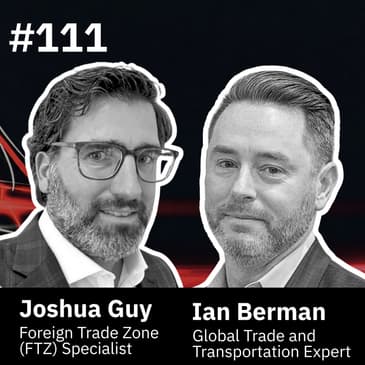
In this episode, Jan Griffiths and Tom Roberts bring back QAD trade experts Ian Berman and Joshua Guy to separate what actually changed from what only sounds like it did. The headline reads like an attack on trade with Mexico and Canada. Ian reframes it fast: the real target is China and Mexico, as the bridge suppliers have used to skate on tariffs. If you’ve been finding loopholes, this is the light being pointed at them.
Nothing changes tomorrow. That’s the trap. The suppliers who wait for final rules will be doing origin math under deadline pressure that the prepared ones have already finished. Qualifying under the new content thresholds forces every supplier to expose its true bill of materials, and then to know its supplier’s supplier’s supplier. That’s not a sourcing problem first. It’s a data problem first.
Joshua makes the same case from the trade-zone side. Foreign-Trade Zones won’t erase the origin issue, but used well, they’re a lever that mitigates duty exposure, with ROI that usually lands inside year one. 2025 was the largest growth year FTZ usage has seen, and DC is staffing up for another record in 2026. Underneath it all, the hosts keep returning to one message: data quality is the survival trait, systems turn that data into decisions fast enough to matter, and agility is the posture, because the volatility isn’t a phase to wait out.
This episode is a reminder that global trade is not back-office reporting. It is a strategic infrastructure. Leaders who treat it as such gain flexibility, cash flow timing advantages, and margin recovery. Those who do not will absorb the cost and call it unavoidable.
Themes Discussed in This Episode
- What actually changed on July 1, and what didn’t
- Why the new rules target China, with Mexico as the transshipment bridge
- Rising US-content and regional-value thresholds under revised rules of origin
- Origin qualification as a data problem before a sourcing problem
- Knowing your supplier’s supplier’s supplier across the bill of materials
- Clean upstream data as a tier-two competitive advantage
- Foreign-Trade Zones as a duty-mitigation lever, not a loophole around origin
- Moving from reactive compliance to proactive planning before the rules are final
Featured Guest
Name: Ian Berman
Title: Global Trade and Transportation Expert
About: Ian is the Manager of Business Consulting with QAD Supply Chain. Ian has been with QAD for 11 years and has 20 years of experience in global trade and transportation management. He holds a Masters Degree in Supply Chain Management as well as an ASCM CLTD Certification.
Connect: LinkedIn
Name: Joshua Guy
Title: Foreign Trade Zone (FTZ) Specialist
About: For more than 25 years, Joshua has worked at the intersection of engineering, product leadership, and global trade, helping organizations bring structure and clarity to complex supply chains. Today, he leads strategy for Foreign-Trade Zone solutions that enable multinational importers to manage tariff exposure, reduce compliance risk, and strengthen financial performance. He also led the development of QAD FTZ, an industry-leading Inventory Control and Recordkeeping System that supports manufacturers, distributors, and 3PLs as they move from reactive compliance to proactive, resilient trade strategy in a volatile global environment.
Connect: LinkedIn
About Your Hosts
Jan Griffiths
Jan is the host and producer of the Auto Supply Chain Champions Podcast and The Automotive Leaders Podcast. A former automotive manufacturing and supply chain executive, Jan is recognized as a Champion for Culture Change in the automotive industry. She brings direct, grounded conversations to leaders navigating execution, disruption, and transformation across the global automotive ecosystem.
Tom Roberts (Co-host)
Tom is Co-host of the Auto Supply Chain Champions Podcast and Vice President of Strategic Industry Development at QAD. He works closely with automotive and industrial manufacturers to close the gap between insight and execution, helping leaders move from visibility to systems of action that drive real operational outcomes.
Episode Highlights
[01:43] Couples Therapy for Your Sourcing Strategy: Jan opens with Pete Mento’s framing of the July 1 news, and the room agrees the metaphor fits: every sourcing decision now comes with an asterisk.
[02:39] The Real Target Isn’t Mexico: Ian reframes the headline. This is aimed at China and the Mexican bridge suppliers have used to skate tariffs, not at North American trade itself.
[03:57] A Light on the True Bill of Materials: New content thresholds force origin math that exposes what a product is actually made of, and pushes visibility down to the supplier’s supplier’s supplier.
[04:40] Tier Two Data Becomes an Advantage: Josh makes the case that clean, auditable upstream data is what separates the suppliers who survive this from the ones who scramble.
[05:19] The Data Sensitivity Problem: Tom names the tension: OEMs want deeper visibility, and tier ones are wary of exposing their supply base and origin data outside their four walls.
[09:02] FTZ as a Tool in the Toolbox: Josh explains what Foreign-Trade Zones can and can’t do. They won’t erase the origin issue, but they mitigate duty exposure in export-heavy flows.
[11:06] A Record Year for Foreign-Trade Zones: 2025 was the largest FTZ growth year yet, and the DC board is staffing up for another record in 2026. Awareness of the lever is finally catching up.
[13:04] The ROI Is a No-Brainer: Josh walks Tom through the math: most companies recoup FTZ setup and software costs inside year one or two, before the deeper savings even count.
[15:50] Rules of Origin, in Plain Terms: Ian breaks down what a rule of origin actually is and why knowing your biggest BOM cost line matters more than any headline percentage.
[19:48] Stress-Test the BOM Now: Jan lays out the starting move: run 82% regional and 50% US content against your bill of materials, prioritize the parts, then build the action plan.
[22:32] The Monday-Morning Playbook: Ian, Josh, and Tom close on three moves: baseline your data, put systems in place, and stay agile, because the volatility isn’t slowing down.
Top Quotes
[04:15] Ian Berman: “ If you're not doing FTA calculations and origin determinations today, my guess is you'll be doing them tomorrow because that's what's really gonna be tied in if you wanna keep being able to use these aspects.”
[12:29] Joshua Guy: “You might not be able to get the full savings that you once might have had, but you can use these different tools available to squeeze out just enough margin to stay competitive.”
[22:11] Jan Griffiths: “It's about reducing those decision-making cycle times, being able to grab the situation, grab the ball, and pivot and move with it quickly.”
[24:40] Tom Roberts: “You got to have great data, and you got to make some decisions, and it's something you can't leave behind. You can't just kinda wait it out. It's good to get in front of it now.”
Follow the Auto Supply Chain Champions Podcast for real conversations with leaders who are making hard choices, focusing their bets, and leading with intent.
🎧 Follow the podcast:
🔗 Learn more about QAD Redzone: https://www.qad.com/
[Transcript]
[00:00:00] Jan Griffiths: This is the Auto Supply Chain Champions Podcast. We are on a mission to bring you real conversations with the leaders who are transforming supply chains in the automotive sector. These leaders are true champions of manufacturing, and we're here to share their stories. I'm Jan Griffiths, your host and producer, and I'm joined by my co-host, Tom Roberts, Vice President of Strategic Industry Development at QAD.
[00:00:30] Tom Roberts: Great to be here, Jan. What I see every day is simple: manufacturers don't have a data problem, they've got an execution problem. This show is about how artificial intelligence, systems of action, and empowered teams can help close that gap.
[00:00:45] Jan Griffiths: Let's get into it. This podcast is powered by QAD RedZone.
Hello, and welcome to another episode of the Auto Supply Chain Champions podcast. Let's check in with my co-host, Tom Roberts. Tom, how are you?
[00:01:00] Tom Roberts: Hi, Jan. Great to see you. We need to deal with the fallout from July 1st with tariffs. We need to understand what content needs to be created in the United States, what the percentage is. Lots to talk about.
[00:01:11] Jan Griffiths: There is a lot to talk about, and Tom and I have been up to our eyeballs in news articles and trying to figure out what exactly happened, but more importantly, what it means to you, the listener of the podcast, somebody who, a leader who is in the automotive supply chain. And I couldn't think of two better people on the planet to have join us for this discussion with their expertise than Ian Berman and Josh Guy from QAD, the trade experts. Gentlemen, welcome back to the mic.
[00:01:40] Joshua Guy: Yeah, absolutely. Thank you for having us again
[00:01:42] Ian Berman: Yeah, thanks Jan and Tom.
[00:01:43] Jan Griffiths: Okay, I'm gonna open this episode with, I'm gonna actually read a post from Pete Mento. And if you don't know Pete Mento from Baker Tilly, you guys should definitely follow him 'cause I love the way that he describes this. So, we're talking about what happened July 1st, and he says this: "USMCA just got the trade equivalent of 'We need to talk.' The agreement isn't dead. Nobody packed their boxes. Nobody changed the locks, but the US just declined to renew the longest breakup conversation in trade history. And he provides a lot more detail in the post, but he closes it like this, he says, "Your sourcing strategy just got invited to couples therapy." And there it is. So, let's start off with you, Ian Berman, what's your take on what happened yesterday? 'Cause we're recording this on July 2nd.
[00:02:39] Ian Berman: All sorts of fun. I think the big thing, as you guys both called out, is the administration is really looking to try and tighten up on what those rules look like for origin definitions, for your products. Talking about nearshoring versus offshoring, how do you bring those things in? And, on the surface, this looks like an attack on trade with US, Mexico, and Canada. And I think what we need to, you know, make sure we're thinking about is this really isn't focused on those two countries specifically. It's actually focused on China and that Mexico's been used as a bridge per se to skate some of these tariffs that are out there.
So, all of you that have been finding loopholes, this is what they're looking at, right? And with that, nothing changes tomorrow, but I think we should all be talking about how this could impact everything and if you should all be emailing, writing, calling your senators to talk about this, you know, for your organizations.
[00:03:42] Jan Griffiths: Yeah, and you're right. It's clear that this is an attempt to close the backdoor through Mexico, for China, but it is also a clear move to increase US content, and that is gonna bring all kinds of problems in itself.
[00:03:57] Ian Berman: Correct. And part of it was, adding in provisions that to qualify in the US you needed another level of content in that, and again, tying back to steel, aluminum, looking at all of those aspects, where are things built. If you're not doing FTA calculations and origin determinations today, my guess is you'll be doing them tomorrow because that's what's really gonna be tie in if you wanna keep being able to use these aspects. It's gonna shine a light on everybody's true bill of materials and getting into that aspect of know your supplier's supplier's supplier, because that's how it's gonna kinda roll into, so.
[00:04:39] Jan Griffiths: That's right.
[00:04:40] Joshua Guy: That was the thing too that I was thinking about with kind of tier one versus tier two. It's data, right? I mean, it's all collecting that upstream data from the suppliers, making sure you've got good data quality, that you understand your BOM, like you said, and I think that's really gonna be the way that companies are gonna be able to survive and kind of get through this is having good quality data upstream, being able to model against that, and then, you know, tier two selection comes into play, right? To make sure that you're getting that clean, auditable, information from them. So, that'll be a competitive advantage for the tier twos.
[00:05:19] Jan Griffiths: Tom, you've seen the problems with data throughout your career. What challenges do you see? I mean, this is obviously both a supply chain and IT challenge.
[00:05:28] Tom Roberts: So, data is everything, right? You need data to understand where things are coming from, who they're coming from, all of those things. There's a lot of actions out there right now like Catena-X, where OEMs want more visibility down through their supply I've talked to people in the tier one world, and there's a lot of concern about potentially sharing some of that data outside of their four walls so that somebody else has access to their supply base, their information.
So, there's a lot of concern, at least in North America suppliers on that. So, when we talk about things like where the origin of parts comes, this is extremely sensitive. And now if you have to answer questions about moving to seventy-five percent of content or eighty-two percent of content, you have to talk about, do I spool up a line? Do I build a plant? Do I have to have an alternative sourcing activity? Hey, can I get some business I didn't have before? There's a lot of issues with that. A lot of sensitivity. There's a lot of work to be done.
[00:06:26] Jan Griffiths: There is indeed. And you know, one of the things that we want, always wanna do is we want people to be more proactive and reactive. So, let's talk about how we do that.
[00:06:38] Ian Berman: Yeah, it's a very, very, very valid point in this. And I think right now, again, as we said, today and in the very near future, you know, you're not gonna have to worry about changing anything, but as you're walking through your sourcing activities in the next quarter, you're doing your buying, you're doing your selling, start asking a few more questions to your suppliers. Where is this? Can I have this type of data? Do you have this type of data? And then, that's gonna allow them to, again, find some of that data, figure out where it might live, so that as these changes or the rules roll out, you're ready to be able to do your validations, your checking, running those calculations to find out if you do qualify today or in the future and where that might look.
Again, the whole CapEx problem of, as Tom alluded to, of how do you spin up a new line or how do you build that out so that you can take advantage of this? Sure, that's a whole different conversation to talk through, but I think right now, as you're doing these activities in your day-to-day, you're working with your suppliers.
No, none of that's gonna change, but you need to be bringing in the information, telling them they need to start giving you those details and information. And, Tom, you hit on something that is core to all of this, and it's been kinda one of the backbones of, all of these agreements and kinda the, quote-unquote, "trade war with China" is all IP, right? And making sure and what's one of the big things is how can we keep IP in North America? How can we, you know, make sure that we not only have the IP for that product, but how to make that product? How do we source those details? I remember a friend of mine who owns a manufacturing company, aftermarket bearings, et cetera, said he does all his manufacturing in China.
If you have a mold go down in China, two minutes you can go next door and find somebody that'll come over and fix it. Right now, that's part of those supply chains and the actual manufacturing things that we need to bring back, we need to nearshore, whether it's Mexico, it's the US, it's Canada. Those are the challenges right now. So, that's where we should start looking at to really progress forward, take advantage of those parts.
[00:09:02] Jan Griffiths: That's a really interesting point. Josh, talk to us about foreign trade zones. How does this play into the FTZ strategy or approach? Is there an advantage here? Is there a benefit here?
[00:09:14] Joshua Guy: Yeah. So, I mean, I look at FTZs as a tool in the toolbox, right? And the FTZs are not gonna get around this origin issue. I mean, that still is gonna apply, but what FTZs can be utilized for is to help manage or mitigate some of the uncertainty and become a savings, right? So, in an export-heavy flow, export, FTZs are a great use, right? They can bring that merchandise into the US, it distribute it out of US Commerce, and they're never gonna pay any duty. So, all of those additional punitive tariffs don't matter.
But again, to me, it's a tool in the toolbox that you can use to maybe help mitigate some of the additional expenses that are gonna be incurred with these changes, right? 'Cause it's not, it's not getting around any of this, but it does give you another tool in your toolbox to help mitigate some of these disruptions.
[00:10:09] Jan Griffiths: Yeah, and as we know, we can talk about nearshoring all day long. It's hard. It's really hard to do, and in some cases you can't do it. So, an FTZ is a good alternative, right?
[00:10:20] Joshua Guy: Oh, absolutely. I mean, the FTZs were originally founded for that purpose. Back in the '30s, it was a way to retain US labor in manufacturing operations. It's since expanded beyond that, and kind of one of the unfortunate things is with all of the punitive tariffs, that manufacturing, that inverted tariff benefit no longer really applies because of the way the merchandise has to be admitted into FTZs. Manufacturers still have substantial ways that they can save, but it would be great if FTZs still did have that tariff inversion benefit, relief from tariff inversion that they previously had before all of these punitive actions.
[00:11:01] Jan Griffiths: Are you seeing a flood of people, Josh, trying to understand FTZs?
[00:11:06] Joshua Guy: Oh, absolutely. 2025 was by far the largest growth of FTZ usage, and I think awareness, right? We recently were at an NAFTZ conference, which is the National Association of Foreign Trade Zones. There were some representatives from the FTZ board in DC, and they talked about the number of FTZ applications they processed last year, record number, which was not a surprise to anybody.
But then, also, they talked about kind of what they're doing, staffing up in anticipation of another year in twenty twenty-six with record applications. So, it doesn't appear to be slowing down even some of the tariff uncertainty has calmed down a bit. Now, I think if you look at the schedule of different things coming down, it really hasn't gone away. We've had a bit of a breathing point, but there's still a lot of uncertainty out there, but the FTZ program has benefited from that. But more importantly, I think the awareness of the FTZ, again, as that tool in the toolbox that you can use has grown.
And so, I think that FTZs are here to stay. They'll continue to experience growth. And again, trade complexity increases, it's gonna be very, very important for these companies to understand all the different options and how to move little levers. You might not be able to get the full savings that you once might have had, but you can use these different tools available to squeeze out just enough margin to stay competitive.
[00:12:41] Jan Griffiths: Yeah.
[00:12:41] Tom Roberts: So Josh, I'm a half a billion or billion dollar supplier. I've got plants in Mexico. I've got maybe a plant in Canada, some in Western Europe, some in China. You know the drill, kind of got a good geological spread of facilities. What am I looking at? What am I looking at as far as ROI and benefit for setting up some of these free trade zones and getting into this, using these processes and tools?
[00:13:04] Joshua Guy: Absolutely. I mean, you know, as far as companies looking to get into the zones program, there are expenses for getting into the FTZ program, and then you have kind of the software costs and the implementation costs. But really, you should be able to recoup those costs within year one, maybe year two, if you don't have a large amount of savings. So the ROI is kind of a no-brainer, right? I mean, you're recouping your outlay very quick. The easy thing too there is it's fairly simple to get to what your cost savings will be. One way to look at it, again, just kind of high level quickly, is if you know the value of merchandise that you imported and your average duty rate, or you know, let's say, what your duty spend was last year, then you know the percentage of merchandise that's exported, percent of merchandise scrapped, yield loss, things like, that's one way to quickly get to just some of the savings, right?
There's more savings that that's not taken into account, but right now, that re-export savings is large for a lot of companies because the duty rates are so high. But there's also some related savings that these importers have. So, if you're a distributor, high volume importer with the weekly entry benefit, basically take the number of entries that you had over the past year, take your average brokerage fee, entry fee, calculate out what you paid for that, then essentially just do that times fifty-two, because as an FTZ, you should only have fifty-two entries a year. You might have some supplementals, but you're cutting down three, four thousand entries a year down to fifty-two. So, that brokerage fee, that NPF, you've cut that way down.
[00:14:50] Tom Roberts: So, if I've got some exploratory work I'm trying to do and there's some steps there, I assume that you can help me out. I assume I'll give you some information you have some sort of awesome calculations and methodologies to help calculate.
[00:15:02] Joshua Guy: Yeah. So, absolutely. I can get you the link on the website, we have a cost benefit analysis that customers or folks exploring can go out there. It asks for just a couple of inputs. It'll give you real time results back of what the savings look like. I think it's even got an option in there so you can put out what you think your outlay is and it'll show you that kind of timeline of the return. So yeah, we'll send that to you and maybe you can include that in the show notes.
[00:15:30] Jan Griffiths: That's a great way for somebody to start to think about it if they haven't already.
[00:15:34] Tom Roberts: Yeah, and I'm sure it doesn't even delineate the risk. I mean, this tells you what you might be on the hook for, but having better data to understand what is actually subject to tariff, you don't wanna miss that, right? You don't wanna get that wrong, and I think that's a whole other piece is the risk mitigation.
[00:15:49] Joshua Guy: Absolutely.
[00:15:50] Tom Roberts: Great.
[00:15:50] Jan Griffiths: Okay, I want to go back to the rules of origin for a moment. Ian, the split between US and Canada, is that a big deal?
[00:15:58] Ian Berman: Certainly can be. I think it goes back to that these rules are ever-changing, and right now you called it out. And again, everybody will make the comments, they're negotiating right now. So, the US, Mexico, Canada, the US wants to break up the three-way connection and Mexico and Canada don't want it.
So there's a whole lot of nuance in all of there, but yes, the current administration is looking to increase some of the percentages, some of the values, and how those calculations are done to do a rules of origin. And for those that are going, "What is a rule of origin? What is he even talking about? Why are we even talking through this?" The government and the WTO, the World Trade Organization, outline a set of rules and how to perform a calculation on a bill of material to understand where that good has a country of origin, or you can validate that that's where the country of origin under those rules.
So, doing all of those calculations, hopefully somebody is doing that and looking at your bill of materials, it goes back to the data concern and question before of, do you have all of this? Can you do that? Right now, the best thing I can think of is as they're starting to put out ideas and they're looking at changes in this, is for your teams to look at how you're doing your calculations today and what values those are.
Now you can say, "Okay, yeah, I know I'm at this number or this number. More importantly, look on that bill of material. What's the biggest cost? What's your biggest, you know, driver on there? And understand what that is. Just understanding where you sit today with all of your current processes will let you better understand how these rules might affect you.
Because again, you can see all these numbers on every article and everything else. That doesn't mean anything to anybody until you're looking at a very specific product. Then it's a conversation with procurement, suppliers, et cetera, of what can you do to help mitigate, bring it down, look at all of those.
Again, nothing is changing this week or next week. So you have a little bit of time, not a whole lot. Don't put this off. Don't wait till after your vacation. But you should start investigating, asking a couple questions to be prepared for whatever happens with these negotiations. You probably already know what your products look like and have a basic idea. Getting into the details, getting into the nitty-gritty, understanding what that is, then you can start looking at, can I take advantage of other agreements, a zone, a different process or method? Things like that. All of those aspects are gonna play into it, into those rules of origin.
And again, I completely appreciate probably the people listening are not global trade experts, and they're not doing the calculations on all of these specifically, but understanding that this is how it's going to work, that these are challenges, these are changes. Now go talk to your experts internally, ask the questions, find out, sit down, figure out what you're doing today. Will this affect us? Yes or no? That's where you really wanna talk, find out, and then talking to your customers, right? If you're a tier three, you better be talking to your tier two to understand what their go-forward path is, and then on up the line. Tier one, you should be talking to tier two, tier three. Everybody needs to come together. It's the supplier's, supplier's, supplier conversation to be able to make sure that, again, everybody is having an advantage on this.
[00:19:48] Jan Griffiths: Yeah, and I think what we do know, even though we know we're going into a 10-year breakup period, which still makes me chuckle, but it's serious business. So, there's a lot of unknowns in that, but what we do know is that the US has clearly said that they want regional content at 82% with 50% specifically US content. That we know. So, a good starting point would be to stress test your BOM with those requirements, then prioritize those parts, and then put your action plan in place. But this idea of like, "Oh, well, let's wait and see," you're not gonna wait years.
[00:20:28] Ian Berman: No.
[00:20:28] Jan Griffiths: That's not gonna happen. So, the wait and see and bury your head in the sand is not gonna be the right approach. This is about being proactive more than it is reactive. And if you haven't started planning for this, now you have some numbers you can plug into your what if scenario sheet. And then, you can consider a foreign trade zone. Maybe it's resourcing. There's all different kinds of things that you can consider, but at least we got some numbers to start with.
[00:20:54] Ian Berman: And I think one of the other things to look at on your tier two, tier threes, they're even talking about extending how they calculate labor and that their labor rate has to be shown as sixteen dollars an hour regardless of what they're actually paying. So, there's a lot of nuance in all of this that's coming down the line. You really have to have a baseline before, otherwise, you're really gonna be in trouble when they do come out with it.
[00:21:19] Jan Griffiths: Yeah. So, what I'm hearing is get your arms around your data, get down to the nitty-gritty on rules of origin, really understand that. And if you don't have a trade expert that you can talk to, reach out to either Ian and Josh, I'm gonna throw you both out there to help. But you really gotta get your arms around that data. And USMCA is not enough, you gotta have it really broken down by specific country, particularly now that the US versus Canada split. And then, the other thing, Ian, you've mentioned a couple of times, sub-tiers. I think a big concern right now is the financial stability of the sub-tier supply base, and what will this do to them. A lot of uncertainty, but you know what? We live in a world of uncertainty. This is the world that we live in right now, and it's about reducing those decision-making cycle times, being able to grab the situation, grab the ball, and pivot and move with it quickly. That's what we're all about now. That's what I get from our conversation today. Ian, what's your advice to leaders out there in the auto industry right now?
[00:22:32] Ian Berman: Right now, call your congressman, senators, maybe start with that. Half jokingly, if you do, if you're engaging, if your company's engaging, I would let them know what your feelings are with your company. Again, I'm not gonna tell you which way to go, what is a bigger prerogative. Obviously, make that contribution. But where that even starts is internally, as you called out, Jan, on that very nice recap, you need to figure out what your baseline is with all of your products and all of your suppliers right now. They've clearly made it clear that going forward, there could and will be changes to this, so we need to be very cognizant of what's going on so you can make a long-term plan.
[00:23:17] Jan Griffiths: Yeah, absolutely. Josh?
[00:23:19] Joshua Guy: Yeah. My takeaway is I think, we've mentioned it a bunch, data quality is critical, right? So data quality, making sure that you have that quality data that you can make decisions on. Number two, systems. Systems are critical. I mean, the complexity of everything now is such that you really have to have systems in place to be able to make sense of the changes, make sense of the data. So, make sure that you have systems in place.
And then, maybe the third is just kind of a reminder that we always think it's slowing down a little bit, and it never does, and it always gets a little bit more crazy and a little bit more chaotic. Be agile, right? Make sure that you have agile processes in place because, you know, we haven't seen the end of this, right? I mean, it's not getting easier anytime soon.
[00:24:05] Jan Griffiths: Absolutely. Tom?
[00:24:07] Tom Roberts: Once ideology is done, we have to deal with what's left, right? I mean, whatever gets put into place as law or, you know, if there's some kind of interpretation, we have to deal with what's behind the suppliers and the OEMs, and everybody has to deal with what's there, regardless of whether they agree with it or not, of course. So I think, again, the foundational elements that Josh talked about, data. Convergence of systems, if you can, great data, the ability to have cross-referencing to look at your product classifications of what's your new bill of material and what the origins are. You gotta have great data, and you gotta make some decisions, and it's something you can't leave behind. You can't just kinda wait it out. It's good to get in front of it now.
[00:24:49] Jan Griffiths: Take action. That's the message.
[00:24:51] Tom Roberts: Take action.
[00:24:51] Jan Griffiths: Take action. And with that, we'll close today. Thank you, gentlemen, for the conversation. Always exciting and interesting bringing you on the show.
[00:25:00] Ian Berman: Absolutely.
[00:25:01] Joshua Guy: Absolutely. Enjoyed it.
[00:25:02] Ian Berman: Thanks everybody.
[00:25:03] Tom Roberts: Thank you.
[00:25:03] Jan Griffiths: We wanna hear from you, our listener. Tell us what are your challenges right now? What conversations do you want to hear across the airwaves on this podcast? Drop us a comment on our podcast website. The link is in the show notes.