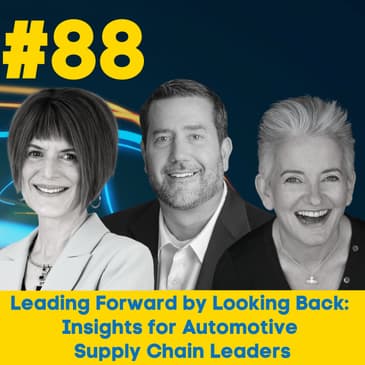
Sometimes the best insights come from looking back.
In this special episode of Auto Supply Chain Prophets, hosts Jan Griffiths, Terry Onica, and James Liegghio break from their usual guest format to reflect on the year's most impactful episodes. Each shares the moments and lessons that resonated most with them and why they matter as the industry faces more pressure, complexity, and change.
Terry highlights her favorite episode with Achim Gatternig from Magna, whose perspective on supplier disruptions, tariffs, and supplier scorecards stood out. The reminder that Supplier Relationship Management (SRM) is no longer optional was a clear call to action—and a practical one.
Jim brings up his pick, the episode with Angela Johnson from Plante Moran. Angela's background in anthropology gave her a unique way of explaining the WRI (Working Relations Index). For Jim, the message was clear: Supply chain is about people, and relationships at every level still matter more than we think.
Jan's pick? The live podcast recorded at the AIAG Supply Chain Conference. For her, that episode captured the real energy of the event. The episode featured various voices, and the diversity of backgrounds and perspectives came through naturally, without trying. And for Jan, that's where podcasting shines best.
Then there was Guillermo from Magna. His episode went beyond operations. He talked about mental health. He shared his own experience. And it hit hard, because not enough people in this industry talk about it.
The hosts gave credit to Magna for creating space for that kind of honesty and agreed that emotional well-being needs to be part of the leadership conversation, especially for the next generation.
Across all these moments, one thing is clear: Tools and systems help. But what really moves the needle is how we lead, communicate, and show up for the people behind the process.
To wrap it up, the hosts want to hear from you. Which episode stuck with you, and why? With more events and more voices coming soon, this conversation is just getting started.
Featured on this episode:
Name: Jan Griffiths
Title: President and Founder, Gravitas Detroit
About: Jan is the architect of cultural change in the automotive industry. As the President & Founder of Gravitas Detroit, Jan brings a wealth of expertise and a passion for transforming company cultures. Additionally, she is the host of the Automotive Leaders Podcast, where she shares insightful conversations with industry visionaries. Jan is also the author of AutoCulture 2.0, a groundbreaking book that challenges the traditional leadership model prevalent in the automotive world. With her extensive experience and commitment to fostering positive change, Jan is at the forefront of revolutionizing the automotive landscape.
Connect: LinkedIn
Name: James “Jim” Liegghio
Title: Manager, Customer Experience & Engagement, Automotive Industry Action Group (AIAG)
About: Jim is a seasoned supply chain leader with over 25 years of experience, particularly in the automotive sector. His expertise spans a wide range of areas, from hands-on plant-level material and production control to high-level corporate logistics roles at major OEMs like FCA. He has navigated the complexities of international logistics, trade compliance, and cross-functional collaboration, gaining a global perspective that enhances his approach to supply chain management. He excels at working across departments to achieve strategic goals, with a strong focus on optimizing operations and fostering relationships. His work isn’t just about logistics; it’s about cultivating a culture of continuous improvement, community, and diversity. Throughout his career, Jim has remained committed to lifelong learning, driven by a genuine curiosity and a passion for leadership.
Connect: LinkedIn
Name: Terry Onica
Title: Director, Automotive at QAD
About: For two decades, Terry has been the automotive vertical director of this provider of manufacturing Enterprise Resource Planning software and supply chain solutions. Her career began in the supply chain in the late 1980s when she led a team to implement Electronic Data Interchange for all the Ford assembly and component plants.
Connect: LinkedIn
Mentioned in this episode:
- Catena-X Explained: Driving Supply Chain Transformation with Real-Time Data Exchange with Kevin Piotrowski
- Procurement in Motion: How SRM Drives Better, Faster Supplier Decisions with Achim Gatternig
- Key Insights on OEM-Supplier Relationships: What the 2025 WRI Results Reveal with Dr. Angela Johnson
- AIAG Supply Chain Conference: Real People, Real Problems, Real Progress
- Inside Magna’s Strategy: Winning Business Through Early Customer Collaboration with Guillermo Cano
- AIAG Supply Chain Conference
Upcoming events:
- QAD Champions of Manufacturing Europe
- QAD Champions of Manufacturing Americas
- AIAG Quality Summit
- AIAG North American Customs and Trade Town Hall
Please visit this link to access our complete collection of podcast episodes.
[Transcript]
[00:00:00] Jan Griffiths: This is the Auto Supply Chain Prophets podcast, and we are on a mission to bring you the latest insights and thought leaders leading the charge on supply chain transformation in our beloved automotive industry. This podcast is powered by QAD and AIAG. I'm Jan Griffiths, your host and producer. Let's meet your co-hosts.
[00:00:27] Jim Liegghio: I'm Jim Liegghio from AIAG.
[00:00:29] Terry Onica: I'm Terry Onica from QAD. Let's dive in.
[00:00:36] Jan Griffiths: Hello and welcome to another of Auto Supply Chain Prophets podcast, where we're committed to shaping a better future for the automotive industry. What if the answers to today's supply chain chaos was actually sitting in your podcast feed? Could they be in our past episodes? Hmm.
Today's episode is a little different. There's no guest, just the three of us, taking a moment to reflect on key episodes from our archives so far this year, and the lessons we believe must be carried forward because we're all about preparing the automotive supply chain people for the future.
Why look back? Because the challenges we face today: uncertainty, volatility, the pressure to move faster, aren't going anywhere. In fact, they're just gonna intensify. But our past conversations are filled with insights, strategies, and real stories that can help supply chain leaders stay ahead.
But before we dive in, let's revisit who we are, our three hosts, and what drives us. For me, my focus is on leadership and culture. You can't stream a 4K video a '95 Windows Operating System now, can you? So what makes you think that we can transform this industry using the same culture and operating model that we've used for the past several decades? The answer is you can't. That's my mission— to transform this industry.
So, Terry, what about you? Who are you, and what drives you?
[00:02:28] Terry Onica: What drives me is my passion for supply chain and helping people to understand how to break down the complexity of the automotive supply chain. So I love doing that. Actually, when I graduated from high school, I wanted be a teacher, and when I look at my role now at QAD, I often go out with our customers and help teach them best practices. I do that in the industry, on behalf of AIAG, so that's what really drives me. I have a big passion for really helping to educate people and bring 'em together to understand and break down things.
[00:03:01] Jan Griffiths: And it shows, doesn't it, Jim? She's the queen of MMOG/LE— undisputed, unchallenged Queen of MMOG/LE, right, Jim?
[00:03:08] James Liegghio: Absolutely. And she's realized her dream of becoming a teacher because she teaches MMOG/LE. And we're very appreciative. She does a great job. Terry consistently gets the highest marks as a teacher, so she's living her passion of supply chain and her passion to be a teacher.
[00:03:22] Jan Griffiths: Yes.
[00:03:22] Terry Onica: Well, I'm glad it shows.
[00:03:24] Jan Griffiths: It does. It does. And we feel it in every podcast episode too. You light up. Jim, your turn. I know AIAG is all about uniting minds and elevating standards, but how does that show up in your work and what's your driving force?
[00:03:40] James Liegghio: You know, Jan, sometimes I have to pinch myself because just like you said, uniting minds, elevating standards. We deal with the brightest minds in automotive. We deal with top leadership. We deal with amazing practitioner-level folks. We deal with novice-level folks. The people that we work with at AIAG—we wouldn't be able to do what we do without people. Let me say it that way.
So, sometimes I have to go back and really reframe my mind and kind of pinch myself. I'm dealing with the crème de la crème here, right? The people that we deal with are fantastic. They're engaged, they're experienced, and that's how we're able to be so impactful in the industry: it's the wealth of experience and expertise that our volunteers drive through our project.
Again, sometimes it's kind of a fever dream. I just have to realize the level of expertise and experience that we're dealing with, and just the caliber of people. Because, face it, this is a technology business, this is a manufacturing business, but at the core of it, this is a people business.
[00:04:32] Jan Griffiths: Yeah, well said.
[00:04:33] Terry Onica: You know, I'd like to comment on that, 'cause being an AIAG volunteer over many years, it's that spirit of collaboration and the passion of the people that are there that really wanna drive best practice and then that gets delivered to the industry. It's just a great organization, and I know that what comes out of there helps people every day in automotive to be better.
[00:04:56] James Liegghio: Yeah, rising tide lifts all boats—that's one of my favorite sayings. The knowledge and the expertise that these volunteers bring to the table benefits the entire industry, right? So, it's a sampling of people that come in and work on projects at AIAG—virtually or in person. But they represent the entire industry, and they are able to bring value and results of the entire industry as well.
[00:05:15] Jan Griffiths: And what I love about all our backgrounds is that we've all been there, right? We've all been on the front lines in hardcore automotive roles. So we know the pain points, we've felt them. We've had to deal with them. But we still have this burning passion to make it better, and to make sure that the new people coming into this industry also have a passion for supply chain and all its related functions. And we wanna create a better world. We wanna create a better industry. So, the three of us, when we come together to talk to our guests, you can feel that passion coming through the mic.
[00:05:53] Terry Onica: What we love doing here is just helping people and our listeners to solve problems. Get maybe other ideas, other best practices. You know, it's always good to benchmark what you're doing and learn, like, how could I do better? And I feel like all of our topics really help people out there that are in the field of supply chain and quality to really get better.
[00:06:15] James Liegghio: I echo that, Terry. I mean, if I think about the planning phase for our podcast, right? And the type of topics and the type of individuals we decide to interview on here, we do it very purposefully—let me say it that way. I think we try to make sure there's value for the audience, the listener. And make sure that the person we're interviewing has something to say and a message to pass on.
There's no surprise that at the end of every episode we say, "What's one piece of advice you can give our listeners?" Right? Because that's what we're here to do: promulgate the word of supply chain and some expertise out there.
[00:06:44] Terry Onica: I wanted to give you a great example. So, Catena-X with Kevin, he did a fantastic job at that. And I was in a meeting today with a colleague, John, and he listened to that episode and he's like, "You know what? I know somebody that now works at Catena-X, and I believe she's at Volkswagen." He said, "I'm gonna reach out to her."
But you know, it engages people to get out and communicate and collaborate, and I love it. He was just so excited. He said, "Yeah, I started talking to her about it and I learned all kinds of various things about Catena-X." So, it's that kind of thing that really excites me that we're doing for people.
[00:07:19] Jan Griffiths: Yeah. But to our listeners, we hear you. We've got you. We have been in your shoes for the most part, that doesn't mean for one second that we have all the answers. We bring on guests that can contribute to your mission, but we also wanna hear from you, and we encourage the engagement. So feel free listener to email either one of us if you have questions, concerns. There's a particular pain point that you are dealing with that you want a special guest on. You have guest ideas. We wanna hear from you, so please reach out. We'll make sure that all of our contact information is in the show notes.
And with that, let's get down to it, and let's talk about our episode so far this year. I wanna know what resonated with each one of us, why it matters, and what lesson can we take into the future. So, let's see, to start us off, Terry, what's the episode that really resonated with you so far this year?
[00:08:18] Terry Onica: I really like Achim's podcast because he talked about such pressing issues today—supplier disruptions, tariffs—how do you handle that? And he really talked about you need to understand the fit for purpose for suppliers at the beginning, whether you're gonna select them or you're in some type of disruption, you need to have that information in front of you. So I love that.
The other thing that he talked about is supplier scorecards, right? Every supplier hates those scorecards, but you know, he really drove the value of why scorecards are important. And he even gave an example of one of his suppliers. So, he said, "You know, scorecards should give you what you're at, so there are no surprises. You know exactly where you stand with your customer."
And then, in turn, as a supplier, he gave an example on the podcast that they learned that information and they were able to quickly like, "Oh, I didn't realize that was happening," and fixed it right away. And their sub-supplier was delighted with that.
So, I think that's good. And then he also talked about how scorecards give everybody in the organization at Magna, one view of the supplier—one consolidated view. So everybody can see the same information at the same time. So I really enjoyed his episode a lot.
[00:09:33] Jan Griffiths: Yeah, I like that too. And I really like the way that there's a cultural aspect to that too, because the organization has to adopt, validate, recognize, and use those scorecards. Otherwise they're meaningless pieces of paper or meaningless screens, right?
[00:09:49] Terry Onica: And I love it because it's true, communication and collaboration, when everybody's doing it together — the customer and the supplier — you're all on the same page. You can deal with it, right? You can deal with anything and make life better. But having all that information is really important. And also, like I said, having the information on all your various suppliers as well.
But do you remember what he said, his one thing at the end was? Remember, he said, "SRM is no longer optional. You need to be doing it today." So I loved his one piece of advice too, 'cause I completely agree with it. You have to have the information at your fingertips today.
[00:10:26] Jan Griffiths: Is that the lesson, Terry, that we take into the future? That SRM is no longer an option—it's a must have.
[00:10:34] Terry Onica: Absolutely. I completely agree and it was great to hear Achim from Magna say that, 'Cause that's so important for everybody out there and that was his recommendation. And they're a pretty large supplier too.
[00:10:44] Jan Griffiths: Yeah, and you know, people may be listening to this and they're going, "Oh, a supply scorecard, really? They've been around forever." It's the simplest things that are often the most effective, but it's not so much—w ell, it is about the scorecard itself—but it's how you use it, how you use it to make decisions.
[00:11:00] Terry Onica: Exactly.
[00:11:01] Jan Griffiths: How you use it to drive actions. That's the magic, isn't it?
[00:11:05] Terry Onica: Yes. And it's great to see the sub-supplier see that value in it, right? It helped them to solve something that could be costing them money or time or whatever. But they get that information, and now they can improve. And it wasn't like he said, you know, I don't think Magna was all over them, beating them up for that. But the supplier actually noticed it on their own and self-corrected before it got outta hand or caused them any kind of issue.
[00:11:27] James Liegghio: That's right. Yeah.
[00:11:29] Jan Griffiths: Jim, what about what about you? What episode really stood out to you? I wanna know which part of that episode hit home with you and why it matters so much?
[00:11:37] James Liegghio: Jan, it's a tough question. I had to think about this one, right? So, Angela Johnson from Plante Moran, I was just blown away — the whole WRI thing has always fascinated me, let me say that first.
Dave Andrea has done a fantastic job with the WRI program over the years. I just find it fascinating to see the trending, and to see how the actions that each of the OEMs impact that score year over year.
But this year in particular has been so disruptive and so uncertain. I was just kind of eagerly awaiting the result to see what happened this year with the relations, because — I think you said it yourself on the episode — old habits die hard, and when things get tough, people revert to old behaviors.
And I think with Angela's background and with her PHD in Anthropology, and her understanding of psychology and people and relationships. I was just really fascinated by the tale she wove about this year's WRI, and kind of the reasoning behind some of the scoring. So, kind of a twofold answer there.
Number one, I'm in intrigued by the WRI, year over year, to see what happens and to see how kind of geopolitical events shape things, and the economics of everything are influenced.
But really, Angela's unique take on behaviors, and seeing her present previously on relationships and psychology behind relationships and different cultures—I think all of that just really fascinated me with her. So I'd have to say that that's one of the episodes I really was intrigued by and really learned a lot from.
[00:12:53] Terry Onica: I love that how she said how our leadership habits that we have can be traced back to your first, you know, real boss. You always remember that first good mentor. And it got, I'm sure, everybody thinking in their mind—popping in their mind right away—who was my first boss that I really liked?
I remember she said that—I thought of mine. And it's amazing, I found that fascinating too, and how she gave an example of GM. If you look back in years past, you know, you had Lopez, right? And then you started getting Steve Kiefer, and you started to see that change. And today, with Jeff Morrison, you see that continue. And you see how now GM's drawing back from a very positive type of a leadership than what they were in the past.
[00:13:36] James Liegghio: Yeah, for sure. And I said a little while ago during the intro, it's a people business. Supply chain is people business. Purchasing is a people business. Those relationships do matter. And Angela explained that, you know, you and I—let’s say Terry and I—are at the working level, may have a great relationship. But if our leaders don't align, and they don't have the same perspective or the same relationship, we can only do so much, right? At the working level.
Or conversely, if the leaders have a great relationship, and they're speaking the same language, but their working levels don't necessarily understand each other, then that can impact the whole thing.
So to me, just that psychology of understanding the buy, sell relationship, it's not transactional, right? It's a relationship thing. And so much in supply chain, in my career, and I'm sure in both of your careers has gone back to getting things done through people you know, and relationships you've built over time. And if you really need something in a pinch, somebody's gonna be there for you to kind of pull you out.
So, my background are primarily logistics and materials management, right? You get into a pinch and you gotta call a favor once in a while. So, I just so fascinating. Understanding Angela how she presented that data, and how that translates really at the macro level into how these relationships are perceived between suppliers and OEMs.
[00:14:42] Jan Griffiths: Yeah, and she actually talked about that section where they talk about the VP engagement level at the top of the OEM.
[00:14:49] James Liegghio: For sure, yeah.
[00:14:50] Jan Griffiths: And we're also seeing that there is a correlation between the WRI results overall financial results, and financial health of the company. What I also like about Angela with an eye to the future, is she's looking at, okay, what's next? What's the next evolution of the WRI? Because the OEMs and the suppliers are definitely taking it more seriously now than I think they ever did before. And that's on Dave Andrea getting it to to that point, but now she's poised to push it again to the next level. So I really —I'm with you, Jim— I can't wait to see what she's gonna do with this over the next 12 months.
[00:15:26] James Liegghio: For sure.
[00:15:26] Terry Onica: And you know, Jim, one other thing we talk about a lot on this show—and it's great to see evidence in the survey—is that internal alignment. So, OEMs that have their quality, their purchasing, their engineering team unsiloed and aligned with suppliers score better, right? Suppliers really like that. And so it's great to have that evidence that she had in that survey that internal alignment is really important.
[00:15:49] Jan Griffiths: Yep. Yep.
[00:15:51] Terry Onica: So what about you, Jan?
[00:15:52] Jan Griffiths: One episode that sticks with me and why? Well, I have to tell you—and this will be no surprise to the two of you—but I loved going live at the AIAG Supply Chain conference.
[00:16:06] Terry Onica: That was a lot of fun.
[00:16:07] Jan Griffiths: There's something magical about grabbing people, literally, and asking them a few questions, and putting people on the mic, because it's authentic, it's real, it's raw. You get the opportunity to really capture the vibe of the conference and send it out to hundreds of thousands of people. Because anybody who's listened to the podcast can get it. So if they missed out on the conference, they can get a feel for the conference. And I love the guest line up that we pulled at that event. I am always a huge fan of Fred Coe.
[00:16:43] Terry Onica: Yes, he's the best. He's highly popular on this program.
[00:16:48] Jan Griffiths: Not only because of his popularity, his knowledge, and the way conducts himself. He's calm and he's collected and he's comfortable in his own skin. You know, he is an authentic leader and I love to see that. I love to see that come out on the mic with him.
And of course, you know, were also trialing some video technology now, so we'll be using video a lot more. So it gave us an opportunity to play with that. So for me, it was more about the power of the podcasting at live events, that's what really with resonated with me. And the fact that we got people from OEMs, we got Tier Ones, and we got Tier Twos.
We got Jennifer from Royal Technologies, talking about, "Hey, don't forget the Tier Twos." And she's exactly right. We've got to have more focus on the Tier Twos, this isn't a supply chain that stops at the end of a Tier One.
[00:17:41] James Liegghio: Yeah, we're working on that at AIAG. We have a big focus on small to mid-tier companies right now. We are great at engaging our biggest members, our large Tier Ones, our OEMs for sure, obviously. But we really want to hear from the small to mid-size suppliers, those sub-tiers that you're referring to. Jan, people like Jenny. A very important voice in the industry right now. We want to hear from them as well, so...
[00:18:00] Terry Onica: You know what I liked about that episode? You're gonna find this interesting—the episode Art. You know why? Because you look at that episode art, and we had multi ages, multi-ethnicities, multi-genders, and I thought—I looked at that episode and that's the first thing I noticed. It's like, "Isn't that cool?"
[00:18:20] Jan Griffiths: The diversity was there and we didn't even try.
[00:18:22] Terry Onica: Yes.
[00:18:23] Jan Griffiths: We weren't even trying. That wasn't even a thought until after the fact.
[00:18:27] Terry Onica: And it was great. We got all those perspectives from all different diverse backgrounds.
[00:18:32] James Liegghio: That just happened naturally.
[00:18:33] Terry Onica: It was awesome.
[00:18:34] James Liegghio: Terry, we didn't plan that. That just kind of popped once we saw the episode art come out. And, you know, Terry made the point, it's very culturally diverse, that group we interviewed. But it's a multi-generational, we had a college student that we interviewed all the way up to a 30 plus year, experienced employee. So, I love that too.
I thought the multi-generational thing combined with the energy of an event to Jan's point of trying to bring that energy of an event out to an audience. It's hard to explain an AIAG event's energy to somebody. I know I work here, so I'm a little bit biased, but until you've gone to an AIAG event and experienced it firsthand, it's really kind of hard to explain it.
But Jan, to your point, capturing it in the moment with live podcasting, that was super cool. That was just a very fun experience, and just really fun to kind of bring that to the masses, if you will.
[00:19:19] Terry Onica: And speaking of Jenny, my favorite part with Jenny in that interview was, remember we were talking about schedule volatility?
[00:19:26] Jan Griffiths: Yes.
[00:19:26] Terry Onica: And how do you deal with that today? And I'm gonna quote her here: "Data's great, but data with a why is even better." So, in other words, don't just send me EDI data and don't tell me—call me, let me know—and then we can let the whole chain know what's going on. And it's gonna go much smoother than just to surprise me with some data—EDI data—with a schedule that goes up or down.
[00:19:48] James Liegghio: And it ties back to what Angela Johnson was saying with the WRI. Suppliers that understand and have an empathy for their OEM customer, and can understand the rationale behind a schedule change or an engineering change, will give a whole lot more leeway to that change—to that exception, right? And it's very much in line with what Jenny said at the conference. It's exactly the same thing: The relationship matters.
[00:20:10] Terry Onica: That's funny, Jim. I didn't think about that, but you are absolutely correct. She's validation. Even down to the Tier Twos, they want that. So, Tier Ones in the survey, listen, 'cause your tier twos want the same thing you do.
[00:20:21] Jan Griffiths: And what was our famous quote about communication? "The problem with communication is the illusion that it has taken place."
[00:20:29] Terry Onica: Exactly, yes.
[00:20:30] Jan Griffiths: And I love that quote because you have to think about it for a second and you go, "Oh, wait a minute." 'Cause we all say, "Well, I told them. I said this. I explained this." And what you communicate in your mind, I'm sure is brilliant, but what other people receive, they don't usually receive the entire message. So, you can never, ever, over communicate. So, yes, communication is strong. Yes, it's about the data, but it's about much more than the data. I absolutely love that. I think we brought out three good episodes that have resonated with the three of us for very different reasons.
But now, we really need to hear from our audience, and we want to hear from you. And we wanna know, what's the most impactful episode you've listened to, and why did it matter to you? Please make sure that you email us directly. We really wanna hear about that.
And then, talking about live events, we got several key events coming up in the second half of the year. We'll put links in the show notes. We've got the QAD Champions of Manufacturing in Europe in October, and the Champions of Manufacturing in US in Dallas in November, the AIAG Quality Summit on October 1st and 2nd, and the North American Customs and Trade Hall coming up. So we got lots of great events coming up, but we cannot end this episode without talking about Guillermo from Magna. Now, can we, Terry?
[00:21:52] Terry Onica: No, we have to talk about him. He was awesome. Do you want me to tell the reason why?
[00:21:57] Jan Griffiths: Yeah. Yeah.
[00:21:58] Terry Onica: Okay, What I loved about Guillermo's—obviously, everything he spoke about from a daily work was very, very important—but how he ended it, saying how important that mental health is in the automotive industry and shared his own experience, he was phenomenal. Off the charts. And people that listened to that—and many that listened to that communicated to me directly—that that was just so powerful, what he had to say.
And I look at it because we're a firefighting industry. We go through a lot of stress. If the part doesn't get there on time, and we have to really think about the people, right? Mental health is so important. So I just love that. What did you all think? Well, how did that hit you in the episode?
[00:22:42] James Liegghio: I feel the same way, Terry. Number one, our audience really took that to heart. Guillermo was very brave to put out there his own experiences and his own examples. We all know, supply chain can be stressful, right? You're trying to control parts and engineering levels, and got geopolitical issues, you got acts of nature going on. You got all kinds of stuff going on. Things that could go wrong day in and day out.
So, but it's very important, I think, to take care of yourself. Some of us, it's taken us 20 plus years in the career to really prioritize mental health and physical health and things like that. And I think the three of us can agree it's very important, and we certainly take measures to manage our own mental and physical health.
But it's important for the audience to hear that. I think sometimes people get caught up in the day to day and they need to hear that message from a leader. I agree with you, Terry. Guillermo's sharing of that was stellar. Perfect.
[00:23:28] Jan Griffiths: And from a leadership and culture perspective, kudos to Magna for giving him the safe space to talk about that on the microphone. Because there are many companies that would not allow that, would not want that to happen. So really, a ton of credit to Magna—but obviously, to him, to Guillermo—for having the strength and the conviction to talk about something that is so very personal, that we don't like to talk about, and we need to talk about in this industry.
I just recently interviewed Jay Butler from Seraph and the topic was the weight of leadership—how leadership is so much more than the numbers and performance. There is a tremendous responsibility that leaders have that we impact people's lives, and we need to understand that that treat it the right way. And so, Guillermo was right in that space. So yes, it was a great episode, and a lot of positive response we had on that episode on social media.
[00:24:30] Terry Onica: Yes. The other one thing he mentioned too, that I liked in his piece of advice—he also mentioned to the next generation how important communication is, and active listening, and, you know, nonverbal cues. And that's probably one of the biggest things you need to learn to do.
And I thought that was an excellent piece of advice. Just like we're talking about today, it all boils down to communication. How we work, how we collaborate, how we get things done. So I liked that as well too.
[00:24:56] Jan Griffiths: Yeah, and in closing today, don’t forget—we wanna hear from you, our beloved audience. And until next time, keep leading through the chaos in the automotive supply chain. You can do it. We've got your back, and we'll keep bringing you the conversations that truly matter.
We love to hear from our listeners. Reach out to any one of us—our contact information is in the show notes. And if you want to dive deeper into our content, check out our website at autosupplychainprophets.com.