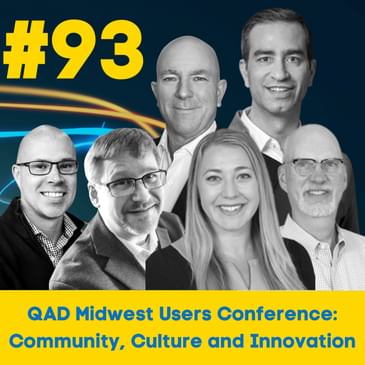
This episode, recorded live at the QAD Midwest Users Conference, brings together voices shaping the future of automotive supply chains. Hosts Jan Griffiths, Terry Onica, and Jim Liegghio sat down with leaders across the supply chain to explore the future of manufacturing, technology, and collaboration.
French Williams from Royal Technologies began by sharing how his company approaches automation. Rooted in a culture of “better tomorrow than today,” Royal has built a model where IT and supply chain work hand in hand, co-developing solutions that allow the company to scale and respond to customer needs.
Autokiniton’s Andy Amstuz takes the mic next. As VP of IT and president of the Midwest User Group, he explains why user groups matter. The community becomes a lifeline when challenges hit.
Autokiniton already puts real-time performance data in front of operators at every work center, proof that frontline visibility drives better decisions.
Fresh off his keynote, QAD’s new CEO, Sanjay Brahmawar, outlined his vision for ERP as a “system of action” rather than a “system of record.” He introduced QAD’s Champion AI, designed to reduce mundane work, tackle complex challenges like inventory costs, and accelerate implementations through “Champion Pace.”
For Sanjay, culture is as critical as technology. He points to Redzone’s track record — 26% productivity gains, 81% more engagement, and 35% lower attrition — as proof that empowering shop-floor teams changes the game.
Andrea Hyska and Jon Smith of Lacks Enterprises brought the conversation down to the plant level, sharing how their IT teams succeed by staying connected to the business.
From extending QMS capabilities to implementing shop floor applications, they credit a collaborative culture and hands-on leadership with making automation practical and effective.
AIAG’s Fred Coe closes with where data exchange is heading. EDI is not going away, but APIs and Catena-X will complement it, which makes standardization and supplier voices at the table urgent. He reminds listeners that shaping the future requires participation, not waiting for others to decide the direction.
By the end of the conference, a clear theme had emerged: culture drives adoption, community accelerates learning, and technology is only effective when people are fully engaged.
At this conference, the future of automotive supply chains didn’t feel theoretical; it felt like it was already being built, one conversation at a time.
Themes discussed in this episode:
- The role of company culture in driving collaboration between IT, supply chain, and operations
- How automation helps tier two suppliers like Royal Technologies scale effectively and serve customers better
- The value of peer networks and user groups in supporting manufacturers through industry volatility
- Why empowering frontline workers with real-time production data strengthens decision-making on the shop floor
- The shift from ERP as a “system of record” to ERP as a “system of action” under QAD’s Champion AI vision
- Why Lacks Enterprises prioritizes teamwork and floor-level engagement to ensure technology projects succeed
- The growing importance of APIs and Catena-X in shaping the future of EDI and supply chain data exchange
- The risk suppliers face if they fail to engage in setting industry standards for connectivity and collaboration
Featured guests:
Name: French Williams
Title: Director of IT at Royal Technologies Corp.
Discussed: [01:27] French shared how Royal Technologies approaches automation with purpose. Guided by the mission “better tomorrow than today,” the company uses collaboration between IT and supply chain to scale effectively, serve customers better, and stay ahead of change through partnerships with QAD and AIAG.
Name: Andrew Amstutz
Title: Vice President, Information Technology at Autokiniton
Discussed: [09:50] Andy talked about the value of user groups, the challenges of volatility and rising demands in the industry, and how Autokiniton empowers its frontline workers with real-time data to stay ahead.
Name: Sanjay Brahmawar
Title: CEO of QAD
Discussed: [17:21] Sanjay laid out his vision for QAD, introducing Champion AI to cut routine work, lower inventory costs, and speed ERP activation to 90 days, while stressing that culture and speed matter as much as technology.
Name: Andrea Hyska
Title: Applications Manager at Lacks Enterprises
Name: Jon Smith
Title: Director of IT at Lacks Enterprises
Discussed: [32:19] Andrea and Jon explained how Lacks Enterprises keeps IT close to the business by meeting people where they work, breaking silos, and driving projects like QMS extensions and shop floor apps that actually fit daily operations.
Name: Fred Coe
Title: Chair, AIAG EDI Advisory Group
Discussed: [38:10] Fred returned to talk about the future of EDI, APIs, and Catena X, noting both excitement and caution among suppliers. He stressed the urgent need for standardization and encouraged every tier to get involved.
[Transcript]
[00:00:00] Jan Griffiths: This is the Auto Supply Chain Prophets podcast, and we are on a mission to bring you the latest insights and thought leaders leading the charge on supply chain transformation in our beloved automotive industry. This podcast is powered by QAD and AIAG. I'm Jan Griffiths, your host and producer. Let's meet your co-hosts.
[00:00:27] Jim Liegghio: I'm Jim Leggio from AIAG.
[00:00:29] Terry Onica: I'm Terry Onica from QAD. Let's dive in.
[00:00:36] Jan Griffiths: The Auto Supply Chain Profits podcast is on the road again, and we are live at the QAD Midwest Users Conference, and I can't wait for you to find out who we're gonna have sitting right here in the empty chair. Terry, what are you looking forward to?
[00:00:55] Terry Onica: Just getting the pulse of what's going on in the industry. The sense of agentic AI know was a big topic. So just curious to kind of feel the vibe of that.
[00:01:05] Jan Griffiths: Yeah. Jim, what are you looking forward to?
[00:01:06] Jim Liegghio: Yeah, I kind of echo Terry's comments. Hear what's going on, what users are concerned about, what they're sharing with their peers, with each other, what they're learning from each other. I think it's just a really interesting and exciting time in automotive. And I haven't really been to an IT kind of user's conference actually ever, so I'm kinda looking forward to the vibe today, for sure.
[00:01:22] Jan Griffiths: Alright, let's get to it.
[00:01:27] And joining us with the mic today is French Williams. He is the IT Director at Royal Technologies. Welcome to the mic.
[00:01:34] French Williams: Thanks, Jan. Excited to be here.
[00:01:36] Terry Onica: Well, we love Royal Technologies. Jenny Smith has been on our program a couple of times, and so we're so excited to have French here today, who's the IT Director at Royal Technologies. Tell us a little bit about what Royal Technologies and what you do.
[00:01:49] French Williams: We are an advanced engineering and manufacturing company, headquartered in Hudsonville, Michigan. We've got facilities in Alabama and Texas. We serve the automotive industry. We're a tier two supplier, also the furniture and consumer goods. And we're most known for plastic injection molding.
[00:02:06] Terry Onica: So, French, when we had Jenny on the show, we know you're very big user of automation. For tier two, I mean, even at the tier one level, I think you would surpassed many. You really believe in it from an ERP standpoint, from a quality standpoint, every application that you would have tied into ERP, Royal Technologies is really behind it. So tell us about that. What's that philosophy and how do you drive that for your business users?
[00:02:31] Jan Griffiths: Yeah, the mindset. How do you do that? Because this partnership between IT and supply chain is so critical and you have that, but what's the secret sauce, French? Come on. Spill.
[00:02:41] French Williams: Yeah. I think it's largely because of the company and the culture that we've got. Our mission statement says: to be better tomorrow than we were today. And I think the collaboration that we have internally, whether it's between IT and the supply chain groups, or IT and other business units, it's really driven by that culture. And I think, as a result, we've been able to co-develop with our business partners within Royal, some great solutions. Over the years, it's really helped us scale over time and grow into the company we are today.
[00:03:10] Terry Onica: So, from a tier two perspective, we had nominated Royal Technology as the voice of the tier two. For other tier twos out there, French, what's the value that you get from automation? Why is Royal tech passionate about it? Can you share other companies out there? The advice. What you get from that?
[00:03:27] French Williams: For us, we don't even really call it automation, internally. It is partially efficiency. For us, it's all about how do we scale and how do we grow successfully, how do we grow efficiently, how do we meet our customers' needs better?
[00:03:39] And that's really where the conversation starts. And in some cases it's like, hey, we can remove this work by automating it or making it easier for us, which in turn makes it easier for us to serve our customer's needs. So, it's never been automation for automation's sake, it's always about how to, how do we become better.
[00:03:56] Jim Liegghio: Awesome. Yeah, and I love that Terry called you the voice of the tier two because that's perfect. You just joined AIAG and we have a lot of reach into tier ones and OEMs, but tier twos. And we're really sharpening our focus on tier twos and how we can enable you guys to have more access to tools and do better. What would you say one of the reasons you guys joined A IAG recently.
[00:04:13] French Williams: I can't speak for Jenny and the supply chain team, but I can speak from a of an IT perspective and I, and from where I sit, I'm glad that we've embraced A IAG and we're becoming a part of the group. Because I think historically.
[00:04:26] We've been very reactive to changes in the industry, especially, automotive. And I think being a more active partner in A IAG, we can plan some of the things that are coming down the pipe, you know, be a part of the conversation on the changes that the tier ones are talking about.
[00:04:40] When we first started our relationship with QAD Terry in your. With within QAD and A IAG we're huge parts of, our decision to, to partner with QAD because of that and the fact that we can now, join Terry as a member of a IG and be a part of those conversations, I think is gonna allow us not only react, but plan to react better to the changes that are happening in the industry as opposed to just waiting for things to happen.
[00:05:05] Trying to figure out answers.
[00:05:06] Jim Liegghio: Welcome to the table. We love hearing that. Yeah. Welcome to the conversation for sure.
[00:05:10] Jan Griffiths: Yeah, I hear two things coming from this interview with you and also when we interviewed Jenny, and that is you wanna stay ahead of the game. So the mindset and the culture at Royal is very much looking forward, you're looking ahead, but I also see that you understand the value of collaboration, the fact that you're on A IAG.
[00:05:30] Encompasses both of those things, but also QAD, the fact that you are here in this conference today, it's all about collaboration and sharing best practices, and that really goes back to a cultural mindset issue within the company.
[00:05:44] French Williams: Oh, a hundred percent. And I'll give Jenny a lot of credit.
[00:05:46] When she joined our organization, she really educated, I think not only myself, but the company on. The importance and the role that supply chain should have within a manufacturer. And, we've been following her lead up to this point and including myself. And then I would also say what you guys do here on this podcast, educating people on, the importance of supply chain careers and what that can mean for people.
[00:06:07] And just trying to attract people, to the industry and to that role is really important. 'cause I honestly believe, as we're competing, as a nation against, the Chinas of the world and things like that. Having, strong supply chain practices and professionals and collaboration.
[00:06:21] 'cause that's one thing I've read recently is that, the Chinese tier ones are collaborating together. Yeah. And that's dangerous. If, you know the automotive industry that we know today doesn't start breaking down some of the silos, which I know. Yeah, I read your book, Jan. I read your book.
[00:06:36] I mean, that is exactly I think what needs to happen and a IG has a big role in that, so.
[00:06:40] Jim Liegghio: Well, thank you. Yeah, and culture's a big piece of that too, right? So the culture of, fostering development of future professionals in supply chain and then other areas, it included, the cultural thing is huge and kudos to you guys at your company at Royal, because you guys pride yourselves on your supply chain culture and your collaborative culture.
[00:06:55] So tell us. Little bit about that, about the culture at your company?
[00:06:58] French Williams: I mentioned the mission statement is to be, better tomorrow than we were today. And that's not just as a company, that's individual development. It's, the way we work together, you visually see it and feel it at the company.
[00:07:09] And at the end of the day, I believe we feel that in our business results and our relationships with our customers and our partners and suppliers.
[00:07:16] Terry Onica: And one thing I wanna know too, and I talk about it a lot, especially when I teach the M-M-O-G-L-E class at a IG, the importance to the people that take the class.
[00:07:24] You gotta get out and understand your software. What's the value of coming to a user group for those that don't come? And also like the champions of manufacturing, you're always attending those. What do you get out of that? How could you encourage others to do it? 'cause I think there's so much value that people don't understand about it.
[00:07:41] French Williams: I'll tell you the number one reason I'm here is for the collaboration. Q 80 D for example, they're an enormous partner for us right now. Our success is intertwined. Sanjay, the new CEO is here. Very interested to hear what he's got to say, what his vision for the company is. We work with a lot of the Q 80 D partners, out there.
[00:07:58] So it's, maintaining those relationships, just encouraging the collaboration, learning about the, what other best practices are in the industry that maybe we can take advantage again to become better tomorrow than we are today. That's the reason I'm here. It's collaboration, it's relationships, it's getting better.
[00:08:13] Terry Onica: One last question. And we gotta talk about is agentic ai. What do you think about that? I know that's really big for q and e. We're getting a lot of companies that wanna do that.
[00:08:24] French Williams: Historically, I've been very conservative on technology. I've been around long enough, been at Royal 23 years, so I've seen a lot of technology cycles and.
[00:08:34] I'm kind of waiting to see a little bit, but we're definitely seeing some of the value today. I see it as a tool. We're a Google shop at Royal. We did release the Gemini chat bot to the organization, and we've noticed some really interesting things. So after about a month or two, we took a snapshot of who was using it and, I would say it was, small subset of users, compared to the whole that have access to it.
[00:08:56] And then we looked three months later. And the number of people using it didn't increase, but the people who are using it doubled. Like they are using it twice as much as they were using it before. So, that tells me there's value there. Yeah, for sure. People are finding utility and it's helping them.
[00:09:12] So then for us, knowing that now, it's like, well, how can we then take those best practices and show other people in the organization and help magnify and multiply that, that improvement or that value that we're seeing out of it. We're definitely gonna be very reliant on our partners, QAD and others as, as far as like, well, how can we leverage this new tool to add some of those efficiencies and those automations that you know that we wanna make and make those things better?
[00:09:36] Using Agen ai,
[00:09:38] Jan Griffiths: talking about Agen ai, it's time for us to head to the main stage and see Sanjay, the new CEO of QAD, make his keynote. Let's go.
[00:09:50] And joining us at the mic today is Andy Amstutz. He is the Vice President of IT for Autokiniton. Andy, welcome to the mic.
[00:09:59] Andy Amstuz: Thank you.
[00:10:00] Jan Griffiths: Auto, Kenton, what do they do?
[00:10:02] Andy Amstuz: We make steel, stampings and welded assemblies for the automotive industry. So the frames and the, body and white are the structural components of the vehicle that protect the passengers in a crash.
[00:10:14] Jan Griffiths: So you are hardcore manufacturing.
[00:10:16] Andy Amstuz: Hardcore manufacturing, steel. Yes.
[00:10:19] Jim Liegghio: It's a noble calling there, I would say. Yeah.
[00:10:21] Terry Onica: But Andy, you also wear an other hat and that's why we're here today at the Midwest User Group. So tell us about your role here as the president of the user group. What do you do?
[00:10:29] Andy Amstuz: Yeah, so I also serve as the president of the Midwest User Group Board. The board of directors for the Midwest User Group meets year round plans, two conferences a year. Engages with. Industry that is around the Q-A-D-E-R-P system, as well as the other QAD ecosystems, the products, and, it's a lot of fun.
[00:10:49] Terry Onica: Why are user groups so important to everybody that comes here? What do you think? They get out of 'em. I always like to tell people when I do training in MMO, Jillian, in the industry. I'm always telling people to plant, you need to get to the user groups. You need to understand what's going on with your software, make sure that you're using all the capabilities, but what do you see as somebody that's been to user groups for many years and now is the president?
[00:11:10] Andy Amstuz: I think it has, a lot to do with having a community of support around you. And I think it's very similar with A IAG, right? That like having that community of people. That you can rely on, that you can call upon, that you can say, Hey, I'm struggling with this. Like, how did you solve this problem?
[00:11:28] Or, what are the new things that I need to know are coming up? How do we, engaging with partners and things of that nature. Really it just forms that ecosystem of people that you can engage with.
[00:11:40] Jim Liegghio: Yeah, that peer support is incredibly important. I think it's one of the underrated benefits of being an A IG member is you have that network of peer support around you at all times, and it's exemplified here at the conference.
[00:11:49] I've already noticed it this morning, Andy. So kudos to you on that.
[00:11:51] Andy Amstuz: Yeah, that's great. Yeah, sure. That is absolutely the environment that we wanna produce.
[00:11:56] Jim Liegghio: What do you think some of the people in the room are going through right now with the change of automotive and the change of pace and what's going on in automotive? It's kind of a crazy world right now, so what are some of your peers going through right now?
[00:12:05] Andy Amstuz: It's a tough world out there. Yeah, for sure. I think that you see. A lot of variation in volumes. A lot of, increase in requirements and in quality requirements. I think that the pace, the volatility, the unknowns.
[00:12:21] That are in the industry right now. There's a lot of struggles.
[00:12:25] Terry Onica: Andy, as the leader of it at Auto, Kenton. How do you manage through all this? How do you keep the business community happy, give them what they need, stay ahead of the game? How do you do that?
[00:12:36] Andy Amstuz: Yeah. Well, it's not an easy task and for any technology person in a manufacturing company, right?
[00:12:42] You're looked at as the expert, like, well, you're. In charge of it. You must know everything.
[00:12:48] Jim Liegghio: Right. And just fix it, by the way. Yeah.
[00:12:49] Andy Amstuz: And oh, by the way, when is that gonna be fixed, right? It's a struggle to keep up on it. And I think that's part of why the community becomes so important, because no one of us knows it all, right?
[00:13:01] We rely on one another as a team, to understand what's happening. Between, our things that are changing in our infrastructure, things that are changing in our ERP environment, right? As well as things that are happening in the AI front. It's things change very quickly.
[00:13:19] Jim Liegghio: Yeah, we just heard on that from Sanjay directly on that.
[00:13:22] Yeah, from QAD just moments ago. So that I was actually quite interested in what he had to say about AI in these different phases of what QA D's implementing, what are your thoughts on some of those that are in the pipeline?
[00:13:31] Andy Amstuz: So it's really pretty amazing in terms of how far things have come just in the last year.
[00:13:37] And we're seeing that in a lot of different areas. I think that, in the beginning, AI was very much. A solution looking for a problem. Now, when companies, that specialize in certain areas like manufacturing, like safety, really are now utilizing the tools and embedding those tools within their products, now we actually have things that we can give to a manufacturer that they can make use of.
[00:14:04] Terry Onica: I've known you for years at Auto Kinon. You're a great customer and you're a tier one supplier and we had a tier two supplier on prior to you. But at a tier one level, you really do a great job. When I look at leaders in it, you are always ahead of the game. Years before, I think most tier one auto suppliers are.
[00:14:24] What do you attribute that to? What is it? The culture? I know it's you, but how are you so visionary and always being on top of your. Your organization and your industry?
[00:14:35] Andy Amstuz: We're definitely always looking ahead. Our customers are always pushing us to do better. Our customers are certainly pushing us from a quality standpoint, from a reliability standpoint.
[00:14:45] When we talk reliability for it, a lot of times we're talking cybersecurity. We're talking about the impact of the supply chain with, how do we make sure that our IT and our OT environments are secure, right? And so, it's interesting in that, a lot of times tier ones have to act very. Entrepreneurial. And we have to really be looking at how do we take advantage of ensuring that we can build that reliability into our environment?
[00:15:15] Terry Onica: And how do you. Break down the silos at AutoD because you're very good. You're always doing things across the border with supply chain, with quality. How do you break those silos down? How have you been successful at that?
[00:15:29] Andy Amstuz: So I think that one of the best ways to do that is to really just be engaged with the business leaders, right? So we have, cross-functional teams, as well as corporate teams, corporate materials, corporate quality. That help to drive our manufacturing plants.
[00:15:46] And from an IT standpoint, we're engaged with each of those teams, right? So they're helping to drive standards across the organization and we're helping. Helping to prepare those standard processes.
[00:15:57] Jim Liegghio: Yeah, I think it's so important to stay in touch cross-functionally. Even in the smaller companies, I think it's easy to get siloed within the organization and kind of focus on your own priorities.
[00:16:05] So it's great to hear that you guys have, tools in place and mechanisms in place to keep everything, rowing in one direction together. It sounds like,
[00:16:11] Jan Griffiths: I like the cross-functional approach. Yeah. But something that just struck me listening to Sanjay's keynote earlier. Is the depth that we're now going into the shop floor, into manufacturing.
[00:16:24] No longer are we just, how do I say it? Not really investing or paying that much attention to our frontline workers. We're talking about bringing data to our frontline workers so that they can make decisions. How do you feel about that?
[00:16:41] Andy Amstuz: Well, we've actually been doing that. At Autokiniton for a number of years now.
[00:16:44] Wow. So we have a very mature manufacturing execution system so that our operators have a display that tells them on the last 10 cycles, how did I do this shift? How have I done last shift? How did they do. Like having that data being presented. Every single work center, every single operation that we have, we have operation displays that display that data and make it available to our frontline workers.
[00:17:11] Jan Griffiths: There it is, Autokiniton ahead of the curve. Andy, thank you so much for joining us today.
[00:17:16] Andy Amstuz: Thanks.
[00:17:21] Jan Griffiths: I am joining us at the mic is the brand new CEO of QAD, Sanjay Brahmawar. Sanjay, welcome to the mic.
[00:17:27] Sanjay Brahmawar: Well, thank you very much for having me. It's really a pleasure.
[00:17:30] Jan Griffiths: It's great to have you. Now you are fresh off the stage from your keynote, and one thing I learned about you and our listeners might be surprised to know, and that is you are not the typical tax CEO now are you?
[00:17:43] Sanjay Brahmawar: No, actually, it's funny that I was telling, the audience and all our clients that, I started as a management trainee and my first job at the age of 21 was going onto the shop floor in Honda and actually learning how to assemble an engine. So I obviously moved across the different functions and I learned, how difficult it is to run a plant actually in real life.
[00:18:03] And when. Things come together when processes, people and systems all come together, how powerful that can be in a sense.
[00:18:10] Jan Griffiths: Yeah. I love that you're able to bring that deep perspective.
[00:18:14] Sanjay Brahmawar: Yeah. No, I mean, All my career I have spent in industrial and in and around manufacturing, so I actually really a understand the space, but I also love the space.
[00:18:23] Jim Liegghio: I really enjoyed your presentation, Sanjay. I really identified with your career progression and kind of understanding what you're trying to do in the world of ERP. So I gotta dive right into the tough questions. What needs to change about traditional or legacy ERP systems in your first 180 days impression?
[00:18:37] Sanjay Brahmawar: Great. Well, thank you for the question. Look, I would say, nobody ever told me that ERP is exciting, right? Nobody woke up in the morning and say, woo-hoo, I'm gonna work on ERP today. Yeah. So I think we're gonna change that. And, we are fundamentally shifting from ERP from a system. Record to a system of action, and at QAD, QAD's Next Gen is basically going to help look at, predicting understanding, helping make decisions, as we look forward in, in business. And so, that's what we are focused on. Systems of record, current ERPs that basically tell you what's happened.
[00:19:15] And we wanna shift to being able to help make decisions. So we want an ERP that is, adapting, act and decides, can, define and, identify issues, can recommend decisions, and also automate certain tasks. And that's the kind of ERP that we are building, which is gonna be a lot more engaging.
[00:19:36] Also when you think about, attracting talent and in manufacturing, as I, can tell you, it's a pretty big challenge bringing talent into manufacturing. We want systems of engagement that actually allow, the next generation manufacturing, shop floor, worker to be able to be a lot more proactive and a lot more, predictive in a sense.
[00:19:55] Jim Liegghio: Yeah. You mentioned possibly up to 2 million vacancies in manufacturing. I think it was by what, 2033 I think was the prediction. So, oh, yes. It's a real problem today and it's a huge exponential problem tomorrow, so
[00:20:05] Sanjay Brahmawar: You're spot on. Manufacturers have very limited choices, right? You can either retrain or re-skill, which is not that easy. You would deploy robots, which is also very capital intensive, quite rigid. But the third option, which is actually I think the most human centric option, which is to, leverage AI to be able to really raise productivity and raise the engagement of your workforce.
[00:20:25] And I think, that's where we are focused, particularly with RedZone and, adaptive.
[00:20:30] Terry Onica: You know one thing, Sanjay, I'm always saying a lot on this show is a lot of companies still use a lot of spreadsheets, word documents, to manage the plant, and you see those throughout the organization. And I'm always trying to say when it gets to ai, you're gonna be stuck.
[00:20:46] You've got to start embracing systems. So for those listeners out there that are on the journey that maybe are using more manual things, all their data's not in the system yet, how would you recommend they get on board and kind of move through and quickly get to ai?
[00:21:01] Sanjay Brahmawar: Yeah. Terry, good point, right? I mean, there's always a certain level of skepticism when you have, such break.
[00:21:08] Through technology and I think this is a once in a generation moment for all of us, particularly in manufacturing. I think, manufacturing generally has been slow to adopt technology and you can see that and there are reasons, good reasons for that. But I think with Agen ai, there's an opportunity now to sort of leapfrog, not worry so much about the UIs and can we have 10 more features but actually go to agents that can make.
[00:21:31] The working, the engagement as well as the productivity gains more significant. And I can tell you the way we are, launching Champion Air, which is our agentic layer, is with a very clear idea about impact and outcomes. We're not talking about actions and, PowerPoints and, sales gimmicks, but actually agents that are in three buckets.
[00:21:52] And so bucket one for me is. Productivity agents. And in some ways I look at it's take the mundane out really. So you've got different personas in manufacturing, production planner, inventory planner for each of these personas. We have built a set of agents and these agents, take the mundane out because there are so many mundane activities or routine activities people have to do in the ERP to get to a production plan and then make decisions.
[00:22:16] So we want to get those. That base work done with an agent and then help the person make the decision faster, make a better decision, a more value-based decision. So that's number one bucket. The second bucket is in fact, very specific problems that are complex to solve. And we are building agents like.
[00:22:33] Reducing inventory, carrying costs. Not an easy problem to solve, but you have an agent that looks end-to-end and can help you do that. And then the third bucket is implementation agents. Often people are, troubled with long lead times in implementing projects of two years or. Just continuous deployments that don't go well.
[00:22:51] And we are building an agentic way of implementing, which we call Champion Pace, which is a 90 day implementation. And that's, again, implementation agents that help you move configuration, move customization, and to bring data in faster.
[00:23:06] Jan Griffiths: Let's talk about that. I'm going to play devil's advocate with you for a moment. So there's listeners out there right now. Supply chain leaders ERP implementation in 90 days. Are you already in mind? Right. That's what they're thinking. Yes. You know that. Yeah. So what do you say to our listeners who are thinking there's not a chance that you will implement an ERP in 90 days? What do you say to the naysayers?
[00:23:30] Sanjay Brahmawar: Well, first of all, I think, we are looking at it from a different point of view. We are thinking not implementation. We're thinking activation. So it's in fact, we want to take out this, long amount of time that's gone through, goes through iterative sessions of configuration.
[00:23:47] So we wanna think more AI activated, driven, setups. We are thinking of. Pre-configured industry templates that we have built, and we think about faster AI driven ways of bringing data into, and also AI driven testing for, for the solution. And that basically condenses and reduces the amount of time and effort that you have to do.
[00:24:08] And hence you take the complexity out. You actually. Build a lot more standardization, and therefore, a faster, path for a client to get to outcome. So 80, 90% of your core processes are operational and running in a mid-size manufacturing plant within 90 days.
[00:24:25] And we believe that we're the only, manufacturing focused ERP that can actually really make that claim.
[00:24:32] Jan Griffiths: Yeah. Wow. So it's not just manufacturing hype. There's clearly a plan, a strategy, and I'm assuming pilots behind this to make this a reality.
[00:24:42] Sanjay Brahmawar: Absolutely. We are obviously launching it officially as, at our Dallas event of manufacturing, but we've already got clients that are working with this new methodology and, should be getting up on stage and being able to share their experience.
[00:24:55] Jan Griffiths: I can't wait to hear that.
[00:24:56] Terry Onica: So one of the things that you said this morning that I thought was fascinating, you've been here 180 days and you've visited 75 customers. Yeah. Wow. My question is, of the automotive suppliers that met with, what are you hearing for them?
[00:25:12] What are they saying that their concerns are right now? What's the heartbeat of the auto industry right now?
[00:25:17] Sanjay Brahmawar: Oh yeah. So yes, I have met a lot of customers and in fact many of them have been, automotive customers. I've done the Detroit, Michigan, belt and it's been a fantastic experience and I can tell you that, these executives, these leaders are, they have a plethora of issues on their tables right now.
[00:25:33] Whether it is EV transformation, it's, supply chain volatility or workforce capability and all at once, you know, so there's a lot. To deal with. And I think, they have the challenge that they can't move fast enough. The systems can't keep pace with all this change. And what I think automotive, companies providers they actually need is, they need, speed, they need visibility, and they need, more transparency. And that's exactly what we are working on with our next gen capabilities to be able to allow these, changes to be made at the space of manufacturing, so
[00:26:05] Jim Liegghio: you mentioned the risk of inaction in the space right now, and that really hit me this morning, the way you explained that.
[00:26:10] And, people don't realize, I think the risk of standing still in any industry, but especially in this industry. Can you talk a little bit more about that, Sanjay?
[00:26:17] Sanjay Brahmawar: Yeah. On one hand I think it's good to be skeptical as I said, every new wave. But you know, in this case the genie's out of the bottle, right?
[00:26:25] So this change is happening whether you like it or you don't like it. So, so I think it's also the responsibility of leaders to, while be skeptical, but also. Think about the opportunity and what this opportunity can bring to your organization. What can it give you in terms of speed? What can it give you in terms of transformation?
[00:26:42] What can it give you in terms of competitive advantage? And I think AgTech AI and what we are building with Champion ai, particularly it is a way to be able to do. Speed to value, low total cost of ownership, and absolutely better and more powerful engagement on the shop floor. So look, I think personally in manufacturing, speed is no longer strategy.
[00:27:05] It's actually super critical. It's a must have. Yeah.
[00:27:08] Jan Griffiths: Speed. We know in the automotive industry, it's all about speed right now. And my favorite tagline is, you wouldn't run a 4K video on a 95 Windows operating system. Right? Absolutely. But yet too much. In automotive, we're focused on the technology, when I say operating system, I mean the culture, the how we get things done, how we make decisions about putting data into the hands of the people that actually can make decisions.
[00:27:36] My question to you is this. How important is culture to being able to fully adopt the speed, the level of speed, and I love your terminology, champion pace. So to get to that champion pace, how important is culture?
[00:27:53] Sanjay Brahmawar: I think super important. I think, look, this is why. Why we acquired RedZone couple of years ago. Because RedZone is where you bring, people and performance together. And I think the winners in the current, environment are gonna be people that can bring the right combination of tech and the leverage of agen AI and that human, human-centered approach. And I think that is, to your point, a more engaged workforce on the shop floor is.
[00:28:20] Is a lot more productive workforce. When we look at, red Zone, we've deployed Red Zone in 1700 plants. There are 600,000 people that are using Red Zone on a daily basis, making priorities, making decisions. We've done 6 million runs, production runs, and that they tell us, we have the data which says these manufacturers are achieving 26% productivity gains.
[00:28:43] 81% more engagement on the shop floor and 35% reduction in their, workforce attrition. So if you combine that, you can figure it out. Is culture important? Absolutely. It's super important, but it's very important how you address it. Just talking about culture is not enough, right?
[00:29:00] Jan Griffiths: Yeah. Absolutely.
[00:29:02] Jim Liegghio: Yeah. It's a powerful combination. Like you said, that retention piece, there's probably hidden factors there that benefit if you can retain somebody. Lot less money to spend on training the next person, that kind of thing. So there's, I think there's hidden savings there too, in a way. Right? So,
[00:29:14] Sanjay Brahmawar: absolutely. Very big.
[00:29:15] Terry Onica: And speaking of results, share with them the results of the inventory at Gentech AI that we're doing and what we're seeing already with our customers.
[00:29:22] Sanjay Brahmawar: Yeah. As I said, inventory carrying courses, probably the third highest cost that a manufacturer has, it's a cost of, equipment or machinery.
[00:29:31] You've got cost of people and then you've got inventory carrying costs, and it's actually a very complex problem to solve because you've got different variables, different parameters that you have to look at, so many things keep changing.
[00:29:42] Look at, you know, well the schedule stability, I mean, schedule stability directly.
[00:29:46] I inventory Yeah, your inventory at hand, your, production schedule.
[00:29:50] And then, the inventory planner actually has to do a pretty amazing job trying to balance obviously these carrying costs and, stockouts, right? I mean, at the end of the day, if you have a stockout, it costs a lot more, to have a production line that's sitting idle.
[00:30:03] So this is a very delicate balance and. What we've done is we've built an agent that basically looks at this end-to-end, chain and then, comes up with recommendations, how to adjust the replenishment levels. And we run this now with, a couple of our customers. And what we've identified is that if you look at six months back data, you can reduce the inventory carrying cost by almost 30%.
[00:30:25] For a particular plot, and I can't name the customer right now, but I can tell you that at, champions of Manufacturing, in Dallas, we will have the customer on stage sharing their experience. And I think this is game changing. This is not about, we need lesser people.
[00:30:38] This is actually making our people 10 x more powerful, maybe even a hundred x more powerful. And this is what I think the message is very important about the gen ai. There's a lot of noise about people reduction and I think one has to even think about it. An average system user with agen ai with champion AI will be almost three x to four x more powerful.
[00:31:00] A super user can be anything between 10 x to a hundred x more powerful with champion ai. So that's another way of looking at and how much more, and think about the productivity gap and the number of open positions we have in manufacturing. Absolutely. Yeah.
[00:31:11] So we are not talking about reducing, we're actually talking about how do we fill that gap,
[00:31:15] Terry Onica: and our earlier guest was from Royal Technology, and he was sharing when they started using ai, just in general. You know, AI and just doing your day-to-day work, there was a limited portion of the workforce that did it, but when they went back, what he was, really surprised at is it necessary, didn't grow more, but those people that were using it really dug deeper.
[00:31:35] Absolutely. And so that's what I think is really cool too, is. Once you understand it, that the ability to drive deeper and get more savings, I'm sure that's gonna happen. Yeah.
[00:31:45] Sanjay Brahmawar: And that's core to our strategy. Terry. I want Q 80 to be known as deep, in manufacturing. And the way we get the depth is obviously our talent and our people. But leveraging ai, we go really deep to be able to help our clients with that. And then the second thing is, well, how do they easily use this technology and have a much more engaging experience? That is exactly what it's all about.
[00:32:05] Jim Liegghio: You're empowering decisions faster. Absolutely. More intelligently.
[00:32:08] Jan Griffiths: And that's a beautiful way to close today. Thank you for so much for joining us at the mic.
[00:32:12] Sanjay Brahmawar: My pleasure. Thank you so much for having me.
[00:32:14] Jan Griffiths: And joining us at the mic is Andrea Haines and Jon Smith from Lacks Enterprises. Andrea, welcome.
[00:32:25] Andrea Haines: Thank you. Thanks for having us.
[00:32:26] Jon Smith: Thank you,
[00:32:26] Jan Griffiths: Jon. Good to have you here.
[00:32:28] Jon, tell us Lacks Enterprises, what do you do?
[00:32:33] Jon Smith: Well, we are primarily an automotive supplier. We supply both tier one and direct to the OEMs.
[00:32:41] We are primarily located out of Grand Rapids, Michigan have probably over near about 20 manufacturing facilities, in that region. And, a pretty large employer in the Grand Rapids area. One of the top 10.
[00:32:56] Jan Griffiths: So you've been in automotive a long time, manufacturing them,
[00:32:59] Jon Smith: Lacks has been there a long time.
[00:33:01] Third generation, you can read about it on the website and, I've been in manufacturing and myself about 30 plus years, so.
[00:33:11] Jan Griffiths: And you lead the IT group, correct?
[00:33:13] Jon Smith: I do. I'm the IT director.
[00:33:16] Terry Onica: So at the user group, I think, one of the really big benefits that I see is organizations like yourself that are using the product, come and share your successes and what you're doing.
[00:33:27] And I know, Andrea, you are here today to talk about what you're doing, at Lacks. So can you share with us what your session is about? Or, I know you're doing a couple sessions, so just let us know what you're doing.
[00:33:39] Andrea Haines: Sure. The session today is focused on QMS or EQMS. It's actually kind of highlighting some of the team because they did a lot of the work behind the scenes for this project.
[00:33:49] But, it's related to needing, documents translated. We're highlighting some of the no-code extensions that are available in QMS and how we tailored those to fit this, project. Need
[00:33:59] Jan Griffiths: QMS.
[00:34:01] Andrea Haines: Yeah, the quality management system.
[00:34:03] Jan Griffiths: Thank you.
[00:34:04] Andrea Haines: No problem.
[00:34:05] Terry Onica: And also you have a role here on the leadership of the board here.
[00:34:10] And you're liaison within on the liaison committee. So can you tell us a little bit about that too? That's an interesting role you have here as well.
[00:34:17] Andrea Haines: Yeah. I'm happy to be on the board. I think it's been really a positive experience. Tracy and I serve on the liaison committee, so we work with, the vendors and sponsors to make sure that they have a great experience at.
[00:34:28] The conference as well. One of the things that came out of the survey that we did last, session was, a more interactive evening event. And so we're gonna trial it out at this one and hopefully it's a success.
[00:34:40] Jan Griffiths: Yeah, I like that.
[00:34:41] Jim Liegghio: Yeah, that piqued my interest. Andrew, we were talking just before the recording here, what the peer-to-peer networking, what's so important about that?
[00:34:47] What do you hope to get outta that? What do you hope the other peers get out of that this time?
[00:34:49] Andrea Haines: I think it's great. I mean, it's a great support system. There's great shared learning, and it's just nice to be able to go back to the business, bring that innovation, bring that support, and really be able to draw from the connections that you're building on the board and then really everyone who's showing up.
[00:35:04] To the conference. What's the continuity behind that? After the show ends? After the conference ends? Is there a regularity to those meetings then? Do you hope to establish or with the board? We do. We meet every month, because we have to plan for the next, conference. And really it's nice because we have a good mix of customers.
[00:35:19] We've got QAD representation and then we also have vendors. So when there are needs that come up, with the business, it's easy to be able to tap into those resources, or just throw an idea around and get some feedback, which is really helpful.
[00:35:32] Terry Onica: At Lacks I really respect what you two do.
[00:35:36] You're very much behind, automating your processes. You're both in it very much understand the business. And Lacks is always to me, when I think of, making sure that you're automating throughout the whole organization, you're always at the forefront. What do you two both just attribute that to?
[00:35:54] What's your culture like? That really drives it. 'cause I have to say I work with a lot of companies, QAD, non QAD and it's rare to really see the embracement of it and technology. And so what's your secret at Lacks to make that happen?
[00:36:09] Jon Smith: We've always striven to have, a team approach, so that's been number one. And something that I actually preach and teach along the way, for the entire IT group. So, it's always been a situation where. I look at it like a DevOps type thing where the development people and the operations people will collaborate and that way, and look to the business to say, all right, what are the needs of the business that we're addressing and how do we add value in that fashion?
[00:36:40] So with those as a motivation behind, what we do, it's then allows us to present to the business solutions that actually, work for them.
[00:36:51] Terry Onica: How do you break silos at Lacks? How do you get everybody talking, communicating? How do you do that? Any secrets there?
[00:36:57] Jon Smith: I wouldn't say there's any secrets, but it does amount to getting in front of people on a regular basis. So making the effort to make the trips to where they're at and meet them their, world, so to speak, and whether that's on the shop floor or in the office with them, but always making a point of getting together with them in their space and not just waiting for them to come to us.
[00:37:22] Terry Onica: What has been one of the most exciting projects that you've implemented?
[00:37:28] Jon Smith: Besides QAD? Yeah.
[00:37:30] Terry Onica: Or just within the QAD suite or outside of it, but what's been something that you are one of your initiatives that you've been really proud of?
[00:37:38] Jon Smith: I would say, using, the shop floor application production execution, has been quite rewarding.
[00:37:45] It's also been very challenging, but at the end of the day, the business, relies on it, completely and being. Able to put it in a position where it's a working solution for them and they look to it for everything they do. It's been very rewarding to put that in play.
[00:38:03] Jim Liegghio: And there you have it. Jon and Andrea from Lacks Enterprises. Thanks very much for being on the show today. Enjoy the rest of your conference.
[00:38:09] Andrea Haines: Thank you guys.
[00:38:10] Jon Smith: Thank you.
[00:38:15] Jan Griffiths: And joining us at the mic is a fan favorite from our auto supply chain profits audience. And that is Fred Coe. Fred is the chair of the EDI Advisory Committee at AIAG. Fred, welcome back.
[00:38:28] Fred Coe: Thank you for having me back. I'm getting comfortable in this seat now. I might be applying for a full-time role here.
[00:38:33] Jan Griffiths: Did you know you were a fan favorite with our audience?
[00:38:35] Fred Coe: I did not.
[00:38:35] Jan Griffiths: You do know.
[00:38:36] Terry Onica: So, Fred, what did you have to share today in the session?
[00:38:40] Fred Coe: I had a great time. We had a really good turnout. I thought the audience was engaged, but we talked about, the survey that we did back in February, about, augmenting EDI with APIs and there seemed to be some interest there.
[00:38:50] Talked about the survey results and the paper that still needs to come out and, getting that out. We talked a little bit about Catena X. A lot of good questions about Catena X. I know it's new or newer to the North American industry. It's more mature in Europe. It was the first number of our audience members heard of Catena X.
[00:39:08] So we had a lot of good questions and, we talked a little bit about, some a SN updates, over at gm. So it was a good session
[00:39:14] Terry Onica: and we were so grateful that Jim was in the audience because. He was our expert on Catena X and taking a lot of questions, but it's great for you to see the
[00:39:24] Jim Liegghio: Yeah, no, I, was very surprised how many questions and interests were around Catena X was glad I was in the room.
[00:39:29] I was trying not to hijack your show up there. You guys did a great job up at the front of the room. But yeah, it was interesting to hear the audience's questions and definitely people were engaged and interested and I'm glad we have a ton of resources on our website, aig.org. If you're wondering, if you're listening and you're wondering what Catena X is all about or some of the use cases, definitely go to aig.org.
[00:39:47] Take a look. Ava is our new virtual assistant, A-V-A. Yeah, I love that by the way. Yeah, it's really cool. She walks across the street. I know she looks at our resident knowledge about AIAG publications and first one's free kind of thing. You gotta take a look and take a cue on what Ava's gotta say.
[00:40:01] So ask for what Catena X is and what it means for the future of automotive. For sure.
[00:40:04] Terry Onica: So everybody was in the session that Fred had. What did you take away? I took away Everybody is saying, please, whatever you do, standardize. Right? Yes. That was one takeaway that I had. What did you take away from the audience today?
[00:40:18] Jim Liegghio: Yeah, I would say there was a little bit of apprehension over what's changing with EDI. We got, I think people love and are married to their traditional EDI systems and they're one eye open on this Catena X thing, right? So I think, my takeaway was people are a little bit cautious maybe, but they were definitely interested to hear what you guys had to say up there. So. Really, great session.
[00:40:35] Jan Griffiths: I got the, it's working, you know, just don't mess with it. Like that's the feeling that I got out there. What about you, Fred?
[00:40:41] Fred Coe: I heard the same thing about standardization. They want standards, not guidelines. There's some fear that, with Catena X, with APIs that, the OEMs and the tier ones will, come together and say, yep, we're gonna do one thing, and then we, it ends up splintering off.
[00:40:55] So that seemed to be their biggest concern with both the APIs and with. Catena X,
[00:41:00] Terry Onica: but one thing that I always like to stress, if you're a tier one out there and you want more standardization, you've got to get involved at AIAG and get involved in the EDI advisory work group, where we're gonna be looking at the APIs, get involved with AIAG, with Catena X.
[00:41:17] You have to let your voice be heard. Because you can't just say, I don't have the standard. They need to hear what you need to have at AIAG, and that is the best place to do it.
[00:41:27] Jim Liegghio: Yeah. Well, Sanjay talked about the risk of inaction, and I guess that's a living example, right? If you don't engage and you're not at the table, then don't complain later on.
[00:41:34] But I guess the point is, engage now while you can and be a volunteer and get your voice heard. So the risk of inaction is not letting people know what you need and what you want.
[00:41:42] Terry Onica: And I've seen it work many times. And Fred, you have too.
[00:41:45] Fred Coe: Yeah, absolutely. And I, Terry, I guess I would add, it's with Catena X and the potential for Catena X to go so much further down the supply chain that it's not just a tier ones that need to be involved, right?
[00:41:55] It's the tier twos, threes, fours, is the potential for Catena X what I think it's going to hit? They should all have a voice.
[00:42:03] Terry Onica: Absolutely.
[00:42:04] Jan Griffiths: What was the question, Terry, about QAD's involvement in the OEM messaging? What was that about at the end? I didn't quite understand that.
[00:42:12] Terry Onica: Sure. In our November release, we are going to put out standard OEM messages and we're starting with Honda first, and then the others will follow, so we'll have a library for our customers to go grab Honda.
[00:42:25] and be able to use that in the product or whatever OEM that they're looking for. So that's starting in November and we're starting first with Honda, and then the others are gonna be released after.
[00:42:35] Jan Griffiths: I love that because so often we hear about communication coming from the OEMs. Making its way all the way through the tier.
[00:42:42] And EDI was probably the first example of that actually happening, becoming a reality. So now I'm hearing, here's something else that's coming along the lines. To bolster communication. Yes. From the OEM through the supply chain.
[00:42:55] Terry Onica: You know, I have a question. Speaking of bolstering through the supply chain, and this is kind of Catena X, but it's also OEM and it ties it back to Jenny.
[00:43:03] One of the things that Jenny had said, Jenny Smith, she was on our podcast, she's a tier two. She was mentioning. When information comes down with a “Why”, it's so much more helpful. So here she is sitting at tier two I, need to know what happened, why, and that helps me to respond better. And I was wondering, would that be something Catena X could do?
[00:43:22] Take the OEM bulletins, put 'em out there so that anybody that. Needs to grab it could be able to get it because I was always thinking about that communication. 'cause you would probably start with a bulletin if, a plant was going down or if on demand really changed one day. But do you think Catena X could do that? 'Cause you hear that all the times, the lower tiers are craving for that information.
[00:43:45] Jim Liegghio: Yeah, I mean it's multi-tier, multi-tenant. Right. So yeah, theoretically it would be a great way to conduit information down quicker than supplier bulletins. To your point, I think right.
[00:43:53] Terry Onica: it's the “Why” right? That needs to be passed down the supply chain.
[00:43:56] Fred Coe: So I think that's a great observation. That's one I hadn't, as a use case I hadn't even thought about, but I think that's a great observation and I think that's what Catena X is being built for.
[00:44:05] Terry Onica: Yes. Yeah, I'm really excited about Catena X and really truly being able to get something down the supply chain. 'Cause you can get it one tier, but you can't get it all the way down. And I think that's the huge promise of Catena.
[00:44:18] Jim Liegghio: Yeah. So Fred, we're here at the Midwest Users Conference for QAD and we're hearing a lot of different perspectives, from the audience members. What do you think the peers in the room are getting out of the conference?
[00:44:26] What do you think they could look to learn this next day and a half or so? What is your perspective on that?
[00:44:30] Fred Coe: There's so much about QADI, I've learned, in the short time I've been the libraries that Terry, that you were talking about and, the ease of doing that.
[00:44:38] I'm hoping that tomorrow you hear more questions about Catena X, and what effect that might have.
[00:44:42] Jan Griffiths: Yeah. Okay. Any closing thoughts, Fred, that you would like to share regarding the future of EDI? Because we know our audience just loves it when you talk about that.
[00:44:52] Fred Coe: So I guess I would say thank you for having me out here.
[00:44:54] For me, I really want to help get EDI to whatever it's going to be next. My personal opinion, the more I learn is APIs will be there to augment and compliment. EDI will still be here when I retire in 10, 15, 20 years, depending on my plan. But, I think APIs are really gonna start playing more of a role, as we move forward and, helping our industry get there.
[00:45:16] And the more we're out here and, talking about it, I think the faster and, easier it's gonna be for the industry.
[00:45:22] Jan Griffiths: That's right. So get out here, get to user conferences, join A IAG, listen to the podcast, It's all about collaboration and getting involved, and that's a beautiful way to close today.
[00:45:32] Fred Coe. Thank you.
[00:45:34] Fred Coe: Thank you.
[00:45:39] Jan Griffiths: Well, as a wrap, guys, we're done and we're finished with our live recording at the QAD Midwest Users Conference. And I have to tell you what really excites me about where we're at today is the conversation around not just technology, but really understanding manufacturing and bringing the technology to the shop floor that came through loud and clear.
[00:46:04] The tone was set with Sanjay's. Keynote this morning where he really gets it, and I love to hear that. But it came through with all of our guests and to me that was the biggest takeaway. Terry, what about you?
[00:46:18] Terry Onica: I think the biggest takeaway for me is to see some of our guests that are so far along with, automation and technology. Sitting back and I think we all observe culture really means something.
[00:46:31] Jan Griffiths: Oh yes.
[00:46:31] Terry Onica: It really means something. Listening to all of them that are doing so well, they've got that positive culture that breaking the silos down, not being afraid of having to make a mistake. That really came across with all the guests we had today.
[00:46:45] Jan Griffiths: And you're so right, Terry, but it's a huge differentiator between the companies that we've seen today that are ahead of the curve with technology and the ones that are not.
[00:46:57] Terry Onica: Yes, absolutely.
[00:46:59] Jan Griffiths: Jim?
[00:46:59] Jim Liegghio: Yeah. For me it was kind of witnessing the sense of community and the sharing among the peers, right? I think it's got its own dynamic, a conference like this and seeing kind of the users and super users of the system sharing best practices, talking about the sense of community, but Terry's point's valid.
[00:47:13] It's cultural too. Like some of these best in class organizations. I see a culture of promoting, Cross-functional learning and understanding of each other's needs, and that sets them apart. I think even the IT department, collaborating with quality and supply chain, it's all one well-oiled machine.
[00:47:27] But I definitely, what struck me about today was the sense of community within this user group.
[00:47:31] Terry Onica: And numbers too. We talked with Sanjay. Yeah. Yeah.
[00:47:34] Jim Liegghio: Up to 2 million manufacturing vacancies by 2033, right? Yes. So getting people excited about manufacturing, getting 'em back on the shop floor. And part of that's empowerment. Sanjay talked about the tools that empower the operator to make smart decisions faster, right? So you drive that empowerment down to the lowest level.
[00:47:50] So yeah, it's a huge problem that the manufacturing talent shortage for sure.
[00:47:54] Terry Onica: And also 30% with the Gentech AI in reducing inventory costs. That's huge.
[00:48:00] Jan Griffiths: Yeah, that's a big number.
[00:48:01] Jim Liegghio: And turnover. Yeah.
[00:48:01] Jan Griffiths: If that number doesn't get CFOs and CEOs excited, I dunno, what does.
[00:48:06] Jim Liegghio: Yes, It was a great day. A lot of learning took place today. It was a really good environment, for sure.
[00:48:10] Jan Griffiths: It was indeed. And that's a wrap from the QAD Midwest User Group Conference.
[00:48:15] We'll see you next time.
[00:48:17] We love to hear from our listeners, reach out to any one of us, our contact information is in the show notes. And if you want to dive deeper into our content, check out our website at autosupplychainprophets.com.