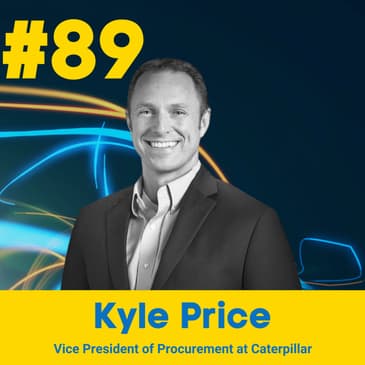
When constant disruption becomes part of the job, how do you build a supply chain that can withstand the pressure?
In this episode, Kyle Price, Vice President of Procurement at Caterpillar, joins Jan, Terry, and James to talk about building a resilient, flexible supply chain in a world that doesn't slow down. With more than 20 years at Caterpillar, Kyle offers valuable insights that acknowledge the complexity of supply chain management, but don't get stuck in it, either.
Supply chains have gone from regional and predictable to global and deeply complex. And the risks? They're not just more frequent; they're evolving.
So how do you lead through that? Kyle says don't wait for the perfect solution. You build flexibility into the design from the start. That means dual sourcing, holding strategic inventory, and using AI to spot risk early.
These ideas aren't new, but Kyle explains how to make them work. Dual sourcing, for example, doesn't have to mean doubling your cost. You can move quickly when needed by identifying backup suppliers early and setting up agreements in advance, without spending heavily up front.
Kyle brings up the importance of prioritization. With massive amounts of supplier data, it's easy to get lost. He explains how Caterpillar uses internal tools, including AI, to focus on what matters most to the business. For them, managing risk is not a side task. It's part of how procurement works day to day.
He also talks about the impact of new regulations. Kyle doesn't see this as something to push back on. For him, it's about being prepared and building the capability to respond. Resiliency, in his view, isn't just about avoiding disruption. It also affects cost, quality, safety, and how competitive you can be.
Jan asks Kyle what he'd tell supply chain leaders who feel too busy or too stretched to think about risk strategy. His advice? Start small. Don't wait for perfection. Focus on the pain points you already know, and build from there. Whether you do it in-house or partner up, just start.
Toward the end, Kyle talks about how he stays connected to the industry outside Caterpillar through his work on the AIAG board and with students at BYU's supply chain program. His goal isn't just to manage risk today but to help build better supply chain leaders for the future.
Themes discussed in this episode:
- Why flexibility needs to be designed into the supply chain from the start
- How AI and data tools are reshaping procurement risk strategies
- How to lead a supply chain team when the pressure never stops
- How risk planning must be embedded into everyday procurement processes
- The growing compliance pressure to trace materials across global supply chains
- How supply chain resiliency drives cost, quality, and safety improvements
- The importance of industry engagement in building the next generation of supply chain leaders
Featured on this episode:
Name: Kyle Price
Title: Vice President of Procurement at Caterpillar
About: Kyle is the Vice President of Procurement at Caterpillar, overseeing the Supply Resiliency organization. In this role, he leads a global procurement team that supports all four Caterpillar verticals and is responsible for developing enterprise strategies and processes that promote operational excellence within the supply network.
Over his 24 years with Caterpillar, Kyle has worked in various areas of the business, taking on increasing levels of responsibility in procurement, operations, quality, supply chain, and product development. He has also completed an international assignment in Europe.
Additionally, Kyle is a member of the Board of Directors for the Automotive Industry Action Group (AIAG) and the Global Supply Chain program at the BYU Marriott School of Business.
Connect: LinkedIn
Mentioned in this episode:
- Materials Management Operations Guideline/Logistics Evaluation (MMOG/LE)
- Customs Brokers Continuing Education Program
- Supervisor Boot Camp
Episode Highlights:
[03:15] Volatility Isn’t Going Anywhere: Supply chains used to be local and predictable, now they’re global and exposed to everything from tariffs to cyberattacks. Kyle breaks down the two biggest reasons volatility keeps growing and why flexibility is no longer optional.
[05:02] No Silver Bullet: Managing risk isn't one thing; it's a mix of smart design, early warning, and fast response when the unexpected hits.
[07:54] Rethinking Dual Sourcing: Flexibility doesn’t have to mean double the cost. Kyle explains how smart planning makes backup sourcing possible without breaking the bank.
[12:48] When Priorities Shift: Kyle shares how Caterpillar uses dynamic tools and AI to reassess priorities as customer needs and global risks evolve constantly.
[14:59] Built into the Process: Forget the flashy initiatives that fade with leadership changes, Kyle explains why real resiliency only sticks when it's embedded into the way decisions actually get made.
[16:27] Map It or Miss It: Regulations, tariffs, and labor shortages aren’t going away, and Kyle explains why supplier mapping isn’t just a compliance task, it’s a strategic edge.
[19:42] Just Start Somewhere: Risk strategy doesn’t need a perfect system, just a starting point. Kyle shares why tackling your obvious pain points first is often the smartest way to build long-term resiliency into everyday procurement work.
[23:07] Giving Back, Gaining More: From shaping industry-wide solutions at AIAG to mentoring the next generation at BYU, Kyle finds just as much inspiration outside Caterpillar as he does within it.
Top Quotes:
[04:29] Kyle: “We certainly talk about tariffs as an area of volatility. Today, we have the pandemic, but you look at things like cybersecurity threats or labor disruptions in the world. I mean, many of those types of things are increasing in double-digit percentages. In some cases, triple-digit percentages according to Gartner, year over year. And to be able to manage that, you've got to have a supply chain that really can be flexible. You can't predict all these types of disruptions, as Jan started off with, I mean, we get disruptions every day of different types.”
[16:46] Kyle: “When we have an immediate supply disruption, but there are so many regulations that are occurring, where we're being asked to geolocate our source of supply of rubber down to a tree and in a specific geolocation. There are regulations and requirements that we're going to have to comply with. All these things require mapping into the supply base. So, it's, you know, we can stand back and say, "We don't want to do it. And it's very complex, and it's going to be hard." Unfortunately, or fortunately, depending on how you look at it, it's something that we have to go do and we need to go do inside of the space.”
[20:40] Kyle: “Start small. When we developed capabilities here at Caterpillar, we were piloting them in some of the areas that were the most urgent for us. And I think that is a great way to learn, and to get into detail while generating value at the same time.”
[24:43] Kyle: “It’s really fun working with students. I mean, when you think about where one of our biggest opportunities is, we've got to get people excited and prepared for the challenges and the opportunities that we have in the supply chain. And so, you get in with them, and you'll be able to mix the experience that we all have with the fresh minds and the fresh eyes and ears of students who are top-notch in terms of thought process. And while they learn a little bit from me, I learn a ton from them. I mean, we have certainly taken back concepts from them and brought them back to my own job to apply them. It's not just about giving back. You get as much as you give, if not more, which is pretty cool.”
[Transcript]
[00:00:00] Jan Griffiths: This is the Auto Supply Chain Prophets podcast, and we are on a mission to bring you the latest insights and thought leaders leading the charge on supply chain transformation in our beloved automotive industry. This podcast is powered by QAD and AIAG. I'm Jan Griffiths, your host and producer. Let's meet your co-hosts.
[00:00:27] Jim Liegghio: I'm Jim Liegghio from AIAG.
[00:00:29] Terry Onica: I'm Terry Onica from QAD. Let's dive in.
[00:00:36] Jan Griffiths: And welcome to another episode of the Auto Supply Chain Prophets Podcast. Let's check in with my co-host, Terry Onica. What have you been up to?
[00:00:43] Terry Onica: Well, I'm really excited. A major OEM who's launching a new EV vehicle has asked us to come on board as a technology provider to their supplier meeting, where they're gonna launch everything they want the supplier to know. So we'll be there with the suppliers, and so I find that really exciting.
They're gonna talk about MMOG/LE. They're gonna talk about quality. Obviously, the OEM knows I can help out with the AIAG side on MMOG/LE, but just really glad that the OEMs are doing that. So often, you know, they come to us for something they're gonna need and we don't hear it firsthand. So, I'm super excited they're gonna do it that way.
[00:01:19] Jan Griffiths: That sounds good. Jim, what have been up to?
[00:01:22] James: Hey, Jan. Yeah, I'm really excited. We have a couple new classes coming up. You know, part of my role here at AIAG is overseeing our training program. So, one of our programs is a Customs Broker continuing ed Program worth 12 continuing ed credits. It's a multi-part series. The kickoff and the wrap up are in person here at AIAG and then there's some kind of webinars in the middle there that kind of continued the educational path. So, I'm really excited to be part of that launch.
We also have a new Supervisor Bootcamp launching in October, and that's more of a shop floor supervisor, somebody who's been promoted to a supervisory or team lead role that really needs to understand kind of the fundamentals of that role. So, two new classes coming up. Super excited about both of those.
[00:01:58] Jan Griffiths: I love that one. I love the shop floor supervisor because how many times have we seen that in our collective careers where people are promoted and we do not give them the training they need to be good leaders.
What does it even mean to be a leader? This is my life, right? This is what I do every day, all the way up to CEOs. That's my first question on the Automotive Leaders Podcast is who are you as a leader? And so many people have to really think about that. Absolutely.
We're a tough industry, particularly in supply chain. We've been through all kinds of crisis. That's why I am thrilled today that we have a guest on our show who's been through it all. He is a Vice President of Procurement at Caterpillar. He has spent almost 24 years of his career at Caterpillar working in all different facets of supply chain and operations. And I love it when people have worked in more than one function, so you can understand the impact of procurement on other functions and what better than operations. So, we are thrilled today to bring onto the show Kyle Price. Kyle, welcome to the show.
[00:03:09] Kyle Price: Hey, thank you Jan. Really appreciate the opportunity to be here and Terry and James look forward to the discussion.
[00:03:15] James: Kyle, thanks for being here. First of all, burning question on my mind. What do you see as the big drivers for future supply chain volatility? I know it's easier to ask than probably answer, but what do you see as the biggest drivers for volatility right now?
[00:03:28] Kyle Price: We can get caught up in the volatility of the moment and for sure there's some trade disruption and things that are occurring at the moment that are creating some volatility. But I think it's important for us to look over the long haul.
For me, it kind of comes down to two factors: One is really how our supply networks are designed, and they are becoming more and more complex. If you look at lot of businesses 20, 30 years ago, they were fairly regionally focused both in terms of their supply and where they manufactured. And today, much more global supply chains. You know, with the Asia market opening up over the last 20 years. And so, you've got a lot of more movement of goods in the world across the space. And so that just creates a lot more complexity and a lot more technology.
And when you think about electrification or autonomy, it's driving a lot more complexity into our products across automotive. The automotive mobility spaces. So, much more complex supply chain than we had 20 years ago.
And I think, for the future, the other one is really our external environment. We certainly talk about tariffs as an area of volatility. Today, we had the pandemic, but you look at things like cybersecurity threats or labor disruptions in the world. I mean, many of those types of things are increasing in double digit percentages. In some cases, triple digit percentages according to Gartner, year over year. And to be able to manage that, you've gotta have a supply chain that really can be flexible. You can't predict all these types of disruptions, as Jan started off with, I mean, we get disruptions every day of different types.
[00:05:02] Terry Onica: You know, Kyle, it's crazy. Even just with recent flooding and everything, you've got so many diverse and dynamic risks. How do you prepare from them all, especially from the OEM perspective, when you have so many suppliers everywhere around the world. What do you do?
[00:05:18] Kyle Price: That is honestly probably one of the biggest questions that we struggle with. It's three different areas that we focus on and I focused on in my career. The first is really to try to be proactive. It's how your supply chain is designed, and if you can design your supply chain to be more flexible, that's the best.
I always use the example of currency. You can't chase currency around the world, right? Currencies will fluctuate. The Brazilian Real may be strong in one year, and four years from now, it'll be weak. And so, if you try to chase currencies as they change, you end up with a lot of inefficiency.
But if you have a supply network, if you have manufacturing capabilities in multiple regions, and strategic inventory to buffer as you shift, then you can manage through those changes, regardless of where and when they occur. And that's the ideal, to have multiple sources or strategic inventory or different approved technologies that can be utilized depending on whether you have a restriction of a certain technology in a certain region of the world that you can no longer access, or you have a tariff in a region of the world. It's really about flexibility and desensitizing the chain. Now, you can't do that everywhere and that's one of the big challenges.
So then, you move to predicting risk. There are a lot of technologies and capabilities out there that are far better than they used to be at predicting risk. Third parties have a lot of capabilities today. AI is augmenting those capabilities. The ability to sift through all the data that is coming in across the globe, both private and public.
I mean, historically, that would all have been manual. Now, we can sift through that kind of millions of lines of data in seconds and get insights. In some cases, we're, you know, I'm seeing us, the industry being able to predict disasters or risks weeks if not months in advance of them actually occurring. And so, if we can predict risk, then we can prepare for risk.
And the last one's just being able to be really efficient at reacting. We won't predict everything. We won't proactively design a supply chain that can resolve all types of risks that are gonna come at us. And so, when we do have risk, we've gotta make sure we're not wasting time learning. And that's another great way AI can come in. It can rapidly help us assess where our risk is at both within the supply chain, and then assess where is our risk inside of our factories as an industry, our supply base as an industry.
So, that's really the way I think about it from my perspective. It's not one answer. I wish it was. I wish we had the silver bullet to the supply chain. That would make my job a lot easier and I would sleep more. But it is complex.
[00:07:54] Jan Griffiths: Kyle, I'd like to go a little deeper into this idea of flexibility and you mentioned the idea of multiple sources, dual sourcing, multiple sources. From my career, that has always been a very difficult sell because you're talking about duplicate tooling. Often, there's a cost involved. So you're looking at the risk of not having a flexible supply chain and being locked into one supplier, and then you've got this cost.
If you're dual sourcing or multiple sourcing, there's a cost to that. How do you handle that internally? What does that look like? Because I know that there's many people listening to this right now going, "Yeah, dual sourcing, that's one way to get a flexible supply chain. That's a great idea." But the cost associated with it.
[00:08:40] Kyle Price: It's a good question, and there's two things I'll say about that: One is we're prioritizing, when you look at the options that you have to do dual sourcing, you can't do it everywhere. To your point, it's capital intensive. In some cases, it's R & E. So you may have validation or other work that needs to be done, design work in order to qualify those sources. Certainly, suppliers have work inside the chain. So, it's important to have some type of prioritization methodology.
You can look at it different ways, whether it's revenue, whether it's profitability, or probably most importantly, what are the critical applications your customers need in order to be able to do their work? And protecting those. And if you really had your core minimum offering that you needed to supply to your customers in the event of a disruption, then those are the critical ones where you want to have those backups.
And then, the other thing I would highlight is dual sourcing is not a binary decision — it's a continuum. So, I always give the example, you may have a supplier that has a financial concern and a disruption. Let's say it's a highly engineered component. The first half of the work that you will do — if you've not done it proactively — is that you will want to understand who are the qualified suppliers that can make that highly engineered component? And that can be difficult to prove out. Who are the competitive suppliers? Do you have commercial agreements set up with them such that you could turn them on quickly?
And so, if you took a two-year cycle, maybe to bring on a highly engineered component, the first half of that is just getting alignment internally to the business that the suppliers qualified, that the commercials are correct. And so you can do all of that work. You can even make some off tooling prototypes to prove out capabilities or measure other current products without ever spending that capital or an R & E. And now you've compressed the time it takes to move source from two years to a year.
So you're much faster from that perspective. You haven't spent a dollar of capital, you spent minimal R & E at this point, and the supplier hasn't laid down any fixed costs. And so, now when that disruption occurs, you may be able to hold some strategic inventory and then accelerate the remainder of that year and be able to crunch it. So, people always think about, I either need a dual source or I don't. There are a lot of decisions you can make in between that that compress the time to react.
[00:11:05] Jan Griffiths: I like that. That's great.
[00:11:06] Terry Onica: I'm a big fan of Supplier Relationship Management Tools, and only because, to your point, Kyle, you can't start to even understand risk or sourcing and the capabilities of suppliers if you're not tracking it somehow, right? If you don't have access to it. And one of the things I am seeing that is really exciting is even seeing tier two start to invest in these tools because I think they're really — I shouldn't say I think — I know these suppliers are starting to understand, I can't figure this all out if I'm not keeping track of everything about them: what they're doing, relationships, financial viability, where they're located in the world.
So, I just think it's critical now more than ever for the whole chain to invest really in being able to understand your supply base quickly. And now with AI, that just makes it even more sweeter because you can start predicting some things as well too. But super excited to hear about the things that you're talking about, what you can do by keeping on top of your suppliers.
[00:12:05] Kyle Price: Yeah, I think that's a great comment, Terry. And it could be overwhelming, right? Many companies have millions of part numbers and thousands of suppliers. So, you know, where do you start? How far do you go? And then, when you get into the end tier network, you end up with tens of thousands or hundreds of thousands of suppliers. So, I think it's critical, again, for you to prioritize. You may not map your network all the way down into the chain on every component. You may not decide to have visibility and monitor risk.
One of the challenges of monitoring risk is that you get a lot of noise, right? So, it can be overwhelming. You can become desensitized to it. You get so many alerts, it's like alert fatigue. And so, it's important to keep it focused on those areas that are most critical to your business and to your customers for sure.
[00:12:48] James: So, along those lines, Kyle, do you do like a reset once in a while and kind of look at your priorities and kind of step back and look at the forest from the trees? How do you prioritize this? You mentioned prioritization a few times, and it's obviously how you manage it, but is there ever a point where you need to step back and kind of just take a new approach or how would you say you manage that?
[00:13:06] Kyle Price: It's a good comment, James. I think it comes in a lot of different ways. I'm sure you've all experienced it in your cases, and maybe you could talk a little bit about your experiences. I think all of you have been in and around industry. But I think sometimes we have big initiatives. You know, Caterpillar publicly has talked about the fact that we launched a supply resiliency initiative out of Caterpillar. Really focusing on a major upgrade in some of our capabilities a number of years ago. And so sometimes you need major initiatives to drive step change in capabilities.
In terms of an ongoing basis, we have — and the industry has available to it — dynamic tools that can, once you set the parameters right, as profitability changes, as revenue mixes changes, as our customer needs shift, as risks shift around the world.
The great thing about a lot of these tools and capabilities — and they're growing in their power — is with AI and with these algorithms. You can dynamically get information that shifts where your focus is. And we have, you know, certainly great tools inside Caterpillar to be able to do that where we can see risk and dynamically receive alerts or areas where we need to refocus, relook priority before, you know, can change as risk shift across the world or as our product mix, shifts, or technology shifts.
[00:14:30] Terry Onica: From my perspective, I really respect that. You're talking about how you're staying on top of risks. It's in your culture. It's in the DNA of what you're doing, that you know what's out there, and you always gotta be looking for it, focusing on, you know, what do we need to do?
It just sounds like from your perspective at Caterpillar, you're really passionate about staying on top of risk and just being ahead of it. So, when the time comes that you gotta prioritize, it's already in your DNA, you're ready to go.
[00:14:59] Kyle Price: Terry, that's a really good comment. And one of the big beliefs that I have that you need processes. You can always drive these big initiatives. We've always, you know, many of us have been through 'em. You can probably name some, Jan or James or Terry, that you've been through, right? That were like big corporate initiatives that flashed. And then five years later everybody was either a joke or no one remembered them. When the old CEO goes out and the new one comes in and a new initiative starts.
And the key with resiliency and being able to adapt to volatility is that those processes and tools and capabilities you put in place have to be embedded in core business processes. Whether they could be new product introduction or when you do sourcing councils — you make sourcing decisions. There are standard work or there is standard work that's used for those.
If you build those tools and the questions and the knowledge and the capability into those processes, then by default, as you launch new products or you make sourcing decisions, if you rely on people or an initiative to drive it, it will run out of its time.
You know, it will not sustain in a business, especially large businesses, and you get into big industrial businesses or automotive businesses. They're highly complex, and you've gotta build that into business processes. You can't have it as a standalone.
[00:16:14] Terry Onica: And I hope people now really understand and suppliers, you know, 'cause when you look at it, think back to the tsunamis. What was that? 2010, 2011? And that's when mapping became critical. I remember the OEMs started saying, "You know, we need to map our suppliers," and here we are 2025, and while a lot are progressing, I think people are starting to wake. So, I hope that people really take take heart what you're saying. You've gotta be prepared. This is gonna happen. There's no more excuses anymore.
[00:16:43] Kyle Price: Well, it's not just those types of disruptions, right? When we have immediate supply disruption, but there's so many regulations that are occurring, where we're being asked to geolocate our source of supply of rubber down to a tree and in a specific geolocation.
There are regulations and requirements that we're gonna have to comply with. All these things require mapping into the supply base. So it's, you know, we can stand back and say, "We don't wanna do it. And it's very complex and it's gonna be hard." Unfortunately or fortunately, depending on how you look at it, it's something that we have to go do and we need to go do inside of the space.
Tariffs are a good example as well. You know, we talk about 232 related tariffs on copper and steel and aluminum derivatives. If you have your supply base mapped and you have detailed understanding of your supply base, it's so much easier for you to go and get that information. And that brings you a competitive advantage in these spaces.
So, finding and getting those tools in place, not just for one problem, but trying to make those solutions capable of answering and solving multiple problems. It gets back, Jan, to your question on, "Well, how do you generate value?" Right? I mean, it's not just I'm trying to solve one problem.
I would like to get back to your question on value too. I will say, you know, we have found in a lot of cases, I find that multiple sources are not... often times not a non-cost and resiliency is not a non cost.
I use an example, there are many different ways to solve resiliency, and so if you take upper Midwest fabrications labor as a resiliency risk, right? We were short welders in the last cycle. We were projected to be even more short of welders, skilled labor in the next cycle. And it's only gonna get a worser problem as the US population stagnates and eventually starts to decline in terms of working age in the next couple decades. So, that's a resiliency risk, right? When we go to ramp, if we can't get supply from that supply base.
One of the ways to solve that is to put, to look at digital factory and automation. And so, yes, there's a cost associated with putting digital factory and automation in place, but that can reduce the cost of the components coming outta that supplier. As you gain efficiency, it can, and does improve quality in many cases of the welds and the products that are coming out of there. And improves our agility. So, you know, more highly automated factory can tend to ramp up faster than one that relies more heavily on manual labor. It's a mix that we have to have.
But those types of things are good examples of where we can drive resiliency and we can drive cost and quality and safety. We believe that having the ability to avoid disruption, one of the highest causes of safety in any factory will be non-standard work, and if you can avoid disruption to your factory, then you prevent non-standard work and you keep your people in your factory safe. You gotta think about resiliency and redundancy and inventory not just as a one solution to this, but it has so many other benefits it can create.
[00:19:42] Jan Griffiths: Kyle, you strike me as somebody who's very forward thinking. You're thinking about resiliency, you're thinking about this level of uncertainty, risk mitigation. I have to tell you, when I was in a supply chain role, I didn't wanna deal with that. Because you have a limited number of resources. There's tremendous pressure for cost reduction, for sourcing, new program launch, for dealing with problem suppliers. The last thing I wanted to do was to have to think about what could possibly go wrong and put people and time and attention into risk mitigation. But you seem to do that.
So, my question to you is this, what advice would you have to leaders in procurement and supply chain that are listening to this show right now? If they don't have these processes already embedded into their work stream and their work culture, where should they start? What's that one piece of advice you would give them?
[00:20:37] Kyle Price: Well, I think the first piece of advice is to start small. When we developed capabilities here at Caterpillar, we were piloting them in some of the areas that were the most urgent for us. And I think that is a great way to learn, and to get into detail while generating value at the same time.
So, I think if you haven't started, I would pick — and we all know those, right? — You don't need tools to tell you that which components or suppliers are right. I mean, you can get around this table, right? And we could all talk about the suppliers or components that hindered us at different companies or different spaces. The obvious ones, you can start work on those straight away, and so I wouldn't wait for a perfect solution or system to start the work. That would be advice number one.
Two is, certainly, to the degree that your company may or may not have the same capability of a major automotive as an example. And so, you want to decide is this something that we think we can do ourselves? Or are we gonna partner with third parties? And there are a lot of capable ones out there. Or industry associations like a AIAG that may be able to help point you to the right areas or have brought together standard solutions.
You gotta decide for yourselves. Is it all us? All third party? Do we need some help, or is it a mix? I think that's important as well. And then, the last thing I would say, again, just going back to that other point, your ultimate goal has to be to build it into various business processes.
One I didn't mention and is important for procurement leaders is you have to have at some kind of cadence or regular category strategy refresh and, you know, how often that is, depending on the resources you have. What that forces you to do right is to step back from the hectic day-to-day business, Jan, that you're talking about, that we all live, and it's hard to get out of.
And that cycle then allows you to kind of sequester the team back for periods of time to think about the future, and to think about the three to five year plan and the long term strategy and the big things, innovative things that we need to go do. And as it relates to volatility, resiliency, and these types of things that we've talked about, you should build those elements into your category strategy, right?
So that as you're going through your category strategy as a normal course of business, you will naturally think about volatility and resiliency and other aspects of supply. that it's not something that you have to force, or run as a one-off bespoke initiative.
[00:23:07] Jan Griffiths: Great advice. And is if all of that doesn't keep you busy enough, Kyle. You care passionately about the world of procurement and supply chain. What do you do outside of Caterpillar to support that passion?
[00:23:21] Kyle Price: Yeah, I mean, from my very first, I had a professor back at Western University where I did my business and undergrad that got me in Dr. Russ Moray, he was a great mentor. And he really did get me passionate about supply chain and procurement, and I've been so ever since. And I've done my best, whether it's been, you know, early on, through certifications, but lately, a lot more as I've gotten more experienced, been involved in different associations. So, I am part of the board of AIAG, and I've been on the board a couple different times, a little over four years, and I find that to be really a great forum for different groups, right? I think, historically been known as more automotive, and now it's getting into, off highway like us and other industrials.
And the supply network has a voice. A lot of the board is made up of other entities that are tier ones, tier twos, tier ends down the supply chain. So that form is really excited for me. And the nice thing about it is we're not trying to solve a problem for Caterpillar or for whoever it may be. We are solving a problem for the industry. And we are trying to make things more efficient for the industry, and that's fun when you get into things like that, right? Because that leaves a legacy.
The other one, I'm part of the BYU Marriott School of Business Advisory Board for Global Supply Chain. It's really fun working with students. I mean, when you think about where is one of our biggest opportunities, we've gotta get people excited and prepared for the challenges and the opportunities that we have in supply chain. And so, you get in with them, and you'll be able to mix the experience that we all have with the fresh minds and the fresh eyes and ears of students that are top-notch in terms of thought process.
And while they learn a little bit from me, I learn a ton from them. I mean, we have certainly taken back concepts from them and brought them back to my own job to apply them. It's not just about giving back. You get as much as you give, if not more, which is pretty cool.
[00:25:24] Jan Griffiths: That's a great way to close us out today. And, Kyle, the three of us, we're also on the Wayne State Supply Chain Advisory Board, so we get you. We know exactly what you're talking about.
[00:25:37] Terry Onica: Absolutely.
[00:25:38] James: Love it.
[00:25:38] Jan Griffiths: Yes. Yes. Okay, that's it from four people who care passionately about supply chain and procurement in the automotive industry. Kyle Price, thank you so much for joining us today.
[00:25:49] Kyle Price: it was a pleasure. Thank you Jan and Terry and James. I really appreciate the opportunity.
[00:25:53] Jan Griffiths: We love to hear from our listeners, reach out to any one of us, our contact information is in the show notes. And if you want to dive deeper into our content, check out our website at autosupplychainprophets.com.