What does it really take to walk into a new purchasing leadership role and make it work?
Not the strategy deck. Not the org chart. The real work: the people, the data, the relationships, and the hard lessons learned along the way.
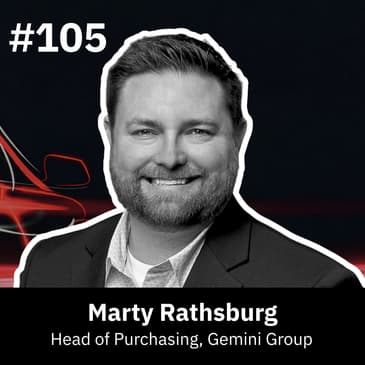
In this episode, Jan Griffiths and co-host Tom Roberts sit down with Marty Rathsburg, the newly appointed Head of Purchasing at the Gemini Group, a tier-one and tier-two automotive supplier with 17 locations across North America. Marty brings decades of experience in operations, purchasing, quality, and private equity. But this episode isn't about what he's done before. It's about what he's doing right now and what he's learning in real time.
One of the challenges Marty ran into? The ERP. Gemini operates on a single ERP platform across all 17 locations, which sounds like an advantage until you realize every plant has customized it differently. Job shops, serial production, different commodity codes, and different supplier codes for the same vendor. The data is there. Getting it to mean something is another challenge entirely. It's a problem that plays out across the industry every day, and it's exactly the kind of execution gap that the right technology and the right systems of action are designed to close.
This is Episode 1 of a two-part journey. We're bringing Marty back in six months to find out how it actually went.
Themes Discussed in This Episode
Why do people come before strategy in any new leadership role
The myth of "one ERP" and why it doesn't solve your data problem
How to prioritize suppliers when everything feels urgent
Stakeholder alignment: building credibility without the ego
What vulnerability looks like in a purchasing leadership role
The courage to call out your own missteps
Featured Guest
Name: Marty Rathsburg
Title: Head of Purchasing, Gemini Group
About: Marty is a transformation-focused operations and procurement leader known for bringing clarity to complex challenges. With 20+ years' experience improving performance and developing high‑impact teams, he’s delivered consistent growth by aligning people, simplifying systems, and driving action. Marty is recognized for his hands-on leadership style, building relationships at every level, and creating cultures where teams move fast and win together. Whether integrating acquisitions or strengthening supply resilience, He brings a grounded, people-first approach to automotive and industrial supply chains.
Connect: LinkedIn
About Your Hosts
Jan Griffiths
Jan is the host and producer of the Auto Supply Chain Champions Podcast and The Automotive Leaders Podcast. A former automotive manufacturing and supply chain executive, Jan is recognized as a Champion for Culture Change in the automotive industry. She brings direct, grounded conversations to leaders navigating execution, disruption, and transformation across the global automotive ecosystem.
Tom Roberts (Co-host)
Tom is Co-host of the Auto Supply Chain Champions Podcast and Vice President of Strategic Industry Development at QAD. He works closely with automotive and industrial manufacturers to close the gap between insight and execution, helping leaders move from visibility to systems of action that drive real operational outcomes.
Mentioned in the Episode:
Episode Highlights
[00:01:22] The Real Challenge of a New Role: Jan sets the stage: stepping into a purchasing and supply chain role is not about strategy on paper. The real challenge is deciding what to focus on first amid complexity.
[00:02:47] Why Marty Chose Gemini Group: Marty shares what drew him to Gemini, rooted in firsthand experience working with them as a supplier and seeing their culture in action.
[00:04:59] Start with People, Not Process: Marty’s first move: sit down with every buyer, listen, take notes, and understand the human dynamics before making any changes.
[00:07:01] One ERP, Many Realities: Despite having a single ERP across the organization, inconsistencies and plant-level differences require deep validation and gut-checking of data.
[00:09:11] The Danger of Silo Optimization: Jan calls out a common industry issue: optimizing at the plant level at the expense of enterprise-wide visibility. The mindset must shift to the full ecosystem.
[00:12:59] Prioritizing Suppliers Beyond Spend: Marty explains how prioritization goes beyond spend, factoring in risk, single sourcing, and future growth. A four-hour car ride with a plant manager becomes a strategic turning point.
[00:14:51] Building Stakeholder Alignment Through Action: Alignment is not achieved in meetings. It is built through listening, collaboration, and solving problems together. Walking in with all the answers is the fastest way to lose trust.
[00:18:17] Three Principles for New Leaders: Marty’s advice: build relationships first, be relentless about understanding the data, and stay focused on outcomes while adapting the path to get there.
Top Quotes
[00:07:01] Marty Rathsburg: “You can't make decisions without the data, right? And you can't make effective decisions without the data… it's like playing with a deck of cards with half the cards there.”
[00:09:11] Jan Griffiths: “We can no longer optimize for some, either a silo or a plant. We can't do that anymore. We have to think of the bigger ecosystem.”
[00:16:21] Marty Rathsburg: “Be vulnerable, and then gain that trust, really moves it along quickly. And I think that is my main mode of operation when I'm trying to build these relationships.”
[00:17:29] Marty Rathsburg: “Don't expect you're gonna take a hundred percent of the right steps… I've gotten comfortable with being uncomfortable, but call it out…”
[00:15:54] Tom Roberts: “You have to have those to start having those relationships, breaking down barriers.”
Don't Miss the Follow-Up
Marty Rathsburg is coming back in six months. We'll find out what worked, what didn't, and what technology he used to solve the toughest problems. Subscribe so you don't miss it.
Follow the Auto Supply Chain Champions Podcast for real conversations with leaders who are making hard choices, focusing their bets, and leading with intent.
🎧 Follow the podcast:
🔗 Learn more about QAD Redzone: https://www.qad.com/
[Transcript]
[00:00:00] Jan Griffiths: This is the Auto Supply Chain Champions Podcast. We are on a mission to bring you real conversations with the leaders who are transforming supply chains in the automotive sector. These leaders are true champions of manufacturing, and we're here to share their stories. I'm Jan Griffiths, your host and producer, and I'm joined by my co-host, Tom Roberts, Vice President of Strategic Industry Development at QAD.
[00:00:30] Tom Roberts: Great to be here, Jan. What I see every day is simple: manufacturers don't have a data problem, they've got an execution problem. This show is about how artificial intelligence, systems of action, and empowered teams can help close that gap.
[00:00:45] Jan Griffiths: Let's get into it. This podcast is powered by QAD RedZone.
Hello, and welcome to another episode of the Auto Supply Chain Champions podcast. Let's check in with my co-host, Tom Roberts. Tom, how you doing?
[00:01:02] Tom Roberts: Hi, Jan. Great to be here. I was at the American Manufacturing Summit last week, so yeah, had some great interaction there and people are pushing forward manufacturing, trying out new technologies. It was a really exciting couple of days.
[00:01:16] Jan Griffiths: Yeah, I feel like there's a lot of buzz, a lot more focus on manufacturing operations these days. Do you?
[00:01:21] Tom Roberts: Yeah, absolutely.
[00:01:22] Jan Griffiths: Tom, I've had some questions lately from people who are starting a new role in purchasing and supply chain, and as we know, taking over a purchasing and supply chain organization, it's easy on paper and it's much harder in reality.
And I do have a little bit of experience in this, having worked in several tier ones, doing that exact same thing. You inherit suppliers, inventory systems, sometimes, disparate systems, multiple different ERP systems, people problems and expectations on day one. And the real question is, it's not what your strategy is. The real question is what do you focus on first? Because there's just so much of it.
And that's why today I am thrilled that we are bringing on the show Marty Rathsburg. Marty has a deep, deep history and experience in operations, in manufacturing, in purchasing, in quality, in automotive, in non-automotive, in private equity. He is got a lot to bring to the table, but he has taken a role as Head of Purchasing at the Gemini Group, and we're gonna talk to him about what he's focusing on now, but then, we are gonna bring him back in six months and see how it actually went. So, this is the story of a journey. Marty Rathsburg, welcome to the show
[00:02:47] Marty Rathsburg: Jan, Tom, thank you very much for having me. I'm very excited to be here, and so passionate about purchasing and supply chain.
[00:02:54] Jan Griffiths: Well, it's great to have you. Marty, let's start from the beginning. Now, what brought you to the Gemini group?
[00:03:01] Marty Rathsburg: Well, Jan, I was fortunate enough to work with Gemini back in the timeframe when I worked for 20 years at another automotive tier one and tier two supplier.
They were a supplier of mine when I ran purchasing and supply chain. Through that time, we built a super strong relationship, and as a result, I saw every one of their plants, I met a bunch of people, and we had some really tough and technical negotiations that led to very great win-win type things for our both of our companies.
And so, fast forward, I worked outside of the industry for five years or so, like you mentioned, and then I got the call from my main contact at the time and said, hey, I am going from a decentralized to a centralized purchasing organization. We were functioning, we're scaling, but we'd love to get that front end put on it and let's see what we can do together.
And so we worked together, we talked about it, and I learned more about their other businesses. It's a vast organization with metals, tooling, 17 locations across North America, and we decided just to dive in. And so, that's how I got here.
[00:04:23] Jan Griffiths: Yeah. And Gemini is a tier one and a tier two.
[00:04:26] Marty Rathsburg: Yes, that's correct. And tier one and tier two in automotive and outside of automotive as well, in different areas.
[00:04:34] Jan Griffiths: Yeah. That's fascinating that you were drawn to them because of the way that they had handled themselves when you were the other side of the table. That speaks volumes to the culture, and in fact, I have interviewed the CEO at Gemini will put a link in the show notes. Very strong culture. So, okay, you know you're with the right company, you know some of the people and you're in, where do you focus first?
[00:04:59] Marty Rathsburg: I dive in on knowing the people, right? You can't really understand anything beyond or make any headway without knowing the people involved. I went and sat with every buyer, learned what really made them tick and what challenges they had, took explicit notes in my mind and some written ones, and then talked to other key people in the organization, the CEO, Tony, that you talked about. The CFO, HR, all the different areas, and most importantly then, with each plant manager. As they're a decentralized organization, each plant manager owns their own P & L, which gives it a different element to businesses that I've been in before in the sense that they control their own destiny and I need to work with them. So, really taking time to understand what's that that was, is where I start. And you mentioned that the strategy part, all that is kind of easy. That's what I've done in the past, but really, like, understanding how to fit that strategy into the context is number one.
[00:06:10] Tom Roberts: Marty, it's great to hear that because, I have to admit, when I first started out in my career for about the first five or seven years, I always thought of procurement as three bids in a buy, and then everybody heads to happy hour.
But I learned from some great procurement leaders at Johnson Controls, that it is far more than that. There is much more of a science to procurement when you have directed by and you have cost models and you have compliance and supplier scorecards performance against the London Metals Exchange or whatever it might be, there's just so much more to it.
How do you go about, again, coming from the technology perspective, how do you get your arms around the data? And arms around the actual transactions that are happening and understand, okay, this is what I've got to look at, I'm gonna make some decisions based on what I'm seeing here as you're trying to pull all that together.
[00:07:01] Marty Rathsburg: Tom, I think you hit the nail on the head right there. You can't make decisions without the data, right? And you can't make effective decisions without the data. And so, coming into the new organization, it was really key to figure out how to pull that together.
From a Gemini perspective, these businesses, even though we have such different diversity in terms of products and customers and locations, we do operate on one ERP, which is an element that some other businesses that have come together don't have. However, each of those businesses have morphed their ERP over time to account for what they want, right? And what they think they need from that perspective. For what they did need, right?
So, we have some ERPs that operate as a job shop. We have some that operate in serial production. And so, when you're trying to pull the data, even though I started off and a lot of people were probably thinking, you're a leg up because you have one ERP, not so much, right? I had to really go back and you gotta gut check every step. You gotta know what you want in terms of, I want receipts, okay. I know what I want, and then I gotta go gut check it against the P & L result or something that would tell us that data is good, or understand from the people why it may have its quirks.
[00:08:24] Tom Roberts: Now, did they have in the data, even though it was the same ERP, did they have like different primary and secondary commodity codes and different PPV reason code? I mean, it was kind of everything was different even though it was the same transactional system.
[00:08:36] Marty Rathsburg: Yeah. So, they had a coding system for primary and secondary commodity, and it was used in different ways between the plants. We were able to bring it back and put some Excel front end on it and make our way pretty easily.
The other part you end up with is a lot of cross-reference matrices, right? Because in this case, we did have different supplier codes for different ERP systems for the same supplier, so we had to pull together some cross-reference, which you can easily do. It's just another step, at least in the beginning.
[00:09:11] Jan Griffiths: And I feel like this is actually a huge issue in the industry because it goes back to mindset. I've seen this several times in my career, where you go in and you're like, oh, it's one ERP, awesome, but then they've optimized for each plant. And we gotta stop doing that.
And from a plant perspective, it makes perfect sense, but you have to think of the greater whole. You have to think of the entire company and the entire ecosystem. We can no longer optimize for some, either a silo or a plant. We can't do that anymore. We have to think of the bigger ecosystem. You've seen that, Tom, you must have seen that many times.
[00:09:55] Tom Roberts: So, I've actually had the opportunity again to work at a supplier that had everything from the chart of accounts down to the dot codes, very rigorously managed as far as their master data and then, all of those changes, ads changes, deletes, all have went through one central master data function. And then there's been others that I've been exposed to where kind of a wild west, even if it's in the same ERP.
So, yeah, I've seen lots of different things, but if you want a great transactional baseline for analytics, or especially artificial intelligence so you don't get data drift and all kinds of other things that you don't want. You've gotta have that data baseline set.
[00:10:36] Marty Rathsburg: Now, I've been very lucky in the sense that we do have some resources here, one of which worked in purchasing prior at the organization, and then moved to a Power BI role. And over time, he had built some baseline dashboards that I could use. So I didn't start at ground zero. I was able to rely on him and we got him reconnected and he had already done some of that groundwork, but taking and understanding things that are missing, while knowing what exactly do I want, right? And communicating to that to him is a big thing for being able to get visibility to that data.
I said it once, I'll say it again, like, you can strategically make decisions without having a good understanding of the data. It's like playing with a deck of cards with half the cards there. It makes it very difficult to do anything.
[00:11:33] Tom Roberts: Absolutely.
[00:11:34] Jan Griffiths: So you focused on the people, you get into the data. What's next?
[00:11:39] Marty Rathsburg: What's next is to continue creating a picture of what outcomes we need. I was hired for a reason, right? They want some outcomes that are different than what they had. This business actually came together based on families that owned their own businesses in the thumb of Michigan, and had the same accountant, and the accountant said, hey, you could have many more synergies if you grouped your businesses together. And as a result, they did it.
They scaled and they grew and they've built an amazing business with a decentralized DNA in it, right? And so, me coming in, I'm thinking, this is great. This business is operating great. It has been scaling. It has been doing activities that bring value to the organization, and now it's my job to come in and help them figure out how I can take my outcomes and figure out where each of them are at and glean some of that to be able to get to the next step.
[00:12:46] Tom Roberts: Now, Marty, do you start with your high runners, your top five or something, and really attack those commodities? Or do you take the ones that you know are more problematic, even if they're not the high runners, or go after it all at once? How do you prioritize?
[00:12:59] Marty Rathsburg: Yeah. You definitely can't dive into everything. You'll get quickly overwhelmed and everyone will start coming to you every direct. It's very important to kind of evaluate based on some risk criteria that may not be just spend level, it might be single sourced, it might be future strategy that your sales team wants to go after.
Identify kind what those top guys are. And then dive in one by one and try to weave your elements. I can give you an example. One of the first things that I did is we have a supplier that is a significant supplier and has a product that we wanna grow in. And the first thing we did is I grabbed the plant manager, and him and I went down to that facility and we sat with the people and talked with them, got an understanding of where we were in the business and moved ourselves forward a bit.
Not only was I able to capture the plant manager in a car for four hours, but I was able to do some FaceTime with that supplier, show the up outcomes and objectives that we wanted to do and work with the team right to go.
[00:14:13] Jan Griffiths: Now, that brings up another question: stakeholder alignment. I've worked in purchasing organizations where purchasing is well respected. That doesn't happen overnight. You have to build credibility. It comes with integrity, it comes with accountability, but you have to build stakeholder alignment with operations, with IT, with the leadership, with sales, with all the different functions.
Now, you've already said you're focusing on people and data and you know how to prioritize the problems, but now you've gotta weave into all of that stakeholder alignment. So, how'd you go about that? I mean, holding a guy hostage for four hours in a car is one way.
[00:14:51] Marty Rathsburg: Strategy, Jan. Strategy. Yes. So, spending time with each of them and really showing that you can take your time, roll up your sleeves when you need to, ask the right questions, show them that you're doing active listening and understanding how you can take where they're at, right? And in the back of your mind, you're thinking how is where they're at gonna align with the outcomes that I'm trying to get to? Or that the organization wants to try to get to. Just continually ask those questions and continually work with them to really gain that, and it helps to jointly solve a problem as well.
If you have a problem in front of you, it helps to dive in together and say, okay, let's solve this together. And when you do solve that, you gain great quality and great trust with them that you are a person that can follow through and work with the people and the team and move, and you're there for the business, for the organization to move forward.
[00:15:54] Tom Roberts: I totally understand. You become a new leader in an organization or you get a new leader, and until you really talk with that person or you talk with your constituency, you're gonna get resistance. And then, but you can't start breaking down those barriers until you have those direct conversations.
So, I know it's easy to say. Sometimes, I don't do it as much as I would like to, but I totally understand where you're at. You have to have those to start having those relationships. Breaking down barriers.
[00:16:21] Marty Rathsburg: Yeah, and having the confidence to know where you're coming from, use your history, like use your knowledge of what you have because that is valuable in a sense, and trying to mesh that with what they're coming in.
You're just meeting them for the first time, so understand quickly, be vulnerable, and then gain that trust, really moves it along quickly. And I think that is my main mode of operation when I'm trying to build these relationships and gain alignment.
[00:16:56] Jan Griffiths: Yeah, it's about collaboration. It really is. It's all about collaboration. And I've seen so many people walk into purchasing and supply chain roles with the, we gotta do it my way. I've done it this way before at another company, and this is the way we're gonna do it.
[00:17:11] Marty Rathsburg: Yes.
[00:17:11] Jan Griffiths: And they alienate everybody around them because they come in with that ego and they think they know best and it just trashes all those relationships, and then they wonder why they're not successful. You've got to build those relationships one car ride, one conversation at a time.
[00:17:29] Marty Rathsburg: Yeah. And don't expect you're gonna take a hundred percent of the right steps, right? There's a lot of people that have been here to the strength of the organization. They've been here 20 plus years, and as a result, they know a lot more than you, right?
So, if you make a misstep, call it out, and it gets uncomfortable. I've gotten comfortable with being uncomfortable, but call it out and say, oh, you know what? Maybe that was the wrong path, can we dial it back a bit? Here's where my head was at, but now I get that maybe there was a little bit more going on. Let's talk about how we can bring that back to us. And so, don't be afraid to fall in that sword and say, listen, we gotta come back to it.
[00:18:08] Jan Griffiths: Yeah. Yeah, that's right. What advice would you have, Marty, to others starting a role like this?
[00:18:17] Marty Rathsburg: Well, I would say, the most important thing, which I've talked about a lot here is to gain those relationships, right? Be vulnerable with people, tell them stories. Let them know your family or what you like to do outside of the office and that kind of thing, versus just come in right away and go at 'em.
Be relentless in getting the data, knowing the data, and going into every conversation with the data that you have. And if you don't know it, don't be afraid to ask around. And then, finally, be outcome focused. Continue to try to rest on the 20 years experience you have and saying, all right, I know what strategic outcomes I need to get to. I was hired for a reason, and it just may take varying levels of time and different paths to get there.
[00:19:10] Jan Griffiths: Marty, thank you for sharing the beginning of your journey with us. Now, would you be willing to come back to the show six months from now and let us know where you're at, the challenges that you encountered, and we wanna know what technology you used to solve some of these issues. Would you be willing to come back and talk to us in six months?
[00:19:35] Marty Rathsburg: Absolutely, Jan, it would be my pleasure.
[00:19:37] Jan Griffiths: Great. Thank you for joining us.
[00:19:40] Marty Rathsburg: Yes. Thank you, Jan. Thank you, Tom.
[00:19:41] Tom Roberts: Our pleasure. Thank you.
[00:19:44] Jan Griffiths: We love to hear from our listeners, reach out to any one of us, our contact information is in the show notes. And if you want to dive deeper into our content, check out our website at autosupplychainprophets.com.