Resilience is the most used word in automotive, and one of the least staffed functions in it. It turns up in board decks, on conference panels, and in webinar titles, and then the next disruption hits, and the response doesn't look any different from the last one: a war room, a handful of empowered people, and a lot of luck.
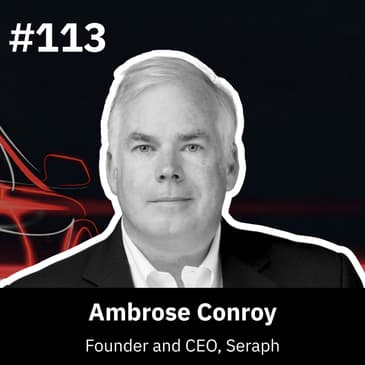
In this episode, Jan Griffiths and Tom Roberts sit down with Ambrose Conroy, CEO of Seraph, to put structure behind a phrase most leaders use loosely. Ambrose built his firm on crisis work, and his answer to the resilience question isn't a mindset. It's an org chart. Build an office of resilience, staff it full-time, and have it report to the CEO or the board.
The model already exists outside automotive. Shell and Apple run standing teams that watch their value chains down to raw material pricing, and Apple's got roughly 100 people doing it. Toyota does the same work without giving it a name. What separates them from most OEMs and tier ones isn't intent. It's the ability to see across their own data.
That's where most companies stop. Multiple ERP instances, disconnected PLM systems, and dozens of cross-reference tables make it slow to answer a simple question: what stops if the rare earth supply is disrupted, or if an earthquake takes out a plant in Japan? Ambrose and Tom are blunt about what dirty master data does to AI. It drifts. It hallucinates. It returns alerts nobody can act on.
Speed is the second half of the argument. In the Novelis disruption, three OEMs faced the same problem. One had an alternate capacity locked in within 48 hours. One followed the full qualification process and lost weeks. The third didn't really know what was going on.
The mindset shift is the hard part, and Jan says so plainly about her own years running the supply chain. Nobody wants to fund headcount against a risk that hasn't happened yet. The leaders who fund it anyway will be the ones still shipping when the next choke point closes.
Themes Discussed in This Episode
- What an office of resilience actually does
- Why resilience fails as a part-time assignment
- Board and CEO ownership of enterprise risk
- Master data as the foundation of risk visibility
- Choke points, commodities, and what-if modeling
- The end of the annual cost-down
- Decision speed as a competitive advantage
- Measuring resilience against competitors
This podcast is powered by QAD RedZone.
Featured Guest
Name: Ambrose Conroy
Title: Founder and CEO of Seraph Consulting
About: Ambrose is the Founder and CEO of Seraph Consulting. He founded Seraph to solve complex, bet-the-business problems for clients and to be the go-to partner for driving operational excellence. Before founding Seraph, Ambrose served as Vice President of Supply Chain Solutions at NAI Global and led the West Coast Global Business Transformation Group at PA Consulting, where he specialized in due diligence, crisis management, and strategic transformation. He began his career as a consultant at CSC.
Connect: LinkedIn
About Your Hosts
Jan Griffiths
Jan is the host and producer of the Auto Supply Chain Champions Podcast and The Automotive Leaders Podcast. A former automotive manufacturing and supply chain executive, Jan is recognized as a Champion for Culture Change in the automotive industry. She brings direct, grounded conversations to leaders navigating execution, disruption, and transformation across the global automotive ecosystem.
Tom Roberts (Co-host)
Tom is Co-host of the Auto Supply Chain Champions Podcast and Vice President of Strategic Industry Development at QAD. He works closely with automotive and industrial manufacturers to close the gap between insight and execution, helping leaders move from visibility to systems of action that drive real operational outcomes.
Mentioned in the Episode:
Episode Highlights
[00:04:35] What an Office of Resilience Is: Ambrose anchors it to the board risk committee mandate. The office exists to protect your ability to deliver today's products and services, no matter what happens.
[00:05:34] Seeing Across Your Own Data: The blocker isn't strategy. It's architecture. Most OEMs and tier ones have built systems that can't give anyone a cross-enterprise view.
[00:07:57] AI Drifts on Dirty Data: Fifty reference tables and disconnected PLM systems produce alerts nobody trusts. Tom points out that's exactly where big data analytics projects fell over a decade ago.
[00:09:04] If It's Not in the System, It's Risk: Working around the system of record feels faster in a crisis, and it's what leaves you people-dependent when things start going wrong, and people get tired.
[00:13:44] The Cost-Down Era Is Over: Annual price decreases aren't coming back. Ambrose argues that if you're not running the what-if scenarios, the crisis and chaos will cost you far more than the five or ten strategic heads you didn't want to fund.
[00:16:45] Who Owns It: CEO, CFO, or board. Anywhere below that, silos and politics kill it before it's produced anything.
[00:19:42] Part-Time Doesn't Work: You need full-time people from finance, legal, supply chain, and strategy, led by someone with the standing to challenge peers. Ambrose calls it a grooming ground for future senior executives.
[00:22:02] Three OEMs, One Disruption: The Novelis situation exposed the gap between empowered decision-making and process compliance, measured in weeks of lost capacity.
[00:24:09] Measuring Risk You Prevented: Purchasing savings as a metric is done, and Ambrose points to an OEM that skipped a volume-specific contract to capture some. Success is relative now: how fast your organization absorbs disruption compared with direct competitors.
Top Quotes
[00:06:33] Ambrose Conroy: "It's not just getting out of China, it's not just regionalization, it's making sure you have business continuity moving forward, no matter what."
[00:16:15] Ambrose Conroy: "So an office of resilience needs to be able to take that into account, and you need to have the data to do it. But you also need to have the organization, you need to have the will, and you need to have the sponsorship from a board level or a CEO level to make it work."
[00:27:00] Ambrose Conroy: "There's a lot of choke points out there right now that could close, thinking through those proactively and comparing how your organization performs to those of your direct competitors is the cleanest way to measure the impact and success of the office of resilience."
If this episode resonated, share it with a fellow automotive leader and subscribe to the Auto Supply Chain Champions Podcast, where we're closing the gap between insight and action across the global automotive supply chain.
Follow the Auto Supply Chain Champions Podcast for real conversations with leaders who are making hard choices, focusing their bets, and leading with intent.
🎧 Follow the podcast:
🔗 Learn more about QAD Redzone: https://www.qad.com/
[Transcript]
[00:00:00] Jan Griffiths: This is the Auto Supply Chain Champions Podcast. We are on a mission to bring you real conversations with the leaders who are transforming supply chains in the automotive sector. These leaders are true champions of manufacturing, and we're here to share their stories. I'm Jan Griffiths, your host and producer, and I'm joined by my co-host, Tom Roberts, Vice President of Strategic Industry Development at QAD.
[00:00:30] Tom Roberts: Great to be here, Jan. What I see every day is simple: manufacturers don't have a data problem, they've got an execution problem. This show is about how artificial intelligence, systems of action, and empowered teams can help close that gap.
[00:00:45] Jan Griffiths: Let's get into it. This podcast is powered by QAD RedZone.
Hello and welcome to another episode of the Auto Supply Chain Champions podcast. Let's check in with my co-host, Tom Roberts. Tom, how you doing?
[00:01:01] Tom Roberts: Hi, Jan. Great to be here, enjoying the summer. I want to talk about resilience in supply chain. Sadly, tragically, there's been another earthquake in Japan. There's still fallout from that already.
So, here we go, talking about how to make sure our supply chains are protected as much as possible
[00:01:20] Jan Griffiths: Well, it does seem, doesn't it, Tom, that you wake up every morning and there's something. And, we just finished a webinar with the Seraph team, and we were talking about choke points. We're talking about bridges and barriers. And we tend to focus on what's in the news right now.
We're talking about the Strait of Hormuz. We're talking about the Bab el-Mandeb. But the question is, what's next? Because the whole idea of resilience is making sure that, you know, step one is, what's your risk? How do you stay ahead of it? And then what do you do about it? And so many people are talking about resilience. I am thrilled today that we are bringing on the show somebody who understands it better than most from multiple different perspectives.
And I have heard our guest talk about an office of resilience, and that sounds like one of those things that people say in conferences and presentations, but there's never actually anything behind it. And you say, "Well, what exactly is an office of resilience?" In fact, I asked that question on another webinar, a different webinar just a few days ago, and the answer is, "Oh, well, you know, it's about resourcing from China, and it's a bit of this, and it's a bit of that."
No, I think it's a lot more than that. So I'm thrilled today to bring on the show Ambrose Conroy, CEO of Seraph.
Ambrose, welcome to the show.
[00:02:44] Ambrose Conroy: Thanks, Jan. Thanks, Tom. It's great to be on
[00:02:47] Jan Griffiths: So who are you? Who are you, Ambrose Conroy? And what is Seraph, and why do you care so much about resilience? Tell us.
[00:02:55] Ambrose Conroy: So I'm a problem solver. I've grown up and really love solving really complex, tough problems, and that's what I enjoy doing. I went into consulting for that very reason 'cause I get to do that. I get to help people solve the unsolvable problems or problems that are just really painful or difficult. When I started Seraph, the name itself I think is pretty telling. So Seraph is an angel of the highest order, burning angel closest to the throne of God. We think of ourselves as angels that can walk through fire, sort of a guardian angel for our clients, and we help them get through some really situations. And we work with a lot of different companies. The majority of our business is automotive, but we work outside of automotive.
Right now, what I'm focused on, and the team focuses on a few other things, but I'm focused on resilience. So how do companies broadly set themselves up to move forward and survive? There's a lot of talk about this being the decade of supply chain, and we're really seeing that holding true. There are so many disruptions. There are so many challenges in the supply chain world that, that we've got to look at. And the other thing that I'm focused on quite a bit is rapid industrialization. How do we get products to market faster, and how do we ramp them up even quicker? The Chinese have perfected this, and in the West, we have to get a lot better at it to stay competitive. And I think that falls into resilience, and how do we just change our whole paradigm, and how do we look at what we're doing and protect ourselves and our organizations?
[00:04:22] Jan Griffiths: Now you're seeing this from a couple of different angles 'cause you work with OEMs, tier ones, and all through the tiers. Put it in simple terms for us, Ambrose. What is an office of resilience? What does it look like?
[00:04:35] Ambrose Conroy: So boards have risk committees, and the risk committee is trying to figure out what could impact our business. So the Office of Resilience is set up to really answer that question. It's how do we protect our day-to-day business? How do we make sure that we can continue to deliver the products and services that we do today no matter what happens?
How do we think that through? How do we analyze and evaluate, and in a cost-effective way, protect ourselves so that we're not out of business in a few years? If we look at, companies that do this well, Shell Oil has a fantastic office of resilience. They're constantly evaluating what's going on across their entire value chain. Apple does a very good job evaluating what's going on across their value chain. A simple shift in chip prices could, could cause them to do something. A change in metal prices. They're looking down to the dirt, into the earth, to see where they can do and what they can do to protect them.
In the automotive industry right now, I think Toyota does the best job of anyone. They know their tier ends. They really work with their supply base to keep things organized. don't call it an office of resilience. This is just what they do on a day-to-day basis. challenge that I have, and that I see across a lot of the OEMs and tier one suppliers right now, and even lower level, is that what we're experiencing is they don't know how to even start. They can't look across all of their data. They have architected their systems in such a way they can't see across the different areas. They've got too many silos, and they can't have that holistic look to understand what happens if rare earth magnets materials are disrupted coming out of Africa going into China. What happens if we have an earthquake like we just had in Japan? What happens if something more goes on in the Strait of Hormuz, and we lose additional aluminum supply or resin?
So it's being able to quickly answer those questions and prepare. what an office of resilience should be able to do. It's not just getting out of China, it's not just regionalization, it's making sure you have business continuity moving forward no matter what.
[00:06:49] Tom Roberts: So Jan, again, music to my ears.
[00:06:50] Jan Griffiths: I know. Go Tom.
[00:06:53] Tom Roberts: So, Ambrose, I've seen a lot of tier ones, certainly where there's just systems that have not been converged, right? So you have multiple ERP systems. Sometimes you can even have more than one PLM system. But typically, multiple versions of ERP that's pretty much par for the course. And if you have not done any master data, transformation to converge those things, it's very hard to have all those cross-references, and AI's gonna drop it immediately.
AI's gonna drift. It's not gonna be able to return those alerts that you're looking for when, X thing happens in this region of the world, you have this part of your supply chain exposed to it. If you don't have that data construct, you won't be able to detect the value that's at risk for you.
[00:07:36] Ambrose Conroy: We've worked with a couple of OEMs. At the OEM level, they really don't have it, and they've created those silos to prevent anyone from seeing that. The two OEMs were working from a single ERP system, but then outside of that ERP system, the PLM and other systems that they had were set up in such a way that you just can't easily get these things to talk.
And your comment on AI, AI hallucinates. It'll do some things, but when you have 50 reference tables, you get something and it may or may not be what you want, and it may or may not be real. The more reference tables you have to build, the more you have to try to search, the longer it takes, the more complicated it is, and the more it costs. So getting that data cleaned up and, and really making sure your systems are effective is important for an office of resilience. And then it goes way beyond the data, but the data, it's a fundamental starting block. If you don't have that, don't know where to start looking, and you have to start to get that data pulled together and get that data cleansed
[00:08:32] Tom Roberts: Yeah. And we saw this is where a lot of analytics projects fell down, 10 years ago, big data and so forth, because again, you're building all those cross-reference tables, and after you've done that, if you don't have a great incoming master data management structure where you're governing that coming in, the minute you clean it up and Billy Bob or Susie decides to add a new secondary commodity, it blows the whole thing up again unless it's been cross-referenced and all those things.
So yeah, it's takes vigilance to make it valuable
[00:09:04] Ambrose Conroy: And it's about building it into the systems, right? We've learned, I've learned over the years that everything that's not in the system of record is a risk. So we need to get it built in. So, whether, in QAD, you need to make sure that you've got everything entered, and it needs to be there, and that needs to be your system of record.
And if you're doing that, then it's great. And for people that are using other systems, they need to do the same thing. The data has to be clean, and it has to be in the system. The more reference tables that you're trying to use, the more you're trying to work outside and around the system, easier it becomes to get lost and to miss something. That goes back to the crisis work that we used to do, where people were always trying to work around the system when things started to go poorly. And then you'd have to come in, and you'd have to figure out how to get it back into the system and get the system back up and running. Because until you did that, you were so people-dependent, when people get tired, things get missed
[00:09:55] Jan Griffiths: You talk about a system of record, and QAD often talks about moving from a system of record to a system of action. And yes, having the data is foundational. It's core. You have to have that. But Ambrose, what I'm seeing is that a lot of people, when they talk about resilience, it's very reactive. They're reacting to a crisis.
But resilience is more about being proactive, which is essentially moving from a system of record to a system of action. Tell us what you've seen companies do well when they're able to be more proactive.
[00:10:30] Ambrose Conroy: What we're seeing is as we get a better view of the data and can really map out the entire value chain with hard data, we recognize the gaps. You see a specific oil that's coming out of one refinery in the Middle East that you had never had a plan to deal with, you might not see that until you start to pull the data and look at it. and, and one of the OEMs we work with was lucky enough to identify that before the crisis started. It's about being able to, before you have the problem, understand the risks that are emerging, understand where you have tangible risks. And on the choke point discussion we just had, Jan, we were mapping out choke points, and we're looking at commodities across choke points and how globally you can really look and see different commodities impacted by different choke points closing around the world.
And it's pretty stunning to see that and can proactively start to identify that. But unless you have the data, unless you can in an action-oriented way to do something about it before you get hit as your risk increases, you're really in trouble. It's very much about being proactive, and it, unfortunately comes down to doing the hard data cleansing work, understanding where your supply base is, looking across the value chain, looking across your products, and figuring out what will be impacted if something happens. And one wants to spend the money in automotive to do that. We're all very lean, right? We've cut to the bone. We don't have a supply chain organization that thinks strategically. We have really driven things to a point where it's trying to buy things at the lowest cost. And I'm seeing, even with that, a lot of breakdowns, where we've pushed so hard against the suppliers right now, and we've locked them in to fixed prices without escalation. And that might have worked a decade ago, but we're now in a higher interest rate environment with higher inflation, and the entire model of procurement, I believe, has really shifted. So you have to be able to look at that as well in a resilience-type manner to understand what's going on. But it all comes down to the data.
[00:12:57] Jan Griffiths: I agree, but I wanted to give you a perspective as a recovering supply chain person. I never, never wanted to deal with risk mitigation and risk assessment, and I'm just being perfectly honest because we just don't... It's not in our DNA in automotive. We just wanna deal with, cost reduction in purchasing, supply chain issues, and launches. Those are the things.
So the idea that I need to take a headcount or two or three and put them into a resiliency project where they have to get their arms around all this data, they have to be proactive, they have to figure out what the next choke point is and how that impacts all of our commodities, honestly, I don't wanna do that, and I'm sure there's a lot of people out there that feel that way.
That's a mindset that has to shift now, doesn't it?
[00:13:44] Ambrose Conroy: It does, and think about it this way, cost-downs are not happening anymore. Costs are going up. So I think we have to all accept that. The era of every year getting a price decrease, that's over. You resource, cost's gonna be higher. If you're not looking at resilience, if you're not running the what if scenarios, if you're not modeling this out, if you're not thinking about what could happen, whether you're doing it on a model or just looking at your supply chain more broadly and trying to figure this out, you're going to have a lot more crisis, a lot more chaos within the value chain, and that's going to disrupt your manufacturing, your assembly, your operations in a way that's going to cost you far more having those five or 10 heads, and that's massive increase, 'cause these are strategic heads. It's a massive increase for a lot of chief purchasing officers or head of supply chain, which is really why we think about this more as an office of resilience type function. And at larger companies, this could be 50 people. Apple has 100 people that work on this. So this is a real active office that has people focused on to trying to understand the what ifs and what could happen on everything that they know. I've got a couple of clients that I work with, if they only knew what they know, they'd be dangerous. But a lot of firms just don't know what they know. They can't pull it together because of all the silos, and the purchasing supply chain organizations are one of those silos.
They rarely wanna talk to engineering. They rarely wanna work with operations. They wanna do their thing, get the material there at the best possible price, and that's always been their mission. I think their mission's changing. I think their mission is to make sure that we're able to, no matter what the disruptions are, get material there or have a plan to pivot, so we know what products we could run, what we could do if we lose, a special oil out of the Middle East, or if aluminum supplies become severely constrained because Qatar can't get aluminum out and that's where 20% of aluminum billets are produced.
So how does all this work, and how do we move forward in an era of such crazy geopolitical disruptions, both at a nation-state level and at a terrorist level? 'Cause right now I think we're seeing more and more non-nation state players being able to disrupt trade because of choke points.
So an office of resilience needs to be able to take that into account, and you need to have the data to do it. But you also need to have the organization, you need to have the will, and you need to have the sponsorship from a board level or a CEO level to make it work.
[00:16:30] Tom Roberts: Ambrose, one of the questions I was gonna ask you was, I see elements of finance here. I see elements of COO of operations, of supply chain and procurement, of IT. Who owns the office of resilience in an organization?
[00:16:45] Ambrose Conroy: I think for it to be effective, it needs to either be owned by the CEO or it needs to be owned by the board. It is really a function that looks across the organization, it's the people that are supposed to challenge things. They're the ones that need to call out that the emperor has no clothes on, and they're the ones that needs to raise the really difficult, challenging issues that they find, and they need to get heard, and they need to drive action.
The only place see that being effective is either reporting to the CEO, possibly the CFO, or to the board itself. And a lot of boards, the risk committees have a mandate to make sure that they're protecting the company and the shareholders. So we're seeing risk committees on corporate boards more and more starting to look at, with different names, but the construct of an office of resilience. And they're not formalizing it yet, as we see more and more disruption, they're realizing that something is needed. So we find this can be implemented much more easily when it's done at that board level. When it's done at the CEO level, it's highly effective. We can possibly do it at a CFO level, but below that, it becomes much harder because you have all those silos and all those politics that prevent it from working.
[00:18:09] Tom Roberts: Do you see organizations gaming scenarios, like actually going through the scenarios, doing a what if and saying, neodymium magnets are not shipping out of Africa, or the index has gone up 15% because of something happening? Do you see them actually looking at what if scenarios, trying to get to that point?
[00:18:26] Ambrose Conroy: So we're doing some desktop exercises with certain clients where we really work through those things, and we try to just brainstorm with them what are their top 40, 50 issues and what materials could impact them. And you run those what if scenarios, we call them desktop planning exercises.
We have models that we put them through, and that helps us to see different things. But that helps with the things that we think are highly likely and are about to disrupt us. It doesn't help with the things that you're not looking at that are hidden in the data in your system. And until you start trying to uncover and look more critically, it becomes challenging.
You're a data guy, you understand that completely. And Jan, you understand people completely and how these things work. And if no one wants to work on the data and no one wants to have the people looking at this, you can only hide your head in the sand so long. At some point, you're gonna get caught and burned
[00:19:18] Tom Roberts: We're the source of our own risk, not necessarily the external situations, the internal situation a lot of companies have created, and they're their own risk, really.
[00:19:26] Ambrose Conroy: They are, or they're compounding the risk. They're hiding from it at this point
[00:19:30] Tom Roberts: Right.
[00:19:30] Jan Griffiths: Is the Office of Resilience staffed with people from different functions and that's their job, or is it a part-time gig for somebody?
[00:19:42] Ambrose Conroy: If you really want to do this, it needs to be a full-time
[00:19:44] Jan Griffiths: Yeah.
[00:19:45] Ambrose Conroy: and you should have people from finance, you should have people from legal, from supply chain, from strategy, and you need a very strong leader, to be in there driving this. Where it works well, you have someone who is being developed to become a senior leader in the organization, and this is their mission for a couple of years to develop it, and they're supposed to work cross-function, and they're supposed to work with their peers or above their peers and challenge their peers. And it's a great grooming ground to become a senior executive in a company.
Unfortunately, a lot of companies want to put in a program manager who happens to not have another project at the time and try to do this very leanly and very lightly with just a couple of people who are part-time. When you try to use part-time resources to do this, you don't have the focus, you're not getting the data, and you're not getting that continual perspective on what the risk is. And I would argue at this point, and I do argue at this point with a lot of clients, that this is so big that if you get this wrong, you might not have a company.
[00:20:53] Jan Griffiths: Yeah.
[00:20:54] Tom Roberts: Absolutely.
[00:20:54] Jan Griffiths: We went through this webinar earlier today, and we identified the choke points in addition to the ones that are in the news, and it blew my mind. The number of names I'd never even heard of and how it impacts all the different commodities, and we'll put a link to that deck in the show notes so people can access it.
But it's that kind of thinking that instead of reacting to the news headlines, it's getting ahead of it, and you need data, you need people, you need a process. It's a whole initiative alt, unto itself. It can't be a side committee. That's the sense that I get, Ambrose.
It can't be a little side project.
[00:21:34] Ambrose Conroy: Well, Jan, when you were running supply chain, I mean, would you have tried to take on an effort like this? I mean, this was a total distraction from what your mission was.
[00:21:43] Jan Griffiths: Exactly. I wouldn't have. And I would have probably asked for the headcount to do it, and I would've been flatly denied, and then it would, I wouldn't have done it. Even though I know deep down inside, the world has changed. The world has changed, and this is a point in time where our thinking in automotive or in any manufacturing environment has to change.
And it's not only about you call the will to do this and the mission to do this, but it's about the process. And we look at how people make sourcing decisions, and we talked, about the Novelis situation. There were three OEMs involved in that, and I will not name them. One had their team fully empowered, had locked and loaded capacity somewhere else, and that was done within 24 to 48 hours.
A second insisted on following all the laborious processes and all the things that we go through in automotive and qualify the supplier and blahbity, blah, blah, blah. Took them forever to make a decision. And the third one didn't really know what day it was. So it's not only about the plan and the activities, it's about the how, how we make decisions.
We gotta get faster at making those decisions, and I would see an office of resilience as somebody who's also driving some of that activity.
[00:23:03] Tom Roberts: Speed.
[00:23:04] Jan Griffiths: Speed?
[00:23:04] Tom Roberts: Driving speed.
[00:23:05] Ambrose Conroy: Speed, speed and action.
[00:23:07] Jan Griffiths: Yep
[00:23:07] Ambrose Conroy: Seraph did a lot of-- we've done a lot of crisis management work in our history, and we still do. And that really feeds it. You have to have those tiger teams ready. You have to go and deploy, and you have to, Jan, as you said, empower them. 'Cause if they're not empowered, if they can't make the decisions, if they don't have the authority to act, then you wait in this political quagmire for weeks. And if one of your competitors gets the only alternate source that's out there, you're done.
[00:23:34] Jan Griffiths: Yeah, that's right.
[00:23:36] Tom Roberts: So Ambrose, how do you measure success when the ultimate goal is to mitigate risk? I mean, we've had suppliers blow up and a lot of the nylon supply is gone, and people have to scurry and find something else. Or have the plant in Japan that makes the metallic flex for black paint get affected in the earthquake, and then all of a sudden 30% of your F-150 volume is at risk. How do you measure risk mitigation? 'Cause usually, purchasing organization they're on the hook for purchasing savings percentages. But how do you measure risk mitigated?
[00:24:09] Ambrose Conroy: First off, I'd say purchasing savings, that metric is done. Like, we're in an inflationary environment, high interest rate environment. Costs are going up. We're not going to see purchasing cost savings. So we need to get away from that because some of the decisions that I'm seeing made today to get those savings are putting incredible risk into supply chains. There's an OEM that I'm looking at right now who had someone who did not lock in a volume-specific contract so that they could get some savings. They gave the client some flexibility. They gave the supplier some flexibility, and that could come back to bite them in a big way. We're, we're trying to work through that right now. But we're... How, how do we measure success in an office of resilience? I think it's all about how do we look at the disruptions and the, pace of disruption compared to competitors in this space, and how does your organization do better than your competitors at handling those disruptions? We did a project when the Ukraine war happened, and we went in for an organization that had had some tools stranded behind the Dnipro River in Ukraine, where the Russians were heavily operating.
Within the first couple of days, we had to get some tools and some equipment out of there very quickly. Had those tools not come out, it would've cost triple millions, for the client we were going for. One of their competitors chose not to get tools out, and they could not get them rebuilt for eight weeks. So that one decision gave them a competitive advantage. That wasn't office of resilience driven, but that was people thinking with a resilience mindset, making a call right away and acting.
We do things that we don't talk about very much. But as we do those things, it's all about how do we keep our clients' businesses running. And those clients who are thinking more proactively can act quickly and move and do this. There were other OEMs and other industries that had product across that river. When they wanted to go get it out, it was too late 'cause there were Russian forces there, and you would've come into contact with them and that just wouldn't have been viable.
So you had to think quickly, differently, and you had to take risk and put money forward to drive those savings. I know an office of resilience will give companies the ability to proactively identify those things. And when global events happen, like the earthquake that just happened in Japan, figure out how do they pull forward.
How do you buy whatever is in the warehouse from that paint manufacturer for the ingredient manufacturer? How do you go after the chips during the last earthquake? How do you deal with something that's going to happen potentially with closing of the Gate of Tears? There's a lot of choke points out there right now that could close, thinking through those proactively and comparing how your organization performs to those of your direct competitors is, I think, the cleanest way to measure the impact and success of the Office of Resilience.
[00:27:21] Jan Griffiths: Yeah. And that's a beautiful way to close today.
Ambrose, thank you so much for joining us. We'll put your contact details in the show notes if people wanna know more about an Office of Resilience. I have never met anybody who is so passionate and determined to make this a reality and bring this reality home into this industry.
So thank you for sharing your thoughts with us today.
[00:27:43] Ambrose Conroy: Thanks, Jan.
[00:27:44] Tom Roberts: Absolutely.
[00:27:45] Jan Griffiths: We wanna hear from you, our listener. Tell us what are your challenges right now? What conversations do you want to hear across the airwaves on this podcast? Drop us a comment on our podcast website. The link is in the show notes.