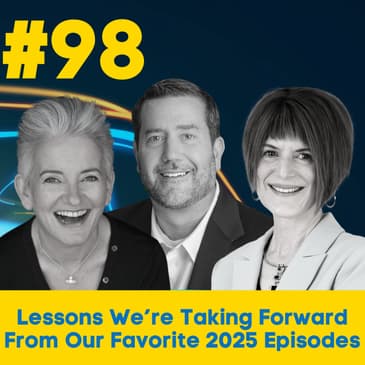
This episode takes a break from our usual detailed discussions to reflect on the conversations that shaped the year for the Auto Supply Chain Prophets podcast.
Jan Griffiths, joined by co-hosts Jim Liegghio and Terry Onica, looks at why specific episodes stuck with them and what those moments reveal about where the automotive supply chain is heading.
Live podcasting quickly rises to the top, especially the Midwest User Group episodes. Hearing customers talk openly about what they deal with every day brought everything back to reality.
The hosts agree that these conversations stood out because they were raw, unscripted, and focused on real-life challenges rather than polished talking points.
From there, the focus shifts to the next generation of supply chain leaders. Episodes recorded at the GM Wayne State Case Competition and other student-focused events captured something rare: genuine excitement about supply chain careers.
Hearing students wrestle with real GM case studies and receive direct feedback from senior leaders reinforced why investing time in education and mentorship matters.
Jim then reflects on episodes centered on leadership under pressure, including Kyle Price from Caterpillar and Darrin Lucas from Nissan. Both talked about disruption as something you plan for, not something that throws you off balance.
Tariffs, volatility, aftersales pressure, none of it was treated as a crisis. The focus remained on preparation, trusting teams, and staying level-headed. The takeaway was simple but powerful. The way leaders respond sets the tone for everyone else.
For Jan, Kate Vitasek’s work on collaborative agreements stood out because it moved beyond talk and into how collaboration actually works. But with structure, accountability, and measurable business impact.
Ted Mabley’s data-driven discussion on RFQs exposed how outdated processes still slow the industry down and why technology only works when people are willing to rethink habits and silos.
The episode closes with a grounded reminder: AI, standards, and platforms matter, but they are not shortcuts. Progress depends on people, relationships, and the willingness to unlearn old ways of working.
With that perspective, the hosts wrap up 2025 grateful for the conversations, the community, and the momentum heading into the year ahead.
Featured on this episode:
Name: Terry Onica
Title: Director, Automotive at QAD
About: For two decades, Terry has been the automotive vertical director of this provider of manufacturing Enterprise Resource Planning software and supply chain solutions. Her career began in the supply chain in the late 1980s when she led a team to implement Electronic Data Interchange for all the Ford assembly and component plants.
Connect: LinkedIn
Name: Jan Griffiths
Title: President and Founder, Gravitas Detroit
About: Jan is the architect of cultural change in the automotive industry. As the President & Founder of Gravitas Detroit, Jan brings a wealth of expertise and a passion for transforming company cultures. Additionally, she is the host of the Automotive Leaders Podcast, where she shares insightful conversations with industry visionaries. Jan is also the author of AutoCulture 2.0, a groundbreaking book that challenges the traditional leadership model prevalent in the automotive world. With her extensive experience and commitment to fostering positive change, Jan is at the forefront of revolutionizing the automotive landscape.
Connect: LinkedIn
Name: James “Jim” Liegghio
Title: Manager, Customer Experience & Engagement, Automotive Industry Action Group (AIAG)
About: Jim is a seasoned supply chain leader with over 25 years of experience, particularly in the automotive sector. His expertise spans a wide range of areas, from hands-on plant-level material and production control to high-level corporate logistics roles at major OEMs like FCA. He has navigated the complexities of international logistics, trade compliance, and cross-functional collaboration, gaining a global perspective that enhances his approach to supply chain management. He excels at working across departments to achieve strategic goals, with a strong focus on optimizing operations and fostering relationships. His work isn’t just about logistics; it’s about cultivating a culture of continuous improvement, community, and diversity. Throughout his career, Jim has remained committed to lifelong learning, driven by a genuine curiosity and a passion for leadership.
Connect: LinkedIn
Mentioned in this episode:
- QAD Midwest Users Conference: Community, Culture and Innovation
- Developing Future Leaders: Inside the General Motors and WSU Supply Chain Case Competition
- Resilient by Design: Embedding Risk Strategy into Procurement Decisions with Kyle Price
- Nissan Redefines Aftersales Across the Americas with Darrin Lucas
- Vested Partnerships: Transforming Automotive Negotiations Into Win-Win Partnerships with Kate Vitasek
- Quote Chaos: Inside The Rising Pressure On Automotive Industry's RFQ Teams with Ted Mabley
- Procurement in Motion: How SRM Drives Better, Faster Supplier Decisions with Achim Gatternig
[Transcript]
[00:00:00] Jan Griffiths: This is the Auto Supply Chain Prophets podcast, and we are on a mission to bring you the latest insights and thought leaders leading the charge on supply chain transformation in our beloved automotive industry. This podcast is powered by QAD and AIAG. I'm Jan Griffiths, your host and producer. Let's meet your co-hosts.
[00:00:27] Jim Liegghio: I'm Jim Liegghio from AIAG.
[00:00:29] Terry Onica: I'm Terry Onica from QAD. Let's dive in.
[00:00:36] Jan Griffiths: It's that time of year, it's December, and we are at that point where we look back in order to look forward, and every once in a while, we all know that it's worth stopping asking the question, which conversations actually moved us and changed the way we think? Because the Auto Supply Chain Prophets Podcast is mission driven. We want to help all leaders in the auto supply chain space prepare for the future.
And as we look back, you know, the beginning of the year, we weren't talking about AI. We weren't talking about tariffs. There's so many things that have happened this year that have changed us and moved us and changed our thinking. We also look back on our successes. We are coming up to the 100th episode of this podcast, and do you know? That only 7% of podcasts actually reach the 100th episode. Why? Because it's a lot of work and you better be mission driven and you better have an impact.
So let's talk about what episodes actually had an impact to us, to the hosts. And let's spread that message out to our viewers, our listeners, in over 20 countries. We are now up to over 15,000 downloads. So, yes, thank you to our audience. The podcast is resonating with everybody out there, and we wanna hear from you. If there are things that you want us to get into the weeds about, we're all about that, just let us know.
So let's start with you, Terry. What episodes, as we look back in 2025, resonated with you the most and why?
[00:02:24] Terry Onica: It's the live episodes that I really enjoyed. So when I look back at the QAD Midwest User Group, I love talking with customers and I just love hearing what's going on and what makes them succeed. And the three customers we had on that podcast are the best. We had French from Royal Technologies, Jon and Andrea from Lacks, and then we had Andy from Autokiniton.
When you look at what they had to say, because now, to me, is the end of the year. You're reflecting, we're kind of taking a breather before we start 2026. And what was the secret sauce? And it's a lot of the same things, but it's good to reflect on these things, that sometimes we get away from throughout the year just because we get so busy. So, I wrote them down: Collaboration,
[00:03:09] Jan Griffiths: Yeah.
[00:03:10] Terry Onica: Communication, continuous learning, community, and standards matter. That was really the underlying feedback that we got across all the participants from QAD and I thought that was very interesting. So what did you all think about the Midwest User Group?
[00:03:27] Jan Griffiths: Yeah, I liked it because it's real people talking about real issues. It's real, it's raw. It's about as authentic as you can get. It's no fluff. It's not somebody trying to sell something. It's not somebody coming up with a corporate fluffy speech. It's real, it's raw, and it's people that want to transform the auto supply chain for the future. What do you think, Jim?
[00:03:49] James Liegghio: You know I have to echo both of your comments about number one, the energy of a live event and podcasting at a live event period was gonna be one of my answers for today. But really, like Terry said, the Midwest User Conference, it showcases actual customers, boots on the ground, people that are out there doing the work. And it always reminds me that no matter what technology is out there, what solutions are out there, it's people behind what makes things happen and what makes things matter. So, as we went into this episode today, I was thinking about just people and relationships in general and how important that is.
So I have to echo both of your comments about the Midwest User Conference, but about live podcasting in general. You get that dynamic, you get different perspectives in the room, right in the moment. It's authentic, and it really resonates with listeners, like you said, Jan.
[00:04:32] Terry Onica: And Jim, I really thought about AIAG and it goes to show why AIAG mattered, 'cause I talked about continuous learning. That's what AIAG's all about, right? Community, really getting together and talking about the issues and how do we get better. And they all said standards matter, right? And so, that's really important. I really thought to myself, I listened to 'em, I'm like, you know, AIAG is really an important place for companies to be at right now.
[00:04:58] Jan Griffiths: As I look back over my career, I was one of those people that would roll their eyes over having to conform and comply to a standard. I was. And one thing I have learned during my time on this podcast and understanding more about the work you do, Terry, with MMOG/LE, and Jim, more about what AIAG does is that they really do matter, and they can have an impact to the bottom line. And I think a lot of people miss that. And what we've been able to bring out this year is some of those voices that are real, that talk about the impact to the bottom line because they adopted the standard properly.
[00:05:32] James Liegghio: It's funny Tanya Boldin and I talking yesterday with a GM employee and he's in the Track program, which is the recent college grad rotational program. And he is getting into finished vehicle quality, and immediately the AIAG standard, the M22 came up. He says, 'Oh yeah, I know that standard, that's already been been handed to me to take a look at and dive right into.'
So to your point about the standards are right there just below the surface or right at the surface. We've got people in the moment, just on a spur of the moment conversation, talking about an AIAG standard unprompted, right? And how important that is to his learning curve and his new role at GM.
[00:06:04] Terry Onica: Jim, if you remember, we had Fred Coe there at the Midwest User Group, and remember he was talking about Catena-X and I tell you, our customers love that. They weren't aware of it. They got to understand what it is, what's coming, and that was just a great session. I think even open your eyes and Jan's.
[00:06:21] James Liegghio: And Terry, I thought it was actually hilarious that you and Fred drew me in. I'm an audience member in your session, right? And all of a sudden Catena-X is up on the screen. I just thought it was so cool to kind of be like drawn into the, not as a presenter, as an observer, and then all of a sudden, realizing I could have been up on stage with you guys, which would've been fun. But I just thought it was hilarious that I was in there for the real time moment of, hey, we've got like Catena-X, what does this mean? And the audience kind of lit up and that's a good memory from this year as well.
[00:06:45] Terry Onica: And the other live one that I really enjoyed is when we were at the GM Wayne State Case Competition. Wow, what an opportunity. As I sat and reflected on the students and all the planning and David Leich and Bill Hurles, what they had to say.
The opportunity for these college students to come in, have a real life case study by GM on a really difficult problem, and have to solve that, and get feedback from the global supply chain director at GM, David Leich, on what he thought about your ideas and your presentation. I mean, you just don't get that anywhere, and hats off to Wayne State and GM for taking that time with the students and giving them that real life experience.
[00:07:28] Jan Griffiths: Really, to see the students and to hear them talk about supply chain and how excited, genuinely excited they were to be part of this and to want to continue in the world of supply chain. And to feel the passion to be in the room and right next to them on the mic and feel that, and we were able to take that energy and translate that energy right through the microphone because of the podcast, and that makes me so happy.
[00:07:56] James Liegghio: Different version of that is having students at the AIAG event. This past summer, we had the AIAG Supply Chain Event, where we podcasted live. And we had a couple of Wayne State University students in and grabbing them on the mic, as well as a couple of the presenters, Tanya Bolden from our team.
So that student perspective and, and like you said, Jan, kind of feeling that energy, feeling that excitement resonate right through the student, it's the same thing. And I echo Terry's comments and your comments, Jan, about the Wayne State GM Case Competition down at Wayne. The stakes are high there, right? You got Executive Vice Presidents there. You got potential offers just around the corner, potentially, for students that might perform. So, a really exciting environment and I thought it was really cool that day, Terry, to interview those students and those folks that coordinate the case competition itself.
[00:08:37] Terry Onica: Yeah, it's fascinating. At QAD, we always talk about building future champions. And you know, we're all later in our career, and just the opportunity to see these future champions on supply chain manufacturing in the making is really exciting. And the other thing that I really enjoyed is that we got to interview the two students from Southeastern High School, that are part of the FAST Program, that's Future Advantage Supply Chain Training program.
Just to hear about from a high school level what they're thinking about supply chain and how it's really opened up their eyes. And I know, Malik and Jeffrey were a part of that conversation. And I've heard Malik say many times, that opportunity he had and that David Leich and Bill Hurles took to sit down and talk to those two was so fascinating and amazing. And they were just so grateful for that experience. And so, hats off to David and Bill for really taking that time to spend with those students and manufacturing into the field of supply chain and manufacturing.
[00:09:39] Jan Griffiths: Yeah, and it was a Saturday. It was a Saturday. So many people wouldn't wanna give up their weekend to do something like this, but they did. Completely selfless.
[00:09:50] Terry Onica: Leaders, as you always say, Jan.
[00:09:51] Jan Griffiths: They are indeed. They are indeed. Yeah. Okay, Jim, what about you? What were your favorite episodes?
[00:09:58] James Liegghio: A tough question. We had such great guests this year. We had such great conversations. Looking back though, I had to take a look again at the Kyle Price episode. Kyle Price of Caterpillar, who's on the AIAG board. His advice and his guidance and the way he spelled out risk management to the audience was just so crystal clear to me. He was just, to me, very effective about conveying their philosophy on risk management and risk mitigation at Caterpillar and some of the things he's used over the years to do that and kind of honed his expertise. And I just go back and listen to that episode and I thought, the advice that was so clear that any procurement leader or budding leader, anybody in any risk management or risk mitigation, center of Excellence can take that advice and run with it. I just thought that was such a great episode, and I think there's a reason why it's number one on our downloads, right? I think it's just, Kyle came through to me on that one.
[00:10:42] Jan Griffiths: Yeah.
[00:10:42] Terry Onica: What I really liked about that as well, at the time we interviewed him, the tariffs were in place. But, he was just like, disruptions are a way of doing business. It doesn't matter if it's tariffs tomorrow, it'll be something else. It's like just being prepared all the time. And just his attitude about it, like it doesn't rock his boat or anything that these were happening. He just said, we have to be prepared every day, right? We have to may be making the right decisions, looking across the board, and I found that really fascinating and a good way to step back, 'cause sometimes we look at things that are happening and think, oh my God. In many ways, the way we handle it is some of the ways that we have in the past and ways we've learned to do better from past experiences.
[00:11:26] James Liegghio: That's a great point, Terry. He had A level head approach to disruption.
[00:11:28] Terry Onica: Yeah.
[00:11:28] James Liegghio: Like you said, if it wasn't one thing, it would for sure be another. And he more or less said, you know, you've gotta be prepared. But you can't be prepared for 100% of every possible scenario that could come around the corner at four in the morning, right? But you have to have basic building blocks and basic resilience in place, if you will. Yeah, that's a great call out, Terry, that he had a great attitude and a great, cool headed approach to it.
[00:11:48] Jan Griffiths: Yeah. Mindset. Mindset's everything. Imagine that mindset infiltrates that entire group that he's responsible for at Caterpillar. I think leaders forget sometimes how much their energy, their mindset, what they care about, and their actions actually filter all the way through their organization. And then, people look up to him and they go, oh, this is how I should be reacting and responding to this. It can have a massive effect.
[00:12:17] Terry Onica: And you know, just as a leader, the calmness about it all, right? 'Cause sometimes executives might get a little frustrated, but he's just was so calm about everything. And can you imagine working in an organization where you're going through that and your leader is just saying, let's just a deep breath. Let's get through this. Let's go through the bag of tricks that we have and let's just face it, right? That's gotta be wonderful, to work for somebody like that, that just doesn't let that get them all, you know, in any kind of tizzy or anything like that.
[00:12:48] James Liegghio: That's where emotional intelligence comes through. As, you know, one of the highest leadership skills that you need, right? To have a cool head. Cooler heads prevail right? Leave your baggage at the door. You're with your team. So yeah, great call out Terry on Kyle's leadership qualities there.
And then, the same thing for Darrin Lucas from Nissan. We just podcasted Darrin Lucas the other day, from Nissan, head of After Sales Supply Chain. And the conversation, if you guys remember, kind of evolved, right? It kind of evolved from, you know, the basic business conversation into Darrin's leadership traits and into his authentic leadership traits and how he empowers his teams. And he even said, it's not my job or my responsibility to get into every single detail about everybody's job. I have to kind of steer the ship and empower my employees and the KPIs will kind of fall into line from there. So people know what they gotta do, they'll take care of it. So, I really thought that was another good authentic leadership conversation, if you will. When we got into it with Darrin.
[00:13:37] Terry Onica: Another leader. Just calm, cool and collected. I mean in aftersales, that's gotta be so hard with trying to keep up with what potentially could go wrong with the consumer's cars on the road and all that forecast and demand planning. But he just seemed to take it with grace. He understood it. He knew what they needed to get done, how they could apply AI. But again, just so calm, cool, collected, and you could tell like Kyle, he was just an amazing leader.
[00:14:05] Jan Griffiths: He was. And there's something special about that Nissan culture. I've never worked in Nissan, but the people that I have interviewed both on this podcast and Automotive Leaders, same thing. And then, to see that career progression for Darrin, starting at a very, very basic level and then working his way up to a director of supply chain role. I've interviewed several people like that at Nissan. It really is something special there. Don't know what it is. I know they're facing their challenges right now in the industry. Hey, we all are, but I don't know, something about their culture is gonna get 'em through. What else, Jim?
[00:14:41] James Liegghio: Just back to people, Jan. I made an effort the other night to go out with some old colleagues from my Daimler Chrysler days, way back when 20 plus years ago we were all on the same team in inbound logistics. And I made an effort to go out the other night, it was kind of one of those nights where you don't really wanna leave the house, it's wintertime, it's cold, it's gray. But you know what? I went out, and there was about 10 of us out of the group that was invited, and it was just great to have these relationships and kind of reestablish these old stories and talk through kind of some of the war stories, but some of the lessons learned. But my point is, the relationships in supply chain matter too, and it's those relationships that you form with colleagues over the years that you know you can rely upon. Calling somebody for some advice or pull in a favor if you absolutely need to. It just reminded me that supply chain is all about relationships. We talk about technology, about AI, a lot of great things out there right now. You know, the world is changing quite drastically, but, to me, it's a lot about people and about relationships, so..
[00:15:33] Jan Griffiths: And that is exactly why I picked the episode with Kate Vitasek.
[00:15:39] Terry Onica: Hmm. Yes.
[00:15:41] Jan Griffiths: A couple of reasons. Now, Kate is a recognized leader on collaborative agreements and how to get there. And that's what I like about Kate is she's not all fluff. She's not talk. She's not just blah, blah, blah, we need to collaborate. I can't tell you how many conferences I've been to this year where people talk about partnerships and collaborations and work together, but nobody actually talks about how. How do you do that? And what I love about Kate is she's got it. She has already created the framework. There's a methodology. There's a way forward. She's got proven success stories behind her. She's got what? What did she say, seven books that she's written on the subject? So she has this. So, I say, for 2026 more Kate Vitasek in automotive, please.
[00:16:30] Terry Onica: I couldn't agree more. We need to learn how to collaborate better and partner to really move forward. And you know, like I said, back in the Midwest User Group, those suppliers were saying that collaboration between customers and suppliers was really key to moving forward. So, I couldn't agree more. And I just like her methodology. I love it when our guests bring something to the podcast to bring us back and remind us we can do better and here's how we can do better. She was amazing.
[00:17:00] Jan Griffiths: Exactly.
[00:17:02] James Liegghio: Some of those concrete tools, something our listeners can really sink their teeth into and put into practice. That's always very valuable. I'm sad I missed recording that episode, you guys, I was think that's the one I was MIA for, but yeah, it sounds like she's an amazing leader and has great tools for everybody to utilize.
[00:17:16] Jan Griffiths: She does. And I think that one of the things that we miss is that we think that collaboration is one of those soft, fluffy words. And it isn't. There is a hard business impact and impact to the bottom line. And trust becomes ever more important in that. And when you have trust, you have speed, you can operate at speed.
And we all know in our beloved auto industry that we're always talking about speed. And you know, we talked a lot about China speed, right? How do we speed up our decision making? Well, we don't get it by following the same old ways of doing business that we've been using for decades. And one of those areas is the traditional negotiation approach, silos, people being in silos, and people negotiating like they gotta be right. It's all about being right and wrong. It's not. It's about getting to the right business outcome, and Kate stresses that time and time again. So, we need this not because it is the right thing to do, because we need it for our survival.
[00:18:21] Terry Onica: Absolutely.
[00:18:22] James Liegghio: Jan, you had another favorite episode if I recall, was it from this year? Was it Ted from UHY?
[00:18:28] Jan Griffiths: It was Ted Mabley from UHY. Now, if you had told me that I would pick a white paper episode, that focused on a white paper as a favorite, I would never have believed you. But I read this white paper word for word, 'cause it was written by a human. It was actually written with Ted in collaboration with CAR, and it's data driven.
And basically, he's talking about the fact that suppliers in the auto industry are processing more than 800 RFQs a year using the same tools that they use 20 years ago. And this hits home with me because I was right there in the middle of it for most of my career. And I know what that feels like. And I know this idea that Ted brought through about sticky knowledge. There's one guy that's been there forever that just knows. That just knows all the rates, knows what questions to ask, and just puts all of that material together and off it goes to the customer. And what came out in this episode, which I don't think we realized until we got into it, was this is prime for Catena-X, for technology.
So I love it when our episodes, one idea starts to build on another, starts to build another. But what a perfect platform to manage all the data and all the requirements and the surveys and all the ESG stuff, all of that. It's massive. And to put all of that on one platform, we got it. We got it.
[00:19:52] Terry Onica: And you know, it took me back to Achim, we interviewed from Magna a while back. When he talked about the value of supplier relationship management and really collecting all that data on the front end and don't put it into somebody's mind. And the ability to get that information quickly and look back on what's working, what can the supplier do. And remember how he talked about how that really helped during the tariffs, right? They had that information quickly. So thinking back to him, he really highlighted that as well, too. And really we gotta get out of these manual ways that we're working regarding this process with suppliers. There's just too much data to keep doing it the same way.
[00:20:32] Jan Griffiths: Yeah, and it's the manual ways of working, but it's the siloed thinking, 'cause I can't tell you how many times in my career I've been, you know, the sales group or whoever was responsible would put a response to an RFQ out there to an OEM. And then, you get awarded the business and all of a sudden you're like, you did what? You quoted what? What? Where did you get that number from?
And I know that our listeners are listening to me saying that right now. And they're going, oh yeah. Oh yeah. Yeah, we've been there. So, there's no need for that. So we are prime, prime to really take advantage of technology. But it is the human that will slow down the adoption of technology. We will slow it down.
The technology is there, but we are gonna have to unlearn a lot of those legacy habits and processes, and we have to get our minds in the right place. And it makes me think of back in the nineties, remember when business process outsourcing was the thing? Everybody was, oh, shared service model, business process outsourcing. And the only ones that succeeded were the ones that really understood the business process, questioned it, took out any of the things that were maybe repetitive or didn't make sense. And then they were able to move that to a low cost. In my mind, it's the same with technology.
AI is not gonna fix your old habits and your culture, it's just not. So, you're gonna have to get together collectively as a cross-functional team, figure out what the process should look like, figure out how to introduce AI, and move forward. That's the only way we're going to succeed.
[00:22:09] James Liegghio: There's a lot of interesting conversations exactly about that right now, Jan, that, you know, AI is not the panacea for everything at all, problem solved at once. No. it's a very useful tool. There's very important use cases and very good outcomes if you prompt it right, and if you know what you're kind of looking for.
We had an interesting conversation the other day down at the Wayne State Supply Chain Advisory Council meeting. You were there, Jan. Terry, I'm sorry you had to miss it. But we were down there and the professors were actually asking business to kind of feedback what would, you know, what are some of the skills students need to start graduating with in order to place and to be successful? And some of that AI discussion came up. But it's just some basic problem solving skills and project management skills also came outta that conversation. Jan, correct me if I'm wrong and jump in, but I thought the whole AI spin was just interesting that everybody kind of thinks about AI as this panacea that's just gonna fix everything, but you need to know how to work with it, not let it take over, in essence, is what I'm saying.
[00:22:58] Jan Griffiths: Absolutely. There's a lot to be learned there. I'm learning myself, I'm creating my own little agents and doing all kinds of GPTs that I'm creating here, but it'll light you, too. Because nobody really knows where it's coming from, where the information is coming from. So yeah, you gotta get it right, but get your processes right. Get your people together first before you start throwing AI at it.
[00:23:21] Terry Onica: You know, I remember, when we interviewed French at the Midwest User Group and he was talking about AI, and I found it fascinating. He said, when they introduced AI, that they went back and looked at, is it growing or is it not growing? And he said, it didn't grow with more users, but those who are using AI, I felt like he said, were like doubling their usage.
[00:23:44] Jan Griffiths: Yeah, deeper. They go deeper.
[00:23:46] Terry Onica: They go deeper. So, you know, and I really would encourage everybody, you don't wanna get behind, right? So you gotta take that step, and maybe just think about what French said, those that start using it, start to really see how it can help. They start to use it more, so, you know, just don't be afraid of it.
[00:24:03] James Liegghio: Yeah, step on the tram. you just start moving faster said. I thought that was with it I'm guilty same as you're in the soup, so to speak, you know, you just start moving faster and faster and deeper and deeper with it. I'm guilty, same, as an adopter.
[00:24:12] Jan Griffiths: Yeah. Well, that's it. That's a wrap for 2025. It's been an awesome year on the podcast, and we wanna take this opportunity to thank every single one of our guests for contributing to the mission and wishing everybody a happy holiday.
[00:24:31] Terry Onica: And Jan, just to add to that, I really wanna encourage everybody enjoy the holiday seasons. I learned that from my dad. It was time to just relax, have fun with family and friends, and enjoy, and you'll come back in 2026, all refreshed and ready to go. So, enjoy it.
[00:24:48] James Liegghio: Same from my side. From all of us at AIAG and myself included, please have a wonderful holiday. Thanks for listening. And cherish your loved ones and come back recharged in 2026.
[00:24:57] Jan Griffiths: We love to hear from our listeners, reach out to any one of us, our contact information is in the show notes. And if you want to dive deeper into our content, check out our website at autosupplychainprophets.com.